For most of its modern life, Leica has sold restraint. Manual-focus M rangefinders that ask you to slow down, the red dot as a status symbol, prestige over frame rates. The SL3-P, announced this week, reads as the opposite of all that: a 44-megapixel full-frame camera that fires at 40 frames per second, with a spec sheet pointed directly at the Sony a1 and the Nikon Z9. For the first time, a Leica SL's numbers look like a flagship's.
What the "P" means here
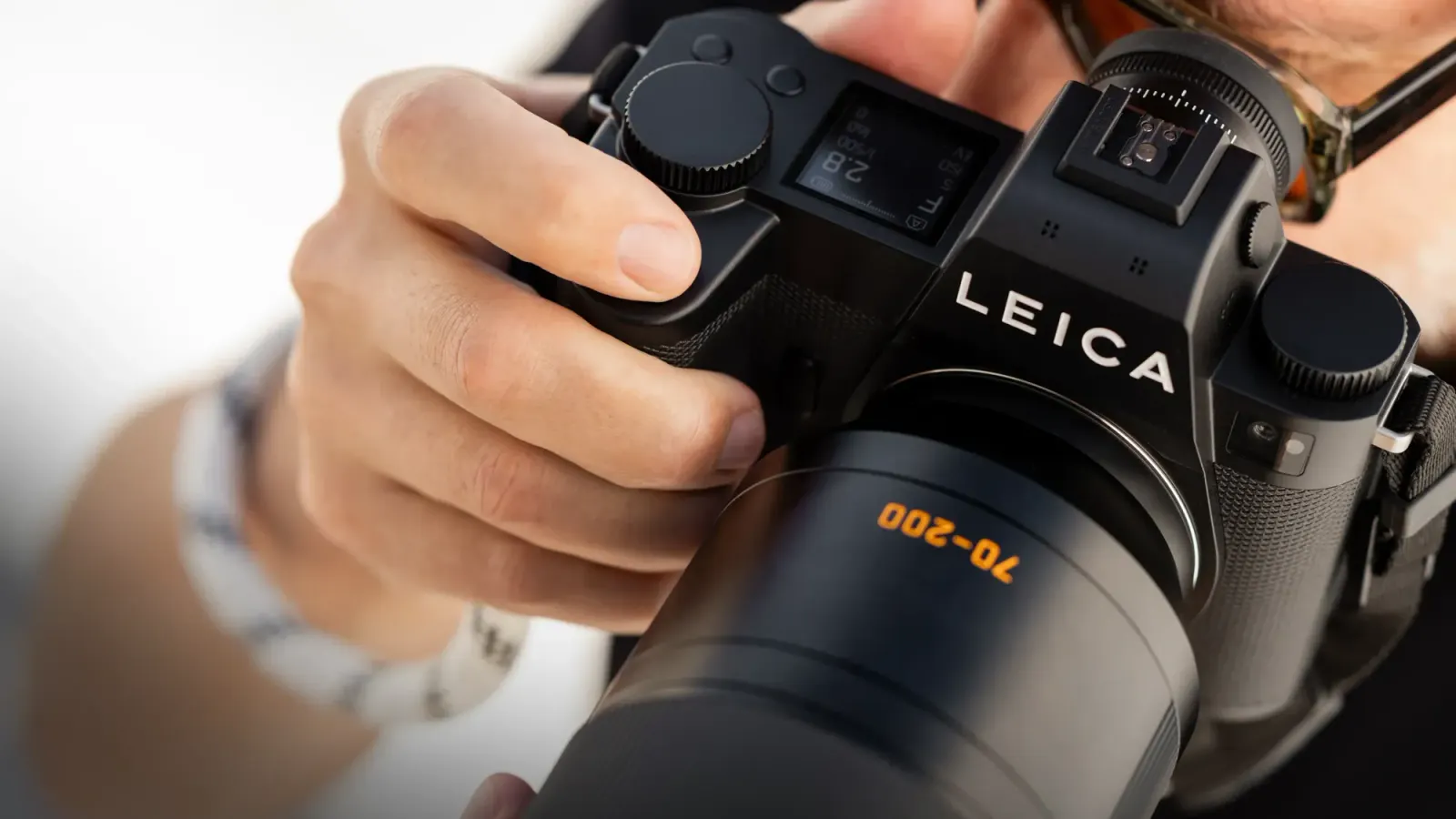
In Leica's language, a "P" model (think M-P, Q-P) is the discreet, professional version. The clearest sign is on the front: the famous red Leica dot is gone, swapped for a deliberately plain look meant to disappear on a job rather than announce itself. For a photojournalist or event shooter, a glowing red logo can be a liability, so losing it is a feature. The "LEICA" lettering across the top of the viewfinder gives the game away to anyone paying attention, but from across a room the camera keeps quiet.
One camera instead of two
Until now, Leica split its SL line in two: the high-resolution SL3 (60MP) and the high-speed SL3-S (24MP). You picked your priority. The SL3-P collapses that choice. It pairs a 44MP backside-illuminated full-frame sensor with 40fps burst shooting, so you get most of the resolution and most of the speed in one body.
On paper that puts it between its own siblings, above the 24MP SL3-S and below the 60MP SL3, while beating both on burst. More than one reviewer came away wondering why Leica still sells the standard SL3 at all. DPReview suggested it might be the only SL Leica really needs.
The specs that matter
The sensor pulls up to 14 stops of dynamic range across an ISO range of 50 to 200,000, and a Multishot mode stacks frames into 176MP files for studio and landscape work. The 40fps figure comes with fine print worth knowing: it is 40fps with the electronic shutter at 12-bit, 25fps at 14-bit, and the mechanical shutter tops out at 7fps. At 44MP, RAW bursts fill the buffer quickly, so how long you can hold the trigger depends on your cards.
Autofocus is the real upgrade. A new hybrid system combines phase detection, depth mapping, and contrast detection across 819 points with subject recognition, and in testing it tracked faces and moving subjects well, on par with the Panasonic S1R II it shares parts with.
Video is deep. The SL3-P shoots 8K Open Gate up to 30p, 6K up to 60fps, 4K at 120fps, and Apple ProRes up to 5.8K, with RAW out over HDMI, recording to an external SSD, two built-in LUTs for L-Log, and a Cinema Mode that thinks in T-stops and shutter angles. There are mic and headphone jacks, full-size HDMI, and USB-C.
The body is made in Germany in full metal, rated IP54 against dust and splash. Inside, the back-to-basics Leica interface color-codes photo and video modes and keeps the menus shallow, putting the core settings on two big dials and letting you ignore the rest. It also supports Content Credentials through the Content Authenticity Initiative, signing images with tamper-proof metadata, which matters more than ever for anyone shooting news.
The catch
The specs are flagship; the rest of the picture is more complicated. At $6,690 for the body, it is expensive, and that is before lenses. The L-Mount's long telephoto options still trail Sony and Nikon, which is exactly where a 40fps action camera wants to be strong. Early reviewers flagged operational quirks, including an autofocus point that resets to center after every burst by default and, on pre-production firmware, slow buffer writes with no on-screen indicator. And the oldest Leica question still applies: how much of the price is the sensor, and how much is the badge.
Priced and available
The SL3-P is available now at $6,690 for the body from Leica stores, the Leica online store, and authorized dealers. Leica launched it with three kits: $7,790 with the 28-70 f/2.8, $8,390 with the 24-70 f/2.8, and $10,995 with both the 24-70 and 70-200 f/2.8. Two new lenses arrived alongside it, a Summilux-SL 50mm f/1.4 that Leica calls the most compact autofocus 50mm f/1.4 yet, and an APO-Macro-Elmarit-SL 100mm f/2.8 with true 1:1 macro, both shipping at the end of 2026.
For Leica, the SL3-P is a statement: on resolution, speed, and autofocus, it is finally in the same conversation as the mainstream flagships it used to sit apart from. Whether you want to play that game in L-Mount, at this price, is the only real question left.