
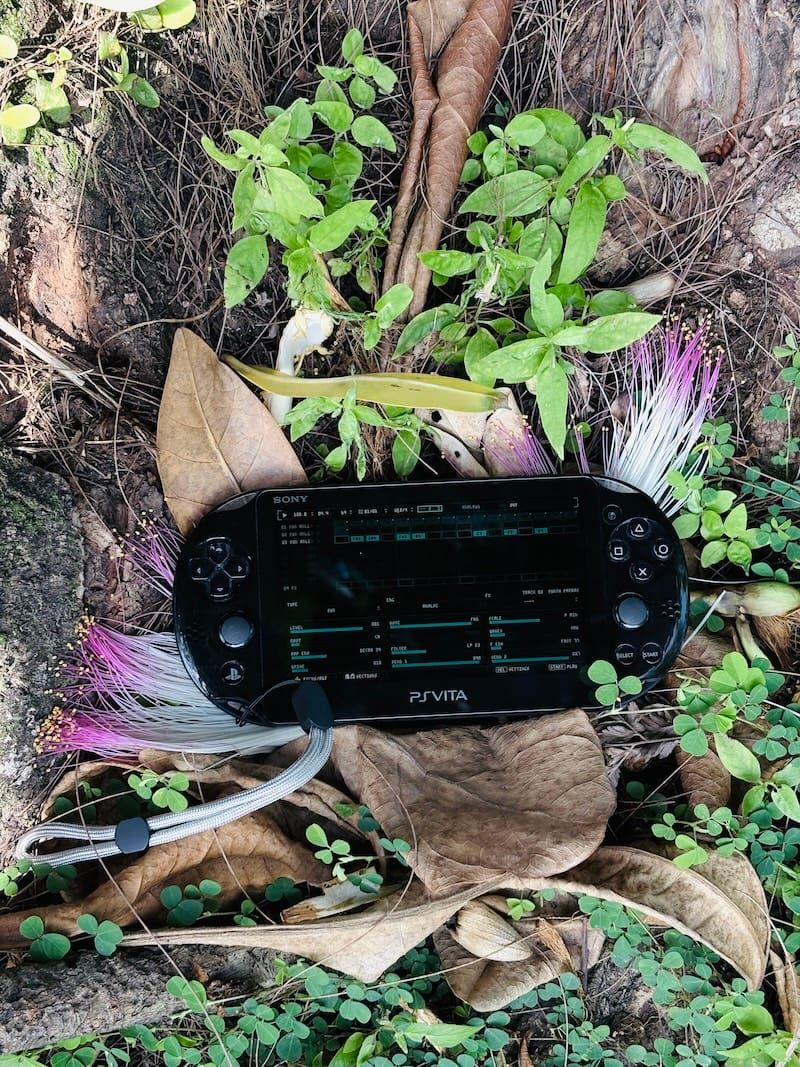
There is a category of object that fails commercially and then refuses to die, and music people are almost always the reason. The Game Boy became an instrument. So did the Speak & Spell, the PlayStation itself, a wall of cheap Casios nobody wanted in 1985 and everybody wants now. Musicians want different things from hardware than the market does: personality, a fixed set of limits, preferably cheap, preferably weird, preferably with buttons. The PlayStation Vita has been waiting on that list for years, with a beautiful screen, two analog sticks, a full set of face buttons, a touchscreen front and another panel on the back, and a body that fits two hands like it was measured for them. It sold badly, died young, and Sony moved on around 2019. DS-8 Drumstream is the argument that this was a waste.
It runs on the Vita itself, made by a small outfit called Intermynd Instruments and given away free on itch.io. Eight tracks of real drum synthesis with direct control over tuning, weight, noise, and decay. Sixty-four step sequencing with automation, probability, and generative variation. A sampler that records through the Vita microphone, slices what it captures, and resamples the running groove back into itself. An arranger for building songs out of patterns, and live effects on an XY pad. Then it sends eight separate tracks out over USB into whatever you record with, which should not be possible on a discontinued handheld.
The design argument underneath it is that touch and physical controls complement rather than compete. Touch is direct, buttons and sticks are precise, and precision is what sequencing and performance actually require. Almost nothing has both. Phones are all glass, grooveboxes are all buttons with a tiny screen apologizing in the corner. The Vita has a good screen you can touch and full controls under your thumbs, and that accident is why the hardware keeps pulling in music developers a decade after anyone stopped caring commercially. To get audio out, Intermynd had to teach the machine to behave like a USB audio interface, which nobody had done, then handed that work to the commons under an MIT license so no one has to solve it again. Instruments come and go. Infrastructure outlasts whoever made it. Worth being precise: DS-8 is free but closed, and only the plumbing beneath it is open.
Intermynd are honest that USB performance is decent rather than exceptional, built for recording finished tracks into a computer rather than live monitoring. Translated, this is a couch instrument, something to make things away from a screen you associate with work. Limits are generative, and a machine with eight tracks asks a different question than a laptop with infinite everything. The cost is not money but effort, since the Vita has to be modified to run homebrew, a well-documented process with a thorough guide and real if modest risk. Anyone with a modded Vita in a drawer should stop reading and go download it. Anyone without one should want it for its own sake, because aging batteries and proprietary memory cards are a strange price for a drum machine unless the strangeness is the appeal.




%20Officially%20Launches%20in%20the%20US%2C%20but%20Skips%20Verizon)
