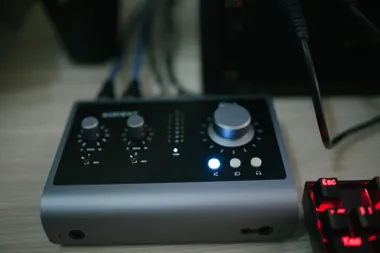

The S4 is Torso Electronics calling itself a sculpting sampler, which sounds like marketing language until you actually sit with what it does. Four parallel stereo tracks, each one running its own five-stage signal chain: a Material stage for playing, recording, and overdubbing an 8-voice polyphonic sampler, a granular engine for breaking sound into grains and stretching them into anything from soft drifting clouds to tight rhythmic chatter, a 48-band resonant filter bank that morphs between classic models, a dual-band color stage for distortion, bit reduction, and noise, and a stereo delay and reverb section with freeze built in. Every parameter across all five stages can be modulated by up to four LFOs, envelopes, random sources, or envelope followers per track, and a dedicated Perform page maps eight sliders and four punch-in effects buttons for pulling the whole thing apart live. It ships black, matte aluminum, 820 grams, a 3.5 inch color display, 21 backlit buttons, 9 endless encoders, running 24-bit/48kHz with 4GB of internal memory. Current price sits at $999 through authorized dealers, ships from the EU with duties already folded into the price, backed by a two-year warranty.
Unknowndivide may earn a commission from purchases made through links in this post. As an Amazon Associate we earn from qualifying purchases.
None of that happens in a vacuum, though. Torso Electronics is a small Copenhagen outfit, founded in 2018 by a group of friends, musicians and engineers who'd spent time playing DIY electronic shows around Montreal, basement jams and small clubs, before regrouping back home with a shared itch: most sequencers and samplers on the market felt like spreadsheets you programmed rather than instruments you played. Their first release, the T-1 Algorithmic Sequencer, launched through a Kickstarter campaign in 2020 and hit its funding goal within fifteen minutes, eventually landing at four times the original target. It built a real following fast, Surgeon named it his go-to sequencer, and Torso followed it three years later with a limited cream-white anniversary edition to mark two years of shipping units.
The S4 is the follow-up, first shown to the public at Superbooth in 2024, and it swung for something a lot more ambitious than a sequencer: a genuinely new kind of sampling workstation, one that treats tape-style capture and modern granular synthesis as the same activity rather than two separate tools bolted together.
That ambition came at a cost early on. When units actually started shipping, the S4 arrived with a fair amount of its promised feature set marked simply as coming soon inside the firmware itself, and reviewers and early buyers ran into real instability along with it, crashes, inconsistent behavior, a build that some felt didn't quite match a four-figure price tag. It was a familiar story for a small hardware startup reaching past what a first firmware build could actually deliver: the ideas were clearly there, the execution needed time to catch up.
That time is mostly what's happened since. Torso has kept pushing updates, a version 2.0 release added new performance and modulation modes along with broad workflow fixes, and by mid-2026 the company was demonstrating a 2.2 build with further additions to the granular engine. The gap between the instrument Torso originally described and the instrument people actually received has narrowed steadily with each firmware cycle, and the S4's reputation has shifted along with it, from a fascinating but half-finished beta into something closer to the tool it was pitched as at launch.
What hasn't changed is the identity underneath it all. Torso's stated goal, going back to the T-1, is building instruments that keep a musician in the flow rather than buried in a menu, tools built around play and immediacy over rigid programming. The S4 is that philosophy applied to sampling: four tracks running in parallel, a chain of devices designed to be touched and turned rather than configured, and enough modulation depth underneath to keep even a single loop evolving indefinitely. It's not a cheap instrument, and it wasn't a finished one on day one. Two years on, it's become the thing Torso originally said it would be.
S4 Sculpting Sampler on Torso Electronics
S4 Sculpting Sampler, on Amazon
Related: Intermynd Instruments DS-8 Drumstream · Roland RE-201 Space Echo · Gifts for Music Producers: 10 Ideas That Get Used Right Away
More in our Home Studio hub.