Teenage Engineering has a reputation for making expensive toys, and the reputation misses the point. The Stockholm company, founded in 2005 by Jesper Kouthoofd, David Eriksson, Jens Rudberg and David Möllerstedt, makes instruments that are deliberately limited, then dresses them in industrial design good enough to sit in a museum. The limits are the product. Every TE device forces a workflow, and the people who love them love them because they stop you from noodling and make you finish something.
The catalog has grown sprawling enough to confuse anyone shopping for a first one. This is every current product family on the official site, what each one actually does, and who it is for.
Unknowndivide may earn a commission from purchases made through links in this guide. As an Amazon Associate we earn from qualifying purchases.
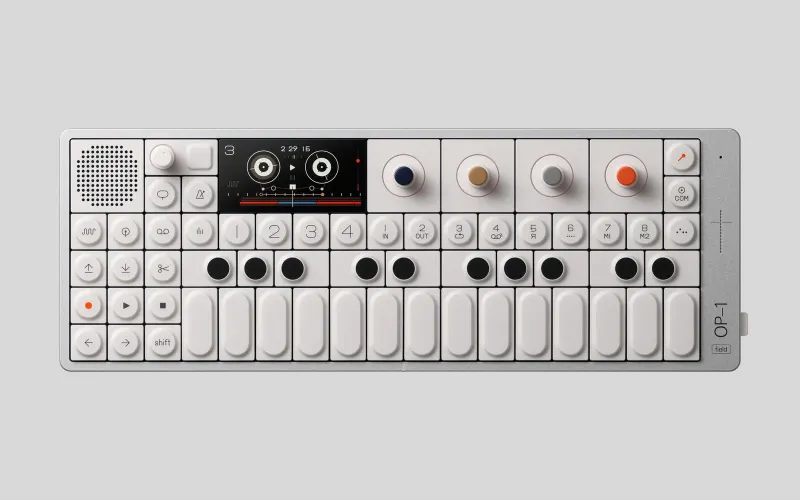
OP-1 field: the flagship
The OP-1 field is the device that defines the company. It is an all-in-one portable synthesizer, sampler and drum machine built around a 4-track tape workflow, which means you record ideas onto virtual tape, bounce them down and keep moving rather than endlessly editing. It also works as a 10-channel USB-C audio interface. It replaced the original OP-1, which became a cult object among producers and is still referenced in TE's catalog. Buy it if you want one instrument to carry everywhere and you are happy to learn its odd, opinionated logic.
OP-XY: the sequencer
TE describes the OP-XY as a 16-track performance sequencer, and that is the right way to think about it. It has 8 instrument tracks plus 8 auxiliary tracks that can control external synthesizers, including modular gear through built-in CV, and handle effects. It grew out of the OP-Z, with a grayscale interface where red marks recording and parameter locks. It is the TE product for people who already own other gear and want a brain for the whole setup. See the OP-XY on Amazon.
OP-Z: the pocket sequencer
The OP-Z is a fully portable 16-track sequencer and synthesizer with both sample-based and synthesis-based sounds. Its core idea is that every track runs independently, with its own speed, length and loop points, so patterns drift against each other in ways a normal step sequencer cannot manage. It has no screen of its own and leans on a phone app, which some people find freeing and others find maddening.
The EP series: samplers for everyone
If you buy one TE product, it should probably be from this line. The EP-133 K.O. II is a portable sampler and sequencer with a built-in microphone, speaker and punch-in effects, designed for fast beat making, and TE advertises it at $329. It is the cheapest serious entry into the company's world and, for most people, the right one. See the EP-133 K.O. II on Amazon.
The rest of the family shares the format with a twist. The EP-1320 medieval swaps the drum kits for hurdy-gurdies, lutes, Gregorian chants and foley, which sounds like a joke until you hear what it does to a beat. The EP-40 riddim is a rhythm and bass system with a live loop mode, built-in synths and a reggae and dub library. The EP-136 K.O.-sidekick is a 2-channel mixer, effects box and sequencer for live remixing, which also works as a desktop audio interface. See the EP-1320 medieval on Amazon.
Pocket operators: the cheapest way in
The pocket operators are bare circuit boards with an LCD, buttons and a battery compartment, built to be affordable and ultra-portable. TE rates battery life at about a month, and every model has 3.5 mm sync and audio connections so several can be chained together. Each model has a specialty: the PO-33 K.O! is a micro sampler with a built-in microphone, while others focus on drums, bass or melody. They are the best gift in music technology. See the PO-33 K.O! on Amazon.
The oddest member of the family is the PO-80 record factory, a compact record cutter by designer Yuri Suzuki that engraves and plays back 5-inch discs with deliberately lo-fi sound.
The field system: TX-6, TP-7, CM-15 and OB-4
The field line is TE's take on pro audio, much of it machined from aluminum and priced accordingly. The TX-6 is a battery-powered mixer and multichannel audio interface small enough to fit in a pocket. See the TX-6 on Amazon.
The TP-7 is a field recorder built to record, edit, trim and layer sound with as little friction as possible, and TE is clear that it is meant as more than a tape recorder. See the TP-7 on Amazon. The CM-15 is a studio-quality microphone with a built-in preamp and a USB-C audio interface, so it can record straight into a laptop or phone. See the CM-15 on Amazon.
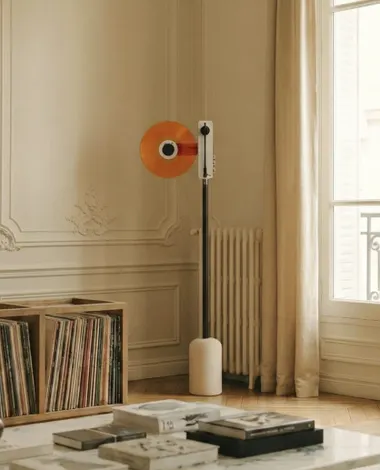
The OB-4 magic radio is the field line's speaker, an ultra-thin Bluetooth loudspeaker with a motorized interface, FM radio, line-in and a continuous 2-hour looping tape function that lets you rewind and remix whatever has been playing. Rounding out the system, the field desk is a modular workspace for the whole kit.
Objects, oddities and collaborations
TE also makes things that are hard to categorize. The computer-1 is a flat-pack mini-ITX PC case in orange or raw aluminum. Choir is a set of eight computerized wooden dolls, each with its own vocal range, that sing a cappella alone or together. At the professional extreme sits the APC-2, a real-time record cutter Unknowndivide covered in APC-2: Teenage Engineering Built a Record Cutter.
The company's design reach goes well beyond its own catalog. Panic designed the Playdate handheld with TE, and the crank-equipped console is still finding new ideas, as Unknowndivide noted in Playdate Season Three Makes the Case for Less.
Which one should you buy?
Start with a pocket operator if you are curious and on a budget. Choose the EP-133 K.O. II if you want to make beats seriously. Pick the OP-1 field if you want one instrument for life, or the OP-XY if you already own a studio and need a conductor. If you would rather sculpt sound than sequence it, look at alternatives like the Torso Electronics S4, a sampler from another Scandinavian company with a very different philosophy.
Whatever you choose, accept the limits. That is what you are paying for.
More in our Home Studio hub.