
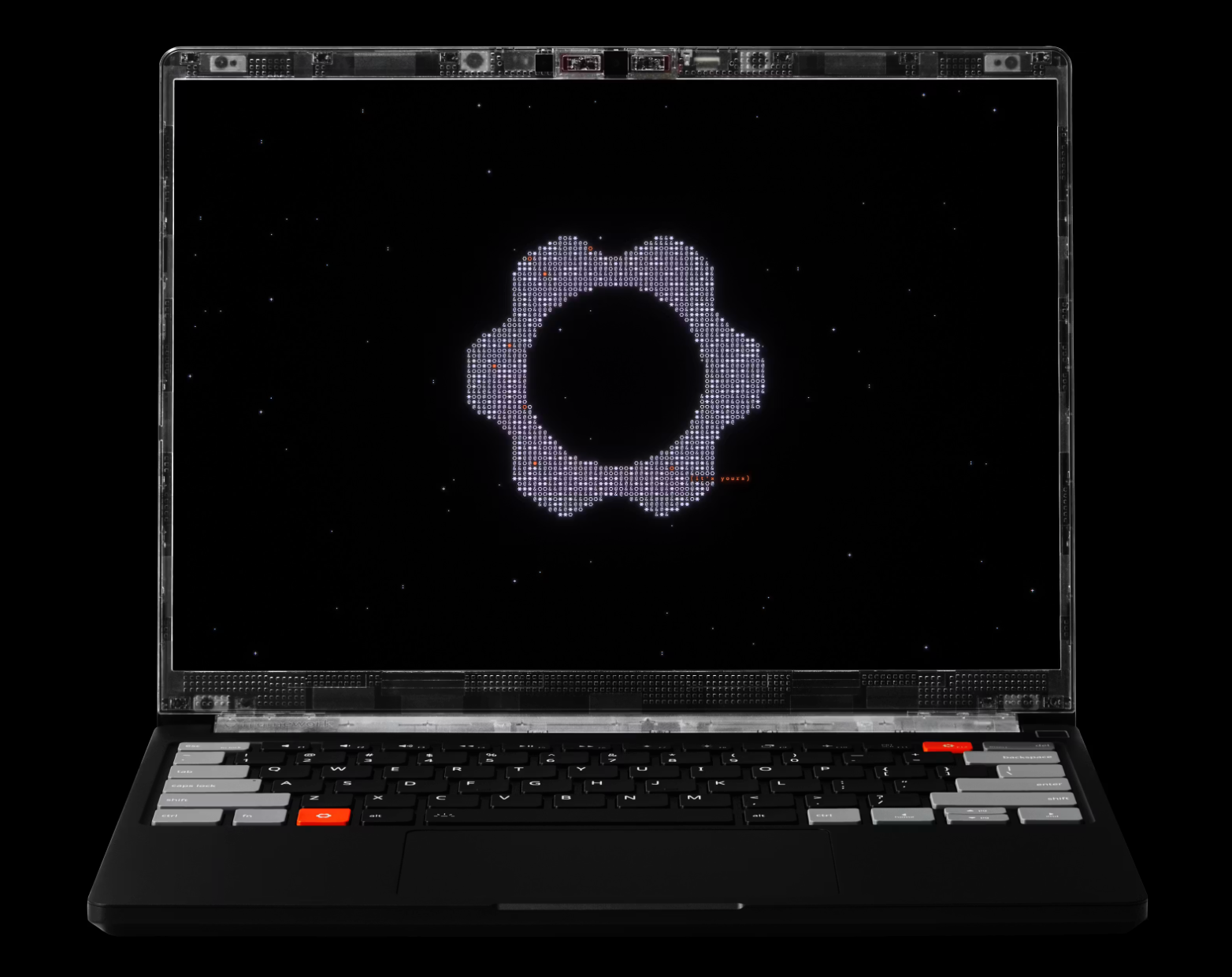
For five years, Framework asked laptop buyers to accept a trade. You got a machine you could open, repair, and upgrade for a decade, and in exchange you lived with middling battery life, a little deck flex, and a touchpad that merely did its job. The Framework Laptop 13 Pro withdraws the ask. Announced in April and shipping in batches since June, it starts at $1,199 for the DIY Edition and $1,499 pre-built, and it answers the question that has trailed the company since day one: can repairable also feel resolved.
The case is the first signal. All three covers are CNC machined from solid 6063 aluminum and finished in a graphite anodize, and the whole machine comes in at 15.85mm thick and 1.4kg. The keyboard keeps 1.5mm of travel and now sits on an aluminum frame that firms up the deck. Below it, a haptic touchpad driven by four piezoelectric actuators clicks identically across its full surface, with feedback and gestures tunable in software. The display is a custom 13.5-inch panel in 3:2, 2880 by 1920, matte and touch-capable, up to 700 nits, with a refresh rate that glides between 30 and 120Hz depending on what is on screen.
The headline number is battery. Framework enlarged the cell to 74Wh, a 21 percent jump over the outgoing Laptop 13, and paired it with Intel Core Ultra Series 3 processors. The company's own testing puts the result at 20 hours of 4K streaming, 17 hours of active web use, 11 hours of video calls, and a full week of standby on Ubuntu. Real days land below lab days, they always do, but this is the first Framework that credibly leaves the charger at home. The Intel build supports up to 8TB of PCIe Gen 5 NVMe storage, and an AMD Ryzen AI 300 configuration is available for those who want it.
The quietly radical part is the memory. Thin laptops built on low-power LPDDR5X almost always solder it to the board, which is exactly how upgradeable machines got squeezed out of the premium tier. Framework is among the first to pair Intel Core Ultra Series 3 with LPCAMM2, a modular format that delivers LPDDR5X at 7467 MT/s in a removable module, up to 64GB. You get the efficiency that makes a 20-hour claim possible, and you can still pull the memory with a screwdriver.
Everything that made Framework worth watching survives the refinement. Ports remain: expansion cards you choose and slot in yourself, from USB-C and HDMI to Ethernet, card readers, and extra storage. Every part carries a QR code linking to its repair guide, and the single tool required comes in the box. Hardware switches electrically sever the webcam and microphones. Pre-builts ship with stock Windows 11 or Ubuntu and nothing else; this is Framework's first Ubuntu Certified machine, and the company seeds hardware and funding to Fedora, NixOS, Bazzite, and other distributions. Design files and firmware for core components live on the company's GitHub. Most telling of all, the new aluminum chassis accepts every Laptop 13 mainboard Framework has ever shipped, and current owners can buy the Pro chassis, display, or input hardware piecemeal from the Marketplace instead of replacing a working computer.
The point of Framework was never that repairability demanded sacrifice. It was that nobody had tried hard enough to prove otherwise. The Laptop 13 Pro is the proof, a machine you would choose on its merits that happens to be the most fixable thing in its class. It sells in batches with pricing locked per batch, and early demand pushed later orders deep into summer. The DIY Edition starts at $1,199 and pre-builts at $1,499, configured directly at the official Framework store.






%20Officially%20Launches%20in%20the%20US%2C%20but%20Skips%20Verizon)
