A Cream Brickle is £1,850, roughly $2,400. The Black is £1,890 and is currently sold out. The Oak is £3,650, or somewhere near $4,700. The Small Brickle range starts at £1,460, about $1,900, and reaches £2,750 in oak. Exchange rates move, and North American pricing has not been posted yet, so treat those dollar figures as ballpark.
That is dining table money. In the oak configuration, it is good dining table money, for a piece of furniture whose stated purpose is holding plastic bricks. Any honest write-up has to sit in that discomfort for a paragraph rather than skipping past it toward the lifestyle photography, and the lifestyle photography here is very good, which is precisely the problem.
So the question worth answering is not whether this is expensive. It is. The question is what specific thing it does that an eighty-dollar stack of drawers does not, and whether that thing is worth the difference.
What it actually solves
The pitch is not storage. Storage is easy and cheap, and everybody already has a solution, usually a large tub, and the large tub is exactly the problem.
Bricks in a tub are functionally invisible. A child who wants a specific piece has to excavate, and the excavation costs more attention than the idea was worth, so the idea dies, and the child goes back to following instructions from a set. That is the actual mechanism, and it explains why so many collections end up as a graveyard of half-broken official builds rather than a supply of raw material.
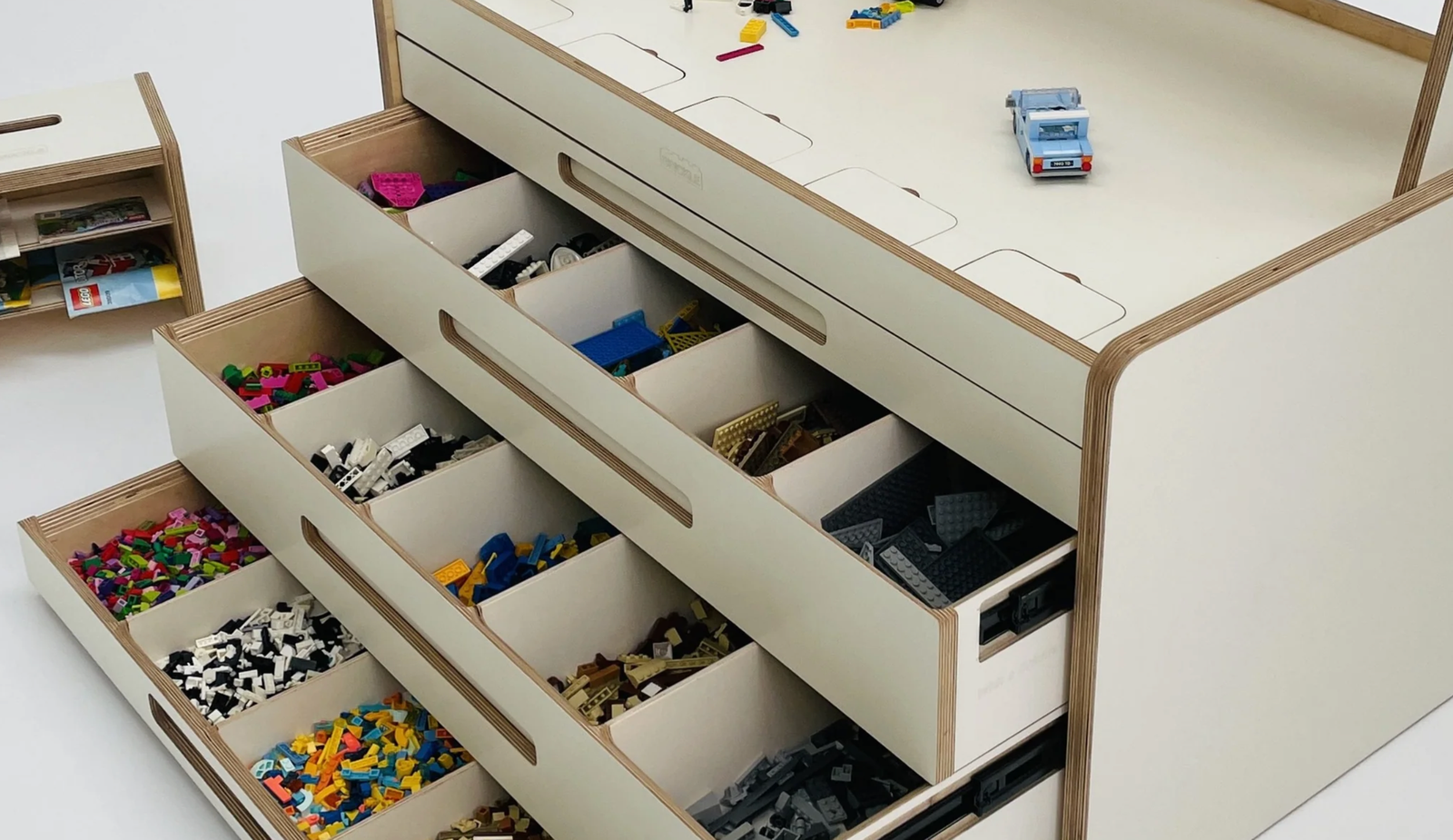
Brickle's answer is a shallow, sorted-drawer system that keeps everything visible and reachable at once from a seated position at a work surface. Sorted, shallow, and at hand. Those three properties are what separate free building from set building, and the difference between those two activities is not small.
There is research the company leans on suggesting the creative benefit of LEGO depends heavily on the mode of play, with instruction-following producing meaningfully different outcomes than open building. That is a defensible foundation for a product, and more than most furniture is built on.
Where the marketing overreaches
Two places, and they should be named.
The first is the screen-time positioning. The company's blog engages directly with Jonathan Haidt, arguing that restricting phones creates a vacuum and children need something absorbing and physical to fill it. The argument is reasonable. It is also the single most effective anxiety in the current parenting market, and building a $2,400 product on top of it means selling relief from guilt as much as selling a table. That is worth knowing about yourself before clicking buy.
The second is a customer testimonial on the homepage stating that a child's ADHD makes focus difficult and that the Brickle helps him persist. That may well be a sincere and accurate report of one family's experience. It is still an anecdote positioned where a claim goes, on a page selling furniture, and furniture does not treat ADHD. Reduced friction genuinely helps some children sustain attention on a task, which is a modest and plausible thing to say. The homepage placement invites a much larger read.
Neither of these makes the product bad. They make the copy do work the product should not have to.
The cheaper version of this idea
Anyone can build a functional approximation for a couple hundred dollars. Small parts organizers, a shallow drawer unit, a decent table, an afternoon of sorting. The sorting is the labor and no purchase removes it.
That approximation gets most of the functional benefit. What it does not get is any chance of living in a room where adults spend time.
That sounds like a joke and is not. The whole design bet here is that the object is attractive enough to sit in the main part of a house rather than being exiled to a bedroom or a basement, and location is not cosmetic. A LEGO table in a child's bedroom gets used alone and occasionally. A LEGO table in the room where the family actually is gets used constantly and communally. If the furniture being beautiful is what buys that placement, then the beauty is functional, and the premium is buying floor space in the good room.
Whether that is worth two thousand dollars over the DIY version is a household-specific answer. It is at least a real argument rather than a marketing one.
Details that suggest a serious maker
The stools are cut from the excess sections of the same plywood sheets as the main units. That is a genuine material efficiency and a small maker being unwilling to throw away good offcuts.
The shelves slot in and out of rails along the unit, so finished builds get displayed rather than dismantled or shoved on a windowsill. Small feature, disproportionate effect on whether a child bothers finishing things.
Custom color matching is available as one-off commissions against a RAL chart, which is a workshop practice rather than a factory one.
Black is sold out in both sizes, which tells you production runs are small and real. And the footer carries a plain statement that LEGO is a trademark of the LEGO Group, which does not sponsor or endorse the product, and that Brickle is independent. That disclosure is legally necessary and also worth reading as a fact about the business: no licensing deal, no corporate parent, contact details that are one person's email address.
The obsolescence question
Children age out. A child deep enough into LEGO to justify this at seven may be done with it at thirteen, and that is a six-year payback on an object that cost as much as a car repair or a vacation.
The counter is that this survives the transition better than most children's furniture, because it is a table with drawers. Strip out the sorting inserts and it is a work surface. That is a more graceful second life than a themed bed or a plastic play kitchen gets, and it partly explains the material choices. Plywood, paint, oak. Nothing about it announces a child's room, which is the same decision that lets it live in the good room in the first place.
Who should buy it
Not most people. That should be obvious from the price and it gets obscured by how well the thing photographs.
It makes sense for a household with a serious multi-year LEGO habit, more than one child using it, and the space to put it somewhere central. In that configuration the cost per use becomes defensible and the placement argument does real work.
It does not make sense as an intervention. Buying $2,400 of furniture to redirect a child away from screens is buying the equipment before the interest, and the interest is the part that cannot be purchased. The families in the testimonials had the habit first.
For everyone else, the useful takeaway is free: sort the bricks by type, keep them shallow, keep them visible, put them somewhere with good light and adult company. That is the actual insight this product is built on, and it works on an IKEA table.
North America shipping opens this month, with the UK, Europe, Australia, and Singapore already served.
Go look
- Brickle
- What is Brickle
- Full size range
- Small Brickle
- Stools and shelves
- Custom color commissions
- Who we are
- Safety and FAQ
- @brickle.co on Instagram
LEGO is a trademark of the LEGO Group, which does not sponsor, authorize, or endorse Brickle.