
The Bertoia Diamond Chair looks like it was drawn in the air with a single line of steel, and that was the point. Harry Bertoia said his chairs were "mainly made of air, like sculpture. Space passes through them." What most people sitting in one do not know is that Bertoia did not want to be a furniture designer at all. He designed this one collection for Knoll in about two years, took a bonus in exchange for the rights, and spent the rest of his life making sculpture, including a barn full of metal rods he played like instruments. Here is the story behind the Diamond Chair, what an original costs, how to tell a real one from a replica, and whether it is worth buying.
The quick answer
- Buy the original from Knoll if you want the chair for life. With a seat pad it lists at $2,229 and is $1,671.75 in Knoll's current 25 percent sale.
- Buy the outdoor version (a black or white coated frame with a vinyl pad) if it is going on a terrace. The chrome frame is not made for outdoor use.
- Buy used with care. Real chairs last for decades, and the two checks below catch almost every copy.
- Skip anything sold as "Bertoia style" or "inspired by Bertoia." Those words are the giveaway for a copy.
The sculptor who did not want to design chairs
Arri Bertoia was born in 1915 in San Lorenzo, a village in the Friuli region of Italy, and moved to Detroit at 15 to join his brother. A scholarship took him to the Cranbrook Academy of Art in Michigan, where in 1939 Eliel Saarinen asked him, at 24, to reopen the metal shop. His classmates there became the most important names in American modern design: Florence Schust, later Florence Knoll, Charles Eames and Eero Saarinen. He made the wedding rings for Ray Eames.
In 1943 he followed the Eameses to California to work on molded plywood chairs. The Eameses sent him to a welding class at Santa Monica City College, the skill that shaped the rest of his career. According to the Harry Bertoia Foundation, his solutions helped make the Eames chairs possible to produce, and he got no credit for them. He was also sketching wire grid chairs at the time. Eames took the wire idea to market first, with a wire chair from Herman Miller in 1950.
That same year Florence and Hans Knoll invited Bertoia to Pennsylvania. Knoll's own history of the chair says they never asked him to design furniture. They gave him a metal shop and asked only that he show them anything interesting. "When it came to rod or wire, whether bent or straight, I seemed to find myself at home," he said. The Diamond Chair was first shown in 1952 and in production by 1953, alongside a side chair, a barstool, a high-backed Bird chair and a wider Large Diamond. Bertoia also designed the jigs used to make them.
By late 1952 he was finished. Knoll paid him extra to own the chair rights permanently, and the money helped him buy the 18th century farmhouse in Pennsylvania where he lived until his death in 1978. He went on to make more than 50 public sculptures and, from 1960, his Sonambient sound sculptures: tall clusters of metal rods that ring and shimmer when touched. He played them in a barn on his Pennsylvania property, and eleven Sonambient albums came out of those recordings. If you love drone and ambient music, they are worth finding; the man who made a chair out of air ended up making music out of steel.
What the original is like
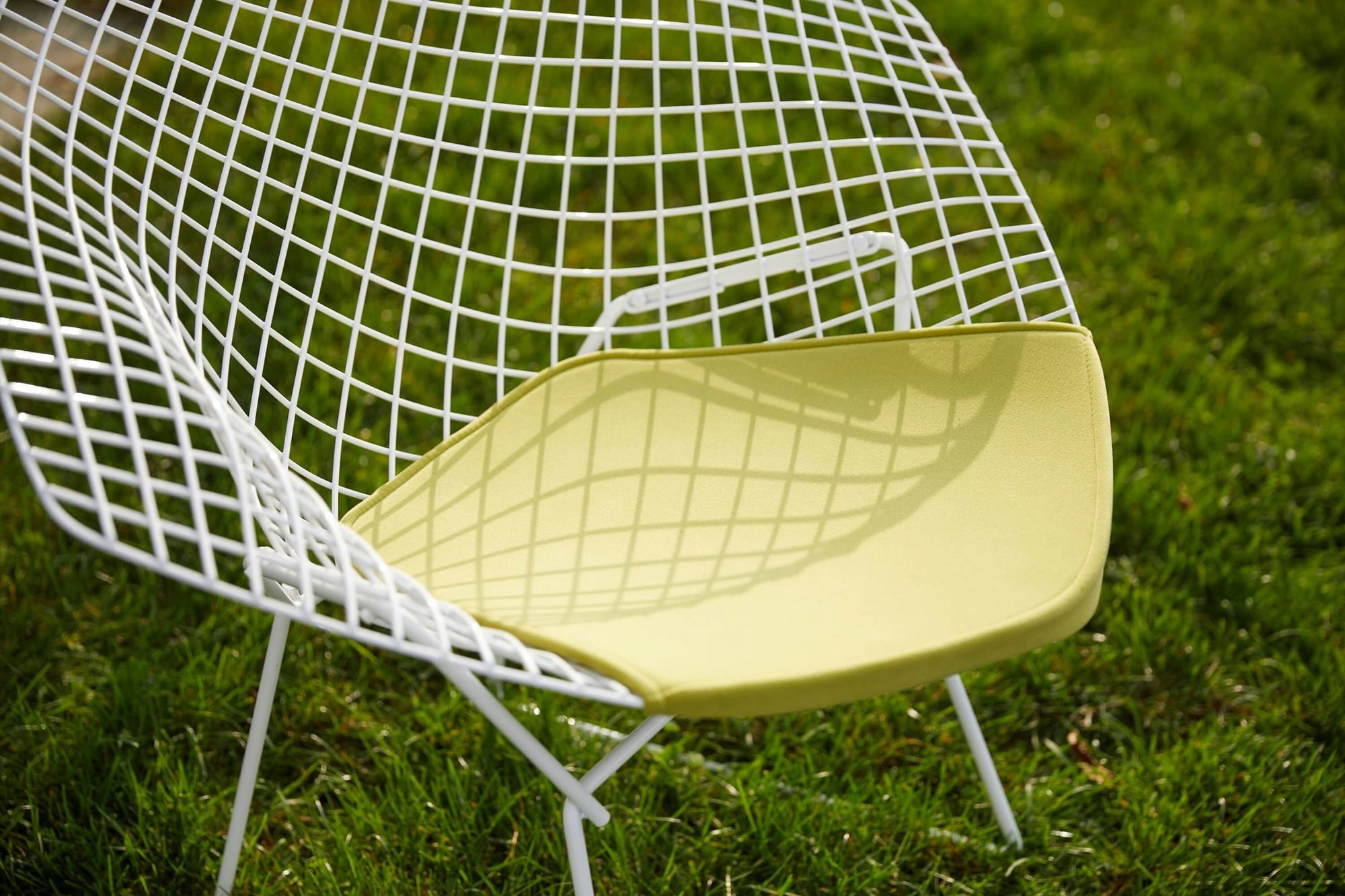
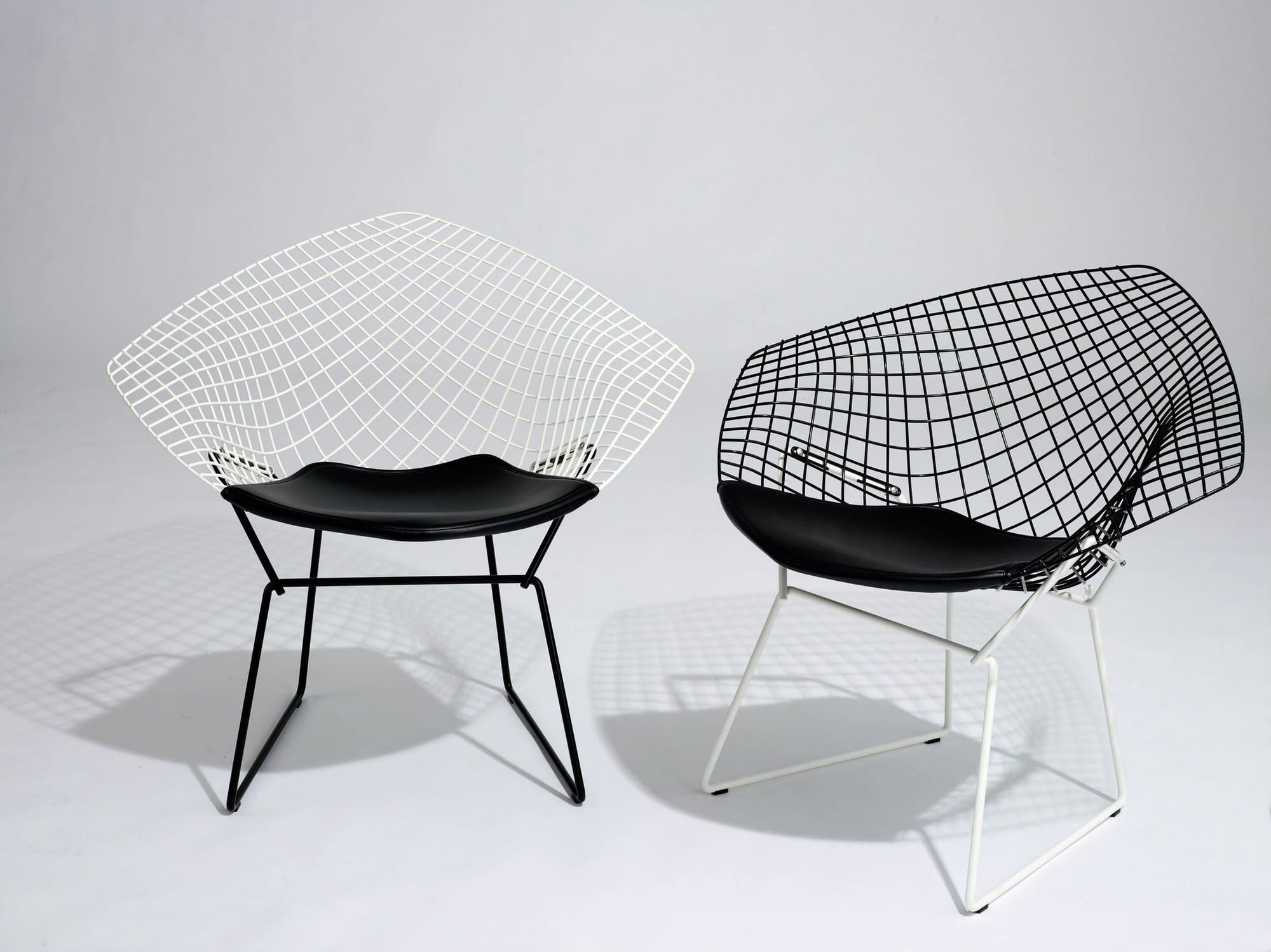
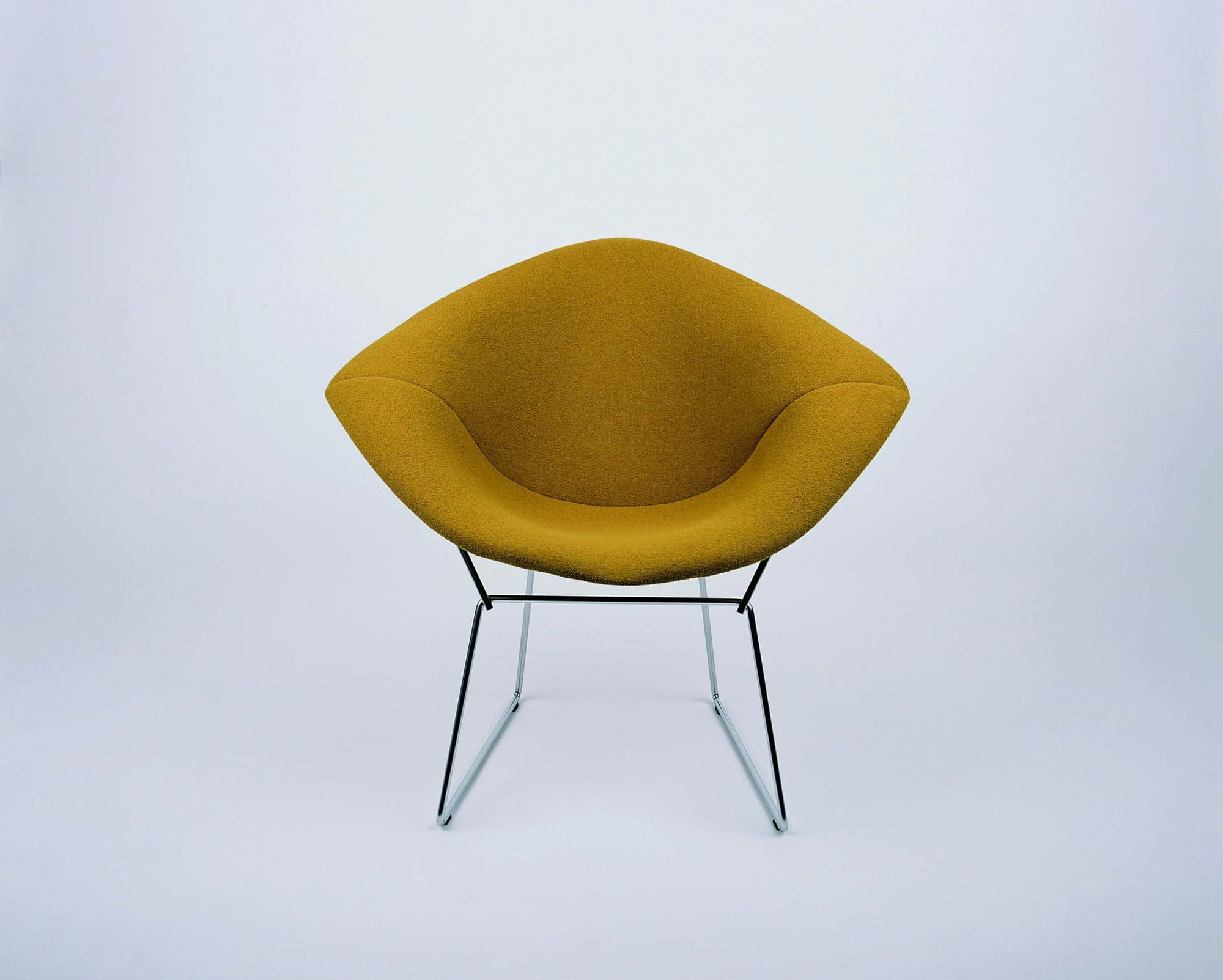
The Diamond is a low lounge chair, not a dining chair. Knoll lists it at 33.5 inches wide, 28.25 inches deep and 30 inches high, with a seat height of 16.5 inches, so you sit low and lean back into a wide shell. The seat and base are welded steel rods. The frame comes in polished or satin chrome, black or white, and, since 2015, an 18 karat gold-plated finish made for Bertoia's 100th birthday. Two-tone versions pair a colored shell with a different base. You can have it bare, with a seat pad, or with a full cover, held on by hidden monofilament and metal hooks. For bigger rooms there is the Large Diamond, 45 inches wide.
Bertoia Diamond Chair real or fake: how to tell
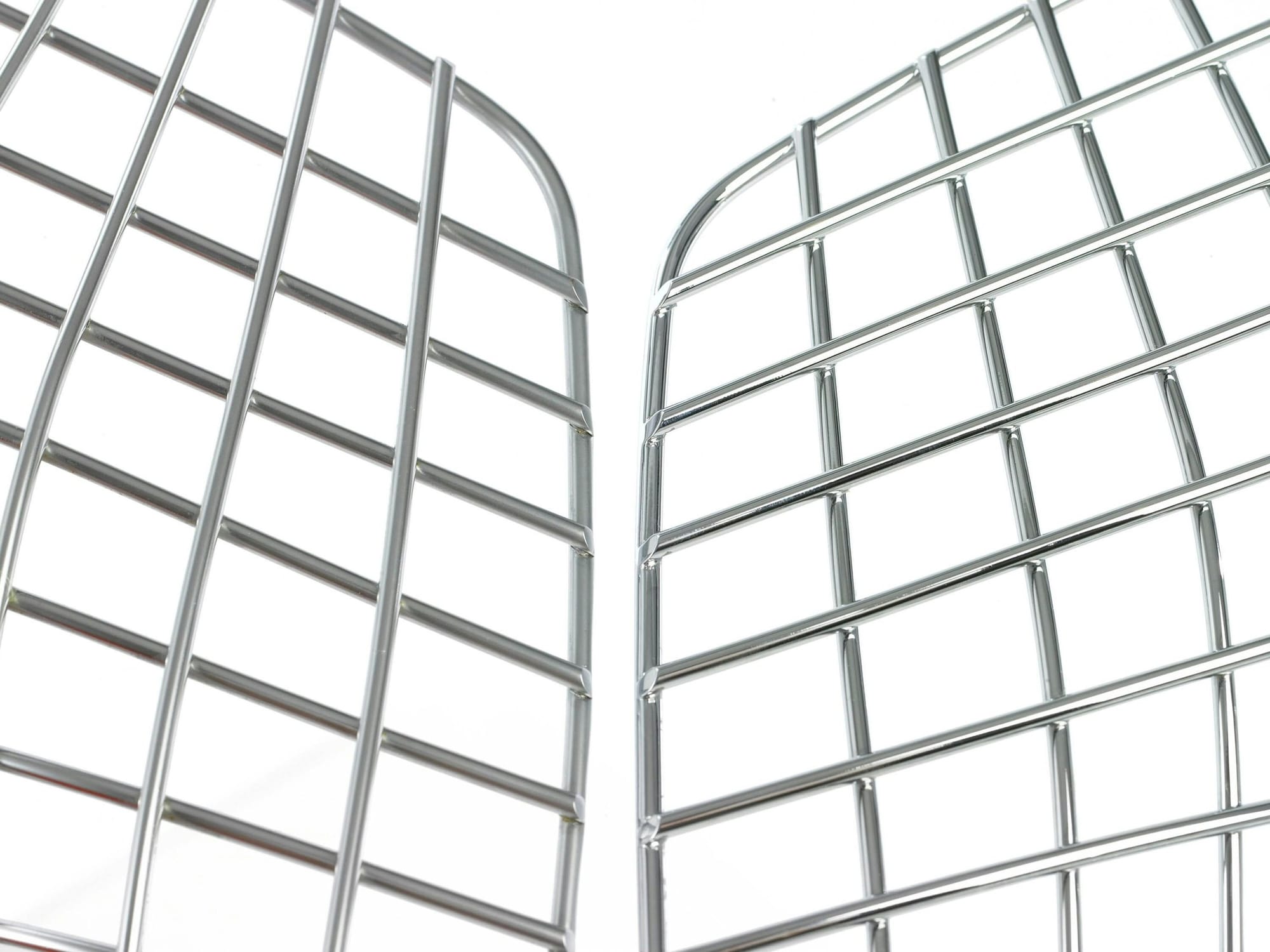
The Harry Bertoia Foundation says two places identify a genuine Knoll chair about 99 percent of the time: the top corners of the back and the bends in the base. Its guide is written around the side chair, but the same details apply to the Diamond.
| Check | Original Knoll chair | Common sign of a copy |
|---|---|---|
| Rim wire | A single rim wire around the edge of the shell | A double rim wire, the most common mark of a modern knockoff |
| Base bends | Very tight inside bends; a half-inch dowel nests neatly inside each one | Wide, lazy bends |
| Wire ends | Grid wires cut at an angle | Blunt, straight cuts |
| Front edge | On chairs made since 1986, the front rim wire sits on top of the grid in a "waterfall" | Flat or awkward front edge |
| Stamp | Since 2004, "Knoll" stamped into the back of the base | No stamp, or a sticker |
| Corner shape | Top corners neither too soft nor too tight, with horizontal grid cells | Overly round corners |
| Wording | Sold as the Bertoia Diamond Chair by Knoll or an authorized dealer | "Bertoia style," "inspired by" or "reproduction" |
One twist for vintage buyers: older originals look different from new ones. Until 1986 the chairs were made in East Greenville, Pennsylvania, and under license in countries from Argentina to Japan, with thinner wire that made them lighter and more see-through. That year production moved to Verona, Italy, and the wire got thicker, the waterfall front edge arrived and the base connectors changed. A thin-wire chair with no stamp can still be completely genuine, so judge vintage pieces by the rim, the bends and the cut ends.

Is the Bertoia Diamond Chair worth it
As a piece of design, yes, and more than most icons, because it is one of the few that takes up almost no visual space. It works in a small apartment where a bulky lounge chair would crowd the room, and it looks just as good outside. Bare wire is not comfortable for long, though. Budget for at least the seat pad; the full cover turns it into a properly cozy reading chair. Full-cover versions list from about $3,500 depending on fabric or leather, roughly $1,300 more than the seat pad.
A copy can cost a few hundred dollars, and from across a room some pass. Up close, the thick double rim and soft bends give them away, the welds and finish rarely last like Knoll's, and you lose the resale value a real one keeps. If the new price is too high, a used original with a seat pad is the smart way in.
Bertoia's Cranbrook friend designed another Knoll classic: see our guide to the Saarinen Tulip Chair, and Barcelona chair vs Womb chair for two more Knoll icons side by side. The Eames Lounge Chair came out of the circle Bertoia worked in, and our mid-century modern guide explains the whole style.
Our call
Our call: buy the original with a seat pad, and skip the replicas. At $1,671.75 in Knoll's current sale, the seat pad version is one of the most affordable ways to own a genuine mid-century icon, and it holds its value. Choose chrome indoors and the black or white coated frame outside. If that is still too much, buy a used Knoll chair and check the single rim wire and the tight base bends before you pay. A double-rim copy saves money once and looks like a copy forever.
Knoll Bertoia Diamond Chair, Seat Pad ($2,229 list, $1,671.75 on sale): our pick, the original welded steel chair with a seat pad in dozens of fabrics. Shop it at Knoll
Knoll Bertoia Diamond Chair, Full Cover (from about $3,500 list, 25 percent off now): the most comfortable version, fully upholstered for long sitting. Shop it at Knoll
The full Bertoia Collection: the side chair, barstool, Large Diamond and Asymmetric Chaise. Browse it at Knoll
More chairs, lamps and furniture with a story: browse everything in our Design Icons hub.
Prices are from Knoll's US online store in mid-November 2026 and can change. History and authenticity details are from Knoll and the Harry Bertoia Foundation.