
Every year someone walks into a furniture shop, sees a polished steel arc swinging over a dining table from a block of white marble, and asks the same two questions. Is that the real Arco lamp? And why does the real one cost what it does? This guide answers both, starting with the strange, practical story of how two brothers in Milan built a ceiling light that never touches the ceiling.
The quick answer
- The original: the Arco floor lamp designed by Achille and Pier Giacomo Castiglioni in 1962 and still made by Flos, with a solid white Carrara marble base and a telescopic stainless steel stem.
- The replica: any look-alike sold under another name. Most copy the silhouette and cut corners on the two things that make Arco work, the weight of the base and the quality of the stem.
- Who should buy which: buy the original if you have a permanent spot for it and want a lamp you can repair for decades. Skip the copies. If the budget is not there yet, buy a different honest lamp and wait.
A street lamp brought indoors
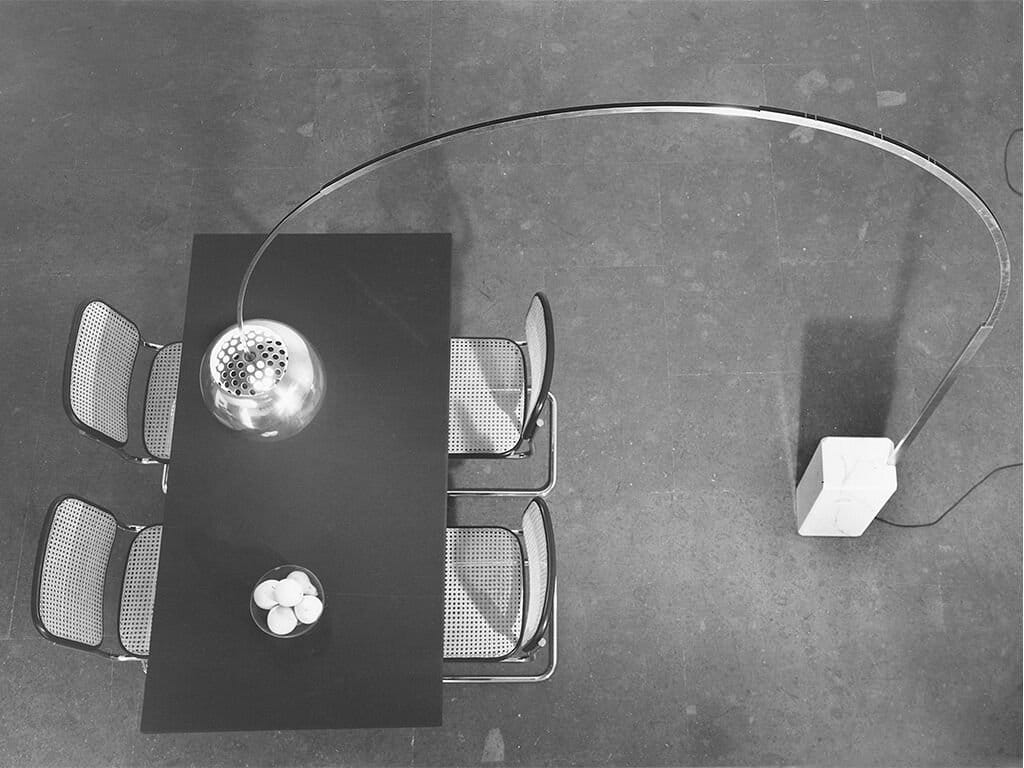
In 1962 Achille and Pier Giacomo Castiglioni were working on a problem most of us still have. A dining table looks best with a light hanging right over it, but tables move, and rented apartments do not let you drill wherever you like. Flos says the brothers took their cue from street lighting, where a pole stands at the curb and an arm carries the light out over the road. Shrink that idea to the scale of a living room and you get Arco: a heavy base off to one side, a long steel curve, and a shade that hangs where a pendant would.
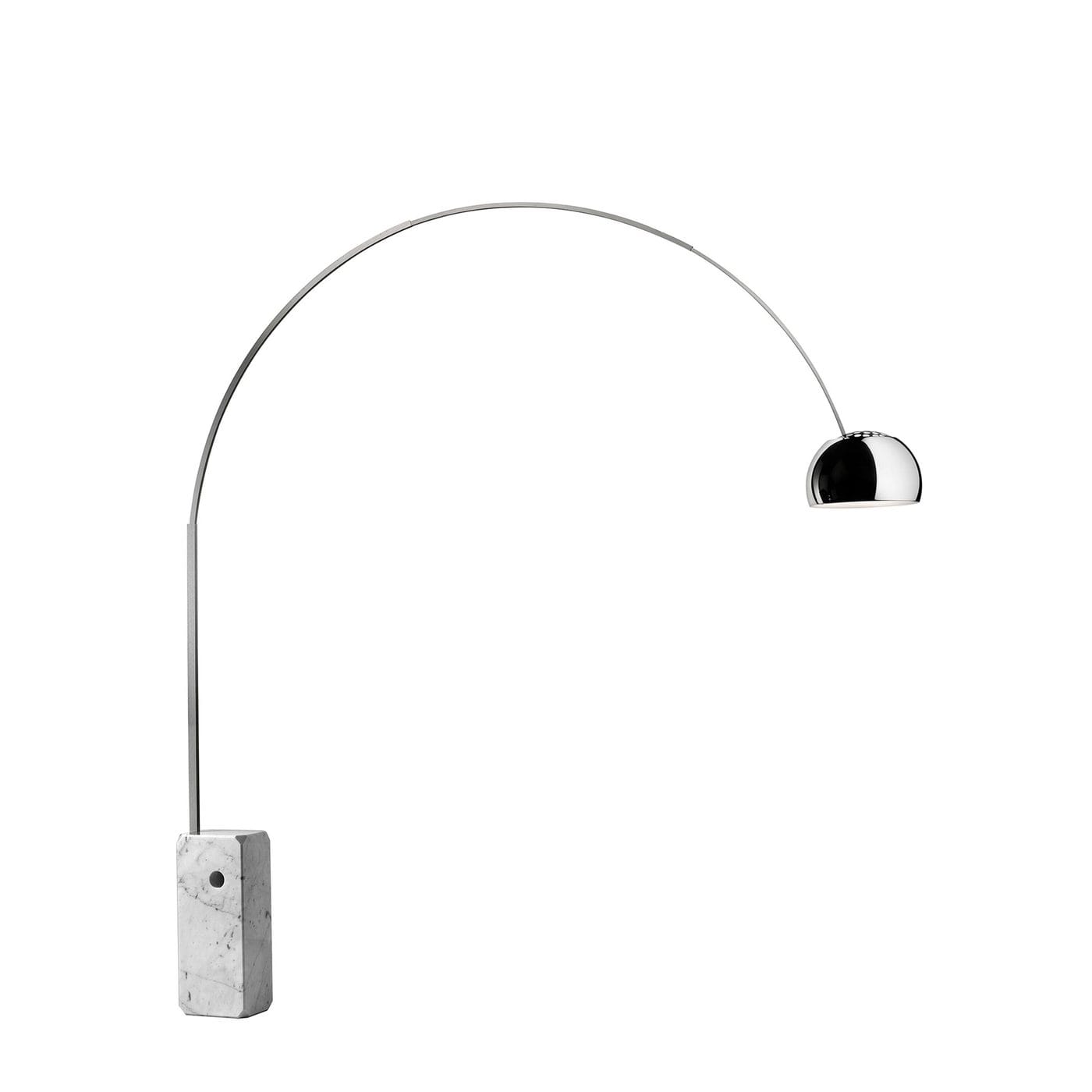
The numbers on the Flos specification sheet show how literal the idea is. The lamp stands about 2.4 meters tall and reaches about 2.2 meters out from its footprint, so the shade lands well over a table while the base sits by a wall. That reach only works because of the counterweight. The complete lamp weighs 63.8 kilograms, or about 141 pounds, and nearly all of it is marble.
The same year the brothers also designed Toio for Flos, a floor lamp built around a car headlight with fishing rod rings guiding the cable. Put the two side by side and you see the Castiglioni habit: borrow something that already works in the world, then make it domestic. Arco borrowed a street lamp. Toio borrowed a car.
The hole in the marble
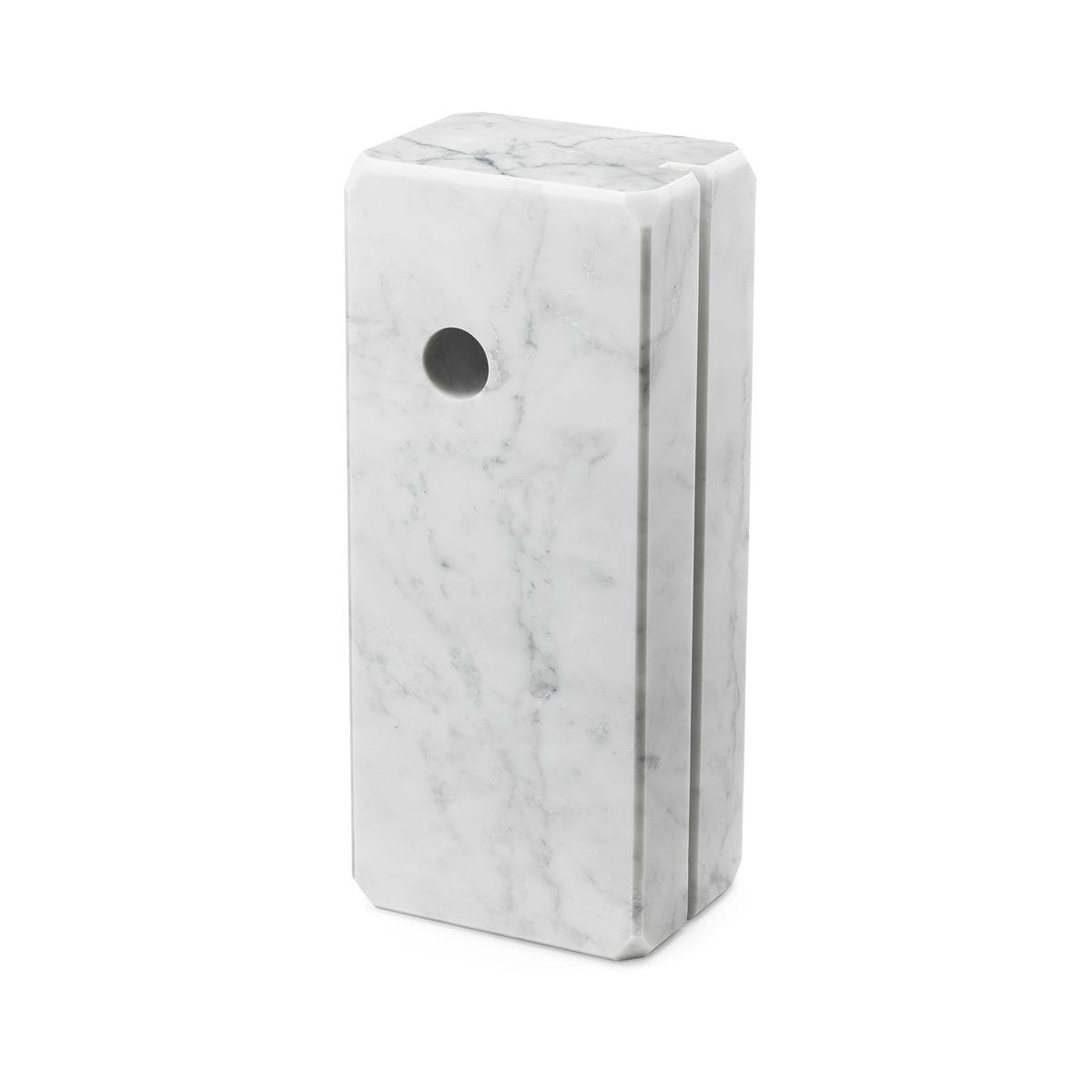
Here is the detail almost nobody notices until they try to move one. There is a hole bored straight through the marble base. It is not decoration. Flos describes it as a hole for transport with a wooden pole: slide a broom handle through it, put one person on each end, and two people can carry a block that would otherwise be a back injury. The corners of the base are also softened, which matters on an object that sits at shin height in a room people walk through.
The shade has its own quiet engineering. Flos makes the reflector from pressed, polished aluminum that swivels and adjusts in height, and the top is perforated. Those holes let heat escape from the bulb and let a little light spill upward, so the lamp never looks like a dark dome floating in the air. The stem is stainless steel and telescopic, made of separate channels that slide inside each other so you can set the reach for your table.
The design world noticed early. Flos points out that Arco is in the permanent collection of the Museum of Modern Art (MoMA) in New York, and the company calls it one of the few objects to receive a Product Lifetime Achievement Award. The Castiglioni studio in Milan, now run as a museum by the Fondazione Achille Castiglioni, keeps the brothers' working methods on view for anyone who wants to see where ideas like this came from.
Arco lamp original vs replica: how to tell
Arco is one of the most copied lamps ever made, and in Europe it has been at the center of the legal argument over copies. In 2011 the Court of Justice of the European Union ruled in a case Flos brought over an Arco look-alike, a decision that pushed Italy toward giving classic industrial designs full copyright protection. In plenty of markets copies are still sold openly. Here is how to separate the two before you pay.
| Check | Original Flos Arco | What to watch for in a replica |
|---|---|---|
| Base | Solid white Carrara marble with a carrying hole and softened edges | Thin marble slabs over a filler, composite stone, or no carrying hole |
| Weight | 63.8 kilograms for the complete lamp, per Flos | A listed weight far below that means less counterweight and more wobble |
| Stem | Telescopic stainless steel channels | Painted or plated mild steel, or a fixed single piece arc |
| Shade | Pressed, polished aluminum with a perforated top, swivels and adjusts | Spun thin metal, fixed angle, holes punched for looks only |
| Name and seller | Sold as Arco by Flos and its authorized stores | Words like inspired by, arc lamp, or mid-century arch lamp in the title |
| Repairs | Flos lists spare parts for Arco, from the reflector to the marble base | Usually no parts, so one broken joint ends the lamp |
That last row is the one people underrate. Flos sells replacement reflectors, stem channels, switches and even the marble base itself. An original Arco is designed to be fixed rather than replaced, which is a big part of why secondhand ones hold their value.
Before you buy one
Measure twice. With a reach of about 2.2 meters, the base needs to sit roughly that far from the middle of your table, and the arc needs clear air above head height. Think about the floor too. A lamp that weighs as much as an adult on a footprint the size of a small side table is fine on concrete or a solid floor, but it is worth thinking about on old boards or a soft rug, where the base can slowly settle.
Then think about where it will live for the next ten years. Arco is not a lamp you move every weekend. People who love theirs tend to put it in one spot and design the room around it.
If you are buying secondhand, ask the seller to show the carrying hole, the full stem extended and the shade from above. Ask about the weight. A genuine owner will usually know it, because they remember carrying it in.
Our call
Our call: buy the original, skip the replica. Arco is expensive because the expensive parts are the design. The heavy marble keeps the reach safe, the steel stem keeps the curve true, and the Flos parts list keeps it alive for decades. A copy gets you the silhouette for a year or two and nothing to fix it with. If an Arco does not fit your budget or your floor right now, buy something honest instead. Toio, from the same brothers in the same year, gives you the Castiglioni thinking in a far lighter package.
Flos Arco floor lamp: the original 1962 design with the Carrara marble base, direct from the maker. See Arco at Flos
Flos Toio floor lamp: the brothers' car headlight lamp from the same year, a lighter way into their work. See Toio at Flos
Achille Castiglioni by Sergio Polano: a deep monograph on the designer's work, for anyone who wants the full story behind Arco and Toio. Check the book
Keep exploring: our guides to the Noguchi Akari light sculptures, the Anglepoise Original 1227 and the Saarinen Tulip chair cover more of the objects that defined modern living. Browse every related post in our Design Icons Hub.
As an Amazon Associate we earn from qualifying purchases.