

Two square paintings, seven years apart, are headed for the same auction podium at Christie's in Rockefeller Center on November 17, and the preview galleries are free to walk into until the night they sell. One is a Klimt landscape that has not been at auction in nearly three decades. The other is the Kandinsky that Christie's expects to challenge his auction record. Together they make this the most interesting art week in New York for people who will never bid.
Christie's Klimt auction: the painting seen through a telescope
Litzlbergkeller, painted in 1915 and 1916, shows an inn on the shore of Lake Attersee in Austria, almost buried in trees. Klimt knew the place intimately. From 1900 he spent his summers at Litzlberg with the Flöge family, and it was on that lake, Christie's notes, that he worked out the square canvas, the high horizon and the dense, tapestry-like surface that define his landscapes.
By the time he painted this one, he had moved across the water to Villa Oleander, and he looked back at his old summer home through a telescope. That is why the picture feels so strange up close. The lens flattened house, forest and lake into a single patterned plane, and Klimt edited out the dock and stairs so that the building sits sealed inside the foliage. It reads less like a postcard than a memory of a place.
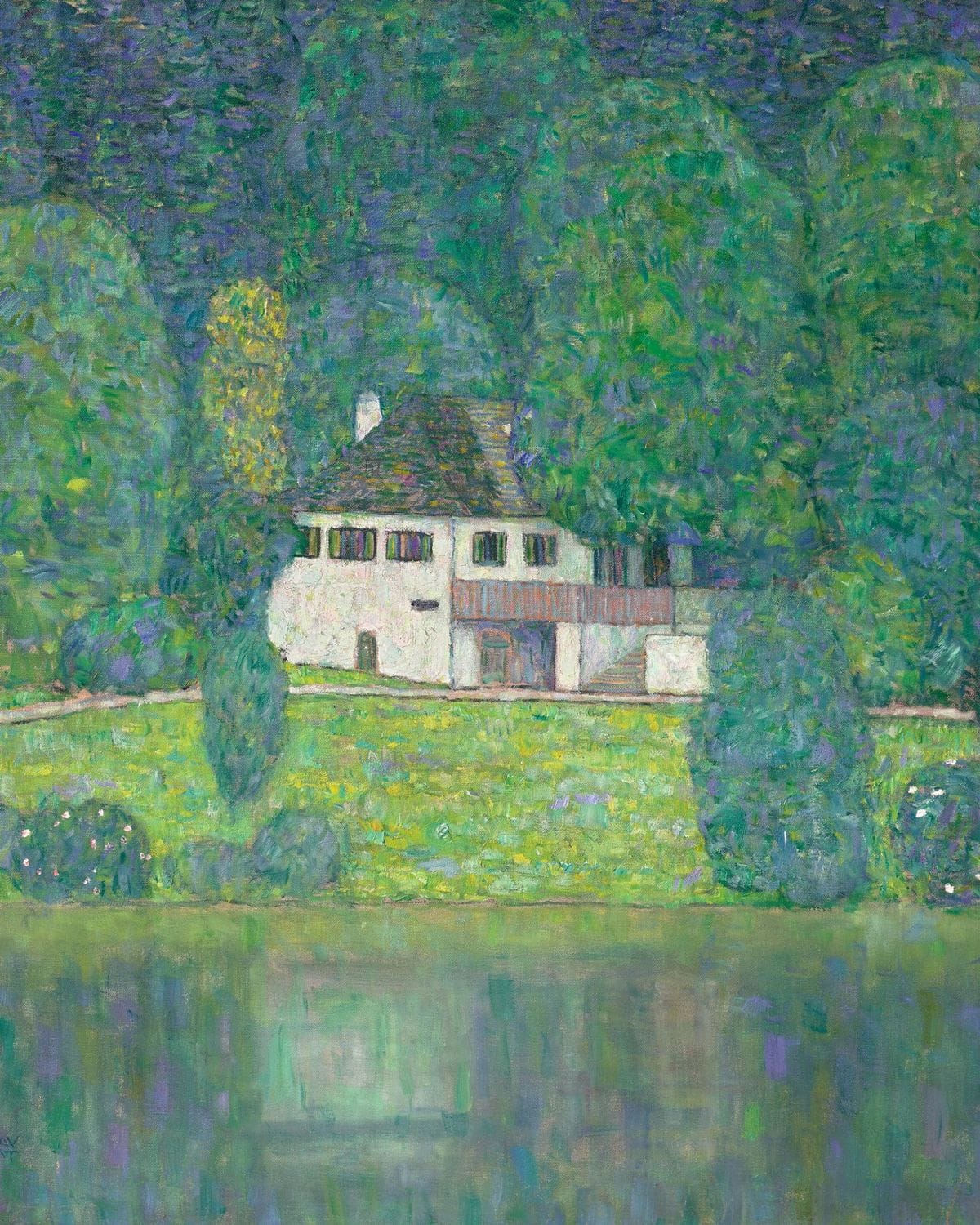
The patron was the banker Otto Primavesi, a close friend and one of Klimt's most important collectors. On 3 May 1916 Klimt wrote to him that the painting was now finished. Its modern history runs through New York: it was bought at the 1997 estate sale of the dealer Serge Sabarsky, where it set what was then a record for Klimt at auction, and has stayed with the same family since, most recently on long-term loan to the Leopold Museum in Vienna. The timing is neat. Neue Galerie, the museum Sabarsky helped conceive, reopens on November 12 with its 25th anniversary show, five days before the sale.
Kandinsky's Betonte Ecken, the X on the wall
Betonte Ecken, or Accented Corners, was painted at the Bauhaus in Weimar between December 1922 and January 1923, right after Kandinsky arrived to teach. It is built on an X: two diagonals cross at a blue form in the middle and push out to all four corners. If the Klimt is about stillness, this is about collision, and Kandinsky meant it that way. He wanted painting to work like music, an idea he traced back to hearing Wagner's Lohengrin in 1896, the night he decided to become an artist. We went deeper into that school in Bauhaus explained.
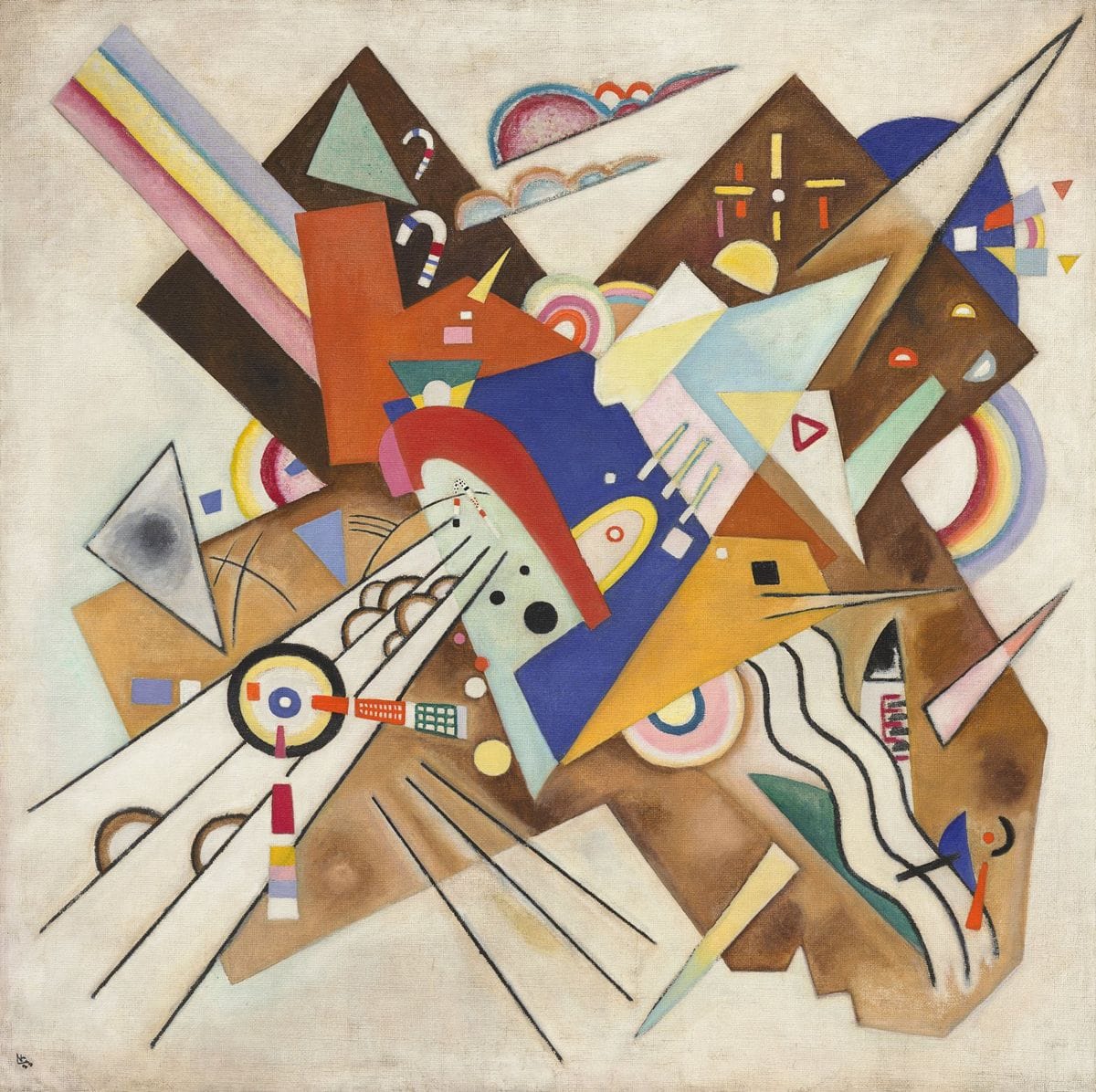
The provenance is the other reason it matters. It was the first Kandinsky owned by Hilla Rebay, the artist and adviser who steered Solomon R. Guggenheim toward abstraction. Guggenheim bought it from her in 1938, it passed to his foundation, and it left in a 1964 sale. The current owners have had it since 1986. Christie's has a short film on the painting:
How to see them before November 17
- Where. Christie's galleries at Rockefeller Center, where a broad selection of the sale is on view, free and open to the public. Christie's has not said which lots hang on which day, so check its viewing page or call ahead if one painting is the reason you are going.
- When. Daily through November 17, 10am to 5pm, Sundays from 1pm.
- The sale. The 20th Century Evening Sale is Tuesday, November 17 at 6:30pm ET, livestreamed by Christie's.
- Read first. Christie's long reads on Litzlbergkeller and Betonte Ecken are worth ten minutes before you go.
If you are planning a museum week around it, our look at Hard Art at MoMA PS1 pairs well.
Our call: the Klimt is the one to watch. The Kandinsky will get the headlines on sale night, and it has earned them. But a Klimt landscape this good, with a story this specific, does not come up often, and the last owners kept it for nearly thirty years. If you are in New York, use the free preview and stand close enough to see how flat the telescope made the trees. If you are not, put the November 17 livestream on and see where it lands.