

Most furniture is finished the day it arrives. The three shelving systems in this guide are never finished. Vitsoe's 606, USM Haller and String were each designed so you could buy a little, add more when your life changes, take the whole thing apart when you move and rebuild it in a different shape in a different room. All three are more than half a century old, all three are still made by the companies that brought them to market, and all three regularly come up whenever someone asks which modular shelving system is worth the money. They are not interchangeable, though. One hangs on the wall like a library, one stands on the floor like a small building, and one began as an entry in a publisher's competition to sell more books. Here is how they differ, and which one we would buy for which home.
The quick answer
- Buy Vitsoe 606 if you want a wall of books, records or a desk that you will keep, extend and move for the rest of your life.
- Buy USM Haller if you need closed storage that stands on its own: sideboards, media units, office cabinets and room dividers.
- Buy String if you want the warmest look, the lowest way in and a system that works just as well in a kitchen or hallway as in a living room.
Three systems, three origin stories
String, 1949: a bookshelf competition
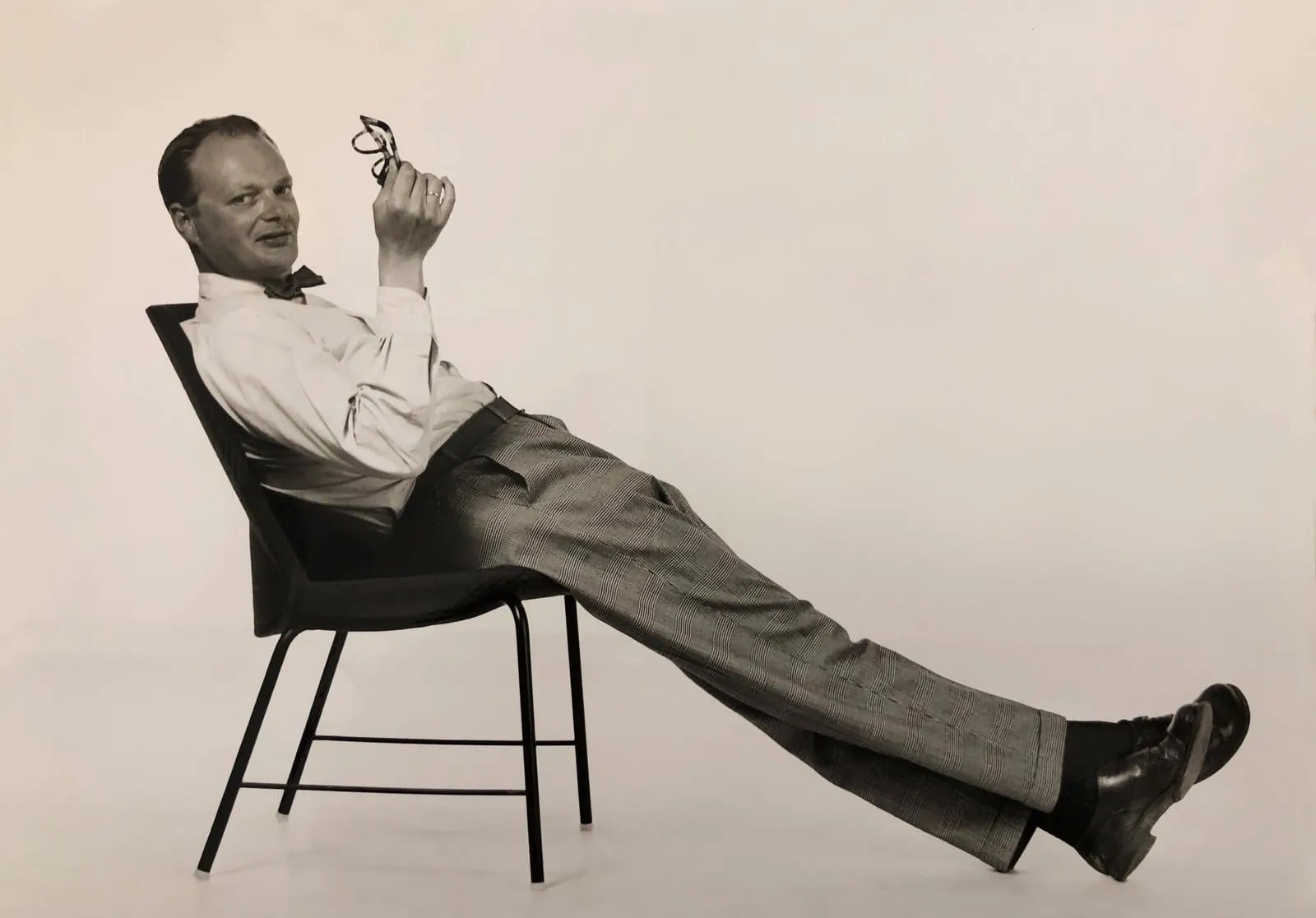
The oldest of the three was born out of a book boom. In postwar Sweden people were buying books faster than they could find places to put them, so in 1949 the publisher Bonniers Folkbibliotek ran a design competition for an affordable, wall-mounted bookshelf that could be expanded and held at least two meters of books. The architects Nisse and Kajsa Strinning, a married couple, entered a design built from just three parts: two ladder-like wire side panels that hang on the wall and shelves that rest between them. They won first prize, and String says the couple sold 40,000 sets in less than a year.
What happened next is the part most owners do not know. In 1952 String shelves were chosen for the newly built United Nations headquarters in New York, and in 1954 the system won a gold medal at the Milan Triennale, the same year the Strinnings added clear plexiglass side panels as the first big addition to the range. Then interest faded. By String's own account, the 1970s preferred disposable furniture, and the system drifted out of fashion until collectors and auction houses rediscovered Scandinavian modernism in the 1980s. In 2004 two young design entrepreneurs, Peter Erlandsson and Pär Josefsson, tracked down the Strinnings and persuaded them to put String back into production. The company says the basic construction is still identical to the original sketch.
Vitsoe 606, 1960: a young designer at Braun
Dieter Rams was 28 and working for the electrical company Braun when he designed the 606 Universal Shelving System. The furniture maker Otto Zapf had visited Rams at Braun and asked him to design furniture, and when Rams asked Braun's director Erwin Braun for permission to take on the side work, Braun agreed, reasoning that good furniture would help sell Braun radios. Zapf introduced Rams to the Danish furniture dealer Niels Vitsøe, the two businessmen founded Vitsoe+Zapf in September 1959, and the shelving system launched in 1960 under the name RZ 60.
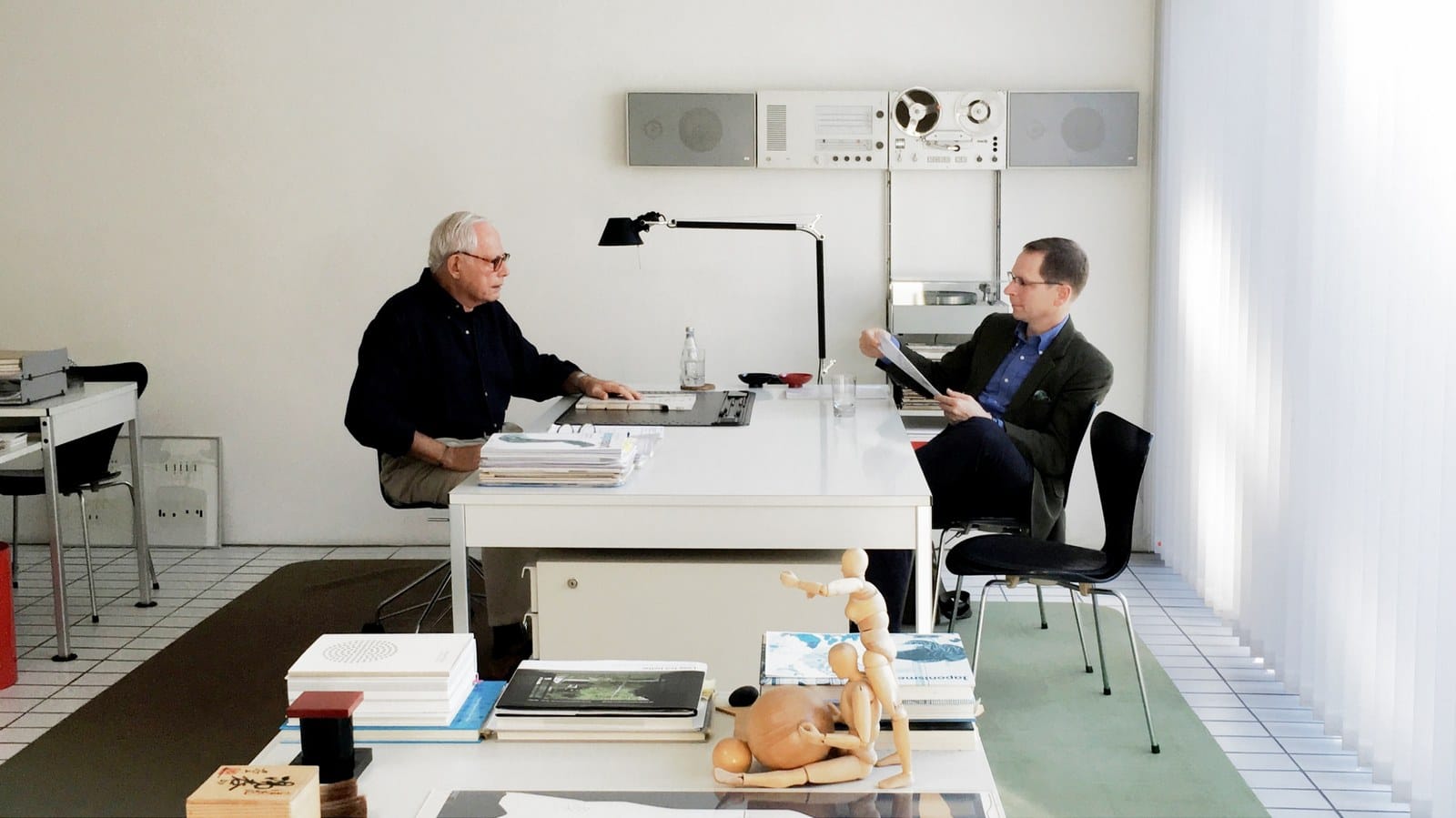
Here is the detail we love. According to Vitsoe's own history, one of the system's key measurements, a 667 millimeter center-to-center dimension, came from a Braun audio 2 radio-phonograph. The shelving was literally sized around a piece of Braun audio equipment, which is why a Rams turntable or radio still sits so naturally on a 606 shelf. The numbered names arrived in 1969, when Vitsoe renamed its products after their year of introduction: 606 for the 1960 shelving, 620 for the 1962 chair. Production moved from Germany to the United Kingdom in 1995 under managing director Mark Adams, and Vitsoe remains the exclusive licensee of Rams's furniture designs. If Rams is new to you, our guide to Dieter Rams's 10 principles of good design explains the thinking, and our look at the Braun SK4 shows the audio side of the same story.
USM Haller, 1965: a factory that became furniture
USM Haller started as architecture. The initials USM stand for U. Schärer Söhne Münsingen, a family metalworking firm near Bern in Switzerland. When the engineer Paul Schärer Jr. joined the business in 1961 he wanted a modern factory, and he hired the architect Fritz Haller, who built it from a flexible system of steel modules. The factory opened in 1965. Schärer liked Haller's modular idea so much that the two developed furniture on the same principle for the company's own offices: chrome-plated steel tubes joined by a chrome-plated ball with six threaded holes, closed in with powder-coated steel panels. Parts of the system were patented in 1965.
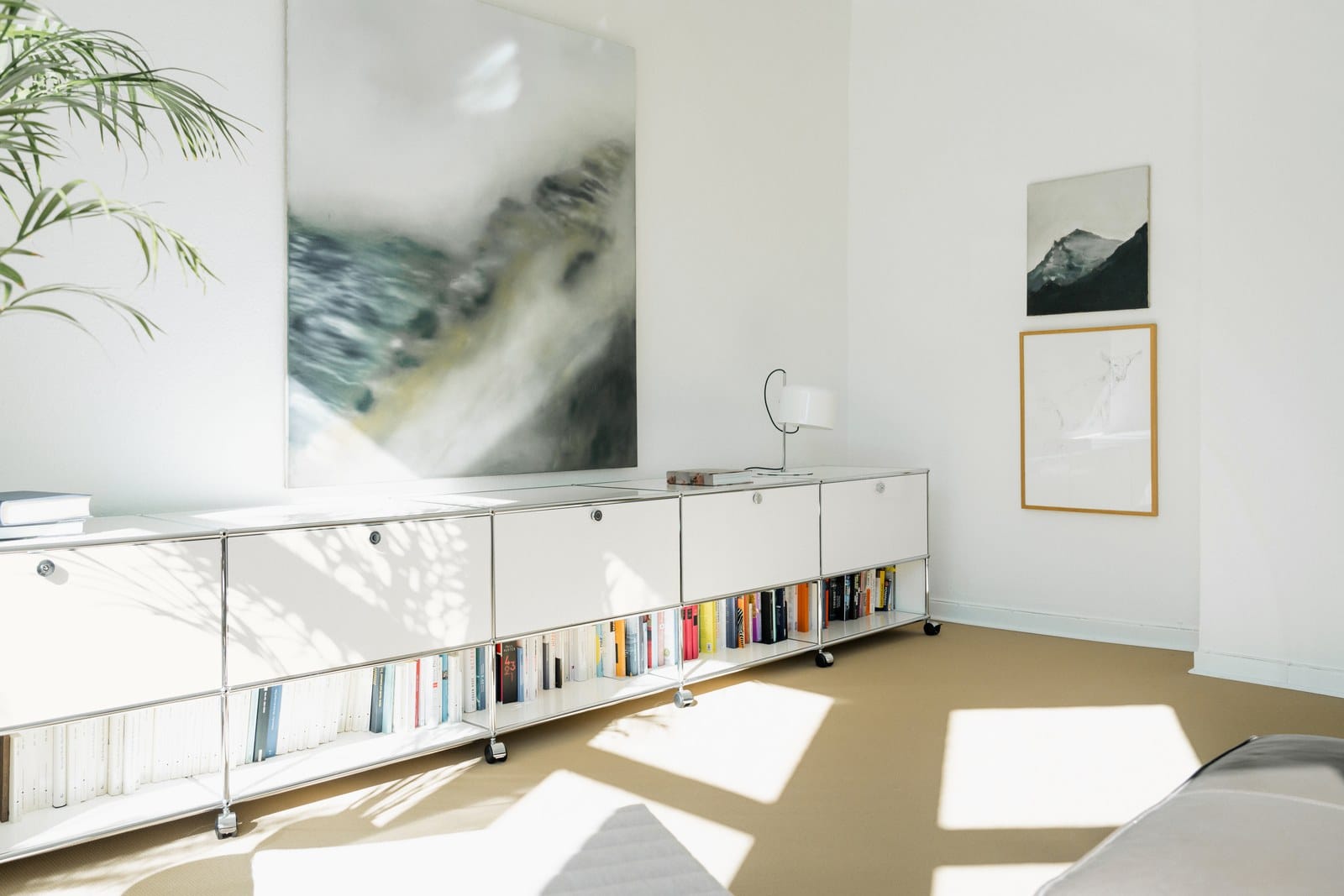
The furniture was never meant to be a product. Then the Rothschild bank in Paris asked USM to fit out an office building with 600 workstations, and series production began in 1969. USM Haller is in the collection of the Museum of Modern Art in New York, it was legally recognized as a work of applied art in 1988, and it is still made in Münsingen. We cover the parts in more detail in our USM Haller explainer.
Vitsoe vs USM Haller vs String compared
| Vitsoe 606 | USM Haller | String | |
|---|---|---|---|
| Introduced | 1960 | 1965 (series production 1969) | 1949 |
| Designed by | Dieter Rams | Fritz Haller with Paul Schärer Jr. | Nisse and Kajsa Strinning |
| Made in | United Kingdom | Switzerland | Sweden |
| How it stands | Aluminum E-Tracks on the wall, on posts in front of it, compressed floor to ceiling or freestanding | Freestanding steel frame that grows up, across and back | Wire or plexiglass side panels on the wall, or floor-standing panels |
| Main materials | Aluminum E-Tracks; shelves and cabinets in off-white, black or silver, with beech options | Chrome-plated steel tubes, chrome-plated ball joints, powder-coated steel panels | Steel wire or plexiglass side panels, wood or metal shelves |
| Colors | Off-white, black, silver and beech, deliberately limited | A fixed palette of powder-coated colors | The widest range of colors and wood finishes |
| Closed storage | Cabinets and drawers hang on the tracks | Its strength: doors, drop-fronts and drawers | Cabinets and drawer units available |
| How you buy | Direct from Vitsoe, planned with a free personal planner | Through USM showrooms, authorized dealers and online | Online and through design retailers |
| Cost to start | Premium, but you can start with a single bay | Premium, and the smallest useful piece is a cabinet | Lowest, especially with String Pocket |
| Best for | Book and record walls, home offices, libraries | Sideboards, media units, offices, room dividers | Kitchens, hallways, kids' rooms, first homes |
Vitsoe vs USM Haller: wall or floor
This is the choice people get wrong most often, because the two systems look like rivals and are really solving different problems. Vitsoe 606 is about the wall. Everything hangs from aluminum E-Tracks with a simple pin, no tools needed, so you can slide a shelf up an inch on a Sunday afternoon. There are two bay widths, 65 and 90 centimeters, and they combine to fit almost any wall; Vitsoe says a 16-foot wall alone has 27 possible combinations. If you cannot or should not drill, the tracks can be fixed to posts that are compressed between floor and ceiling, which makes 606 a surprisingly good option for renters. Shelves can even be hung upside down or turned vertical as a magnetic pinboard.
USM Haller is about volume. Its frame stands on the floor and grows in three directions, so it is at its best as a sideboard, a credenza under a television, a filing wall in an office or a low divider between rooms. It closes better than anything else here: drop-down doors, drawers and solid panels turn it into a cabinet rather than a shelf. What it does less well is a tall, open wall of books; a Haller bookcase works, but it is heavier, more expensive per foot of books and visually busier than a Vitsoe wall doing the same job.
Vitsoe vs String: the real difference
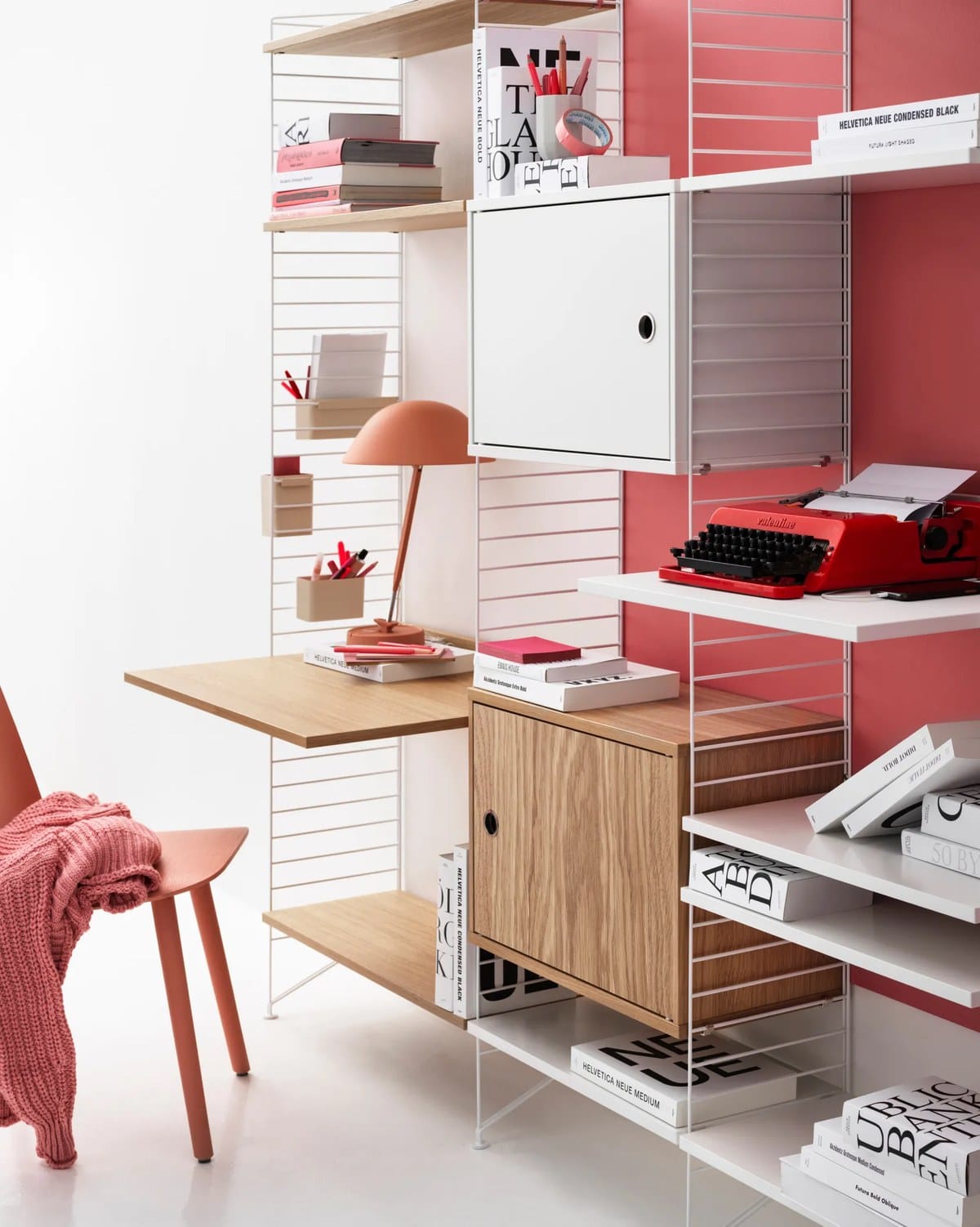
Both hang on the wall, both can take a desk, both let you add pieces over decades. The difference is in the feel and the commitment. String's wire side panels are light and almost graphic, and the range of colors, woods and accessories is far wider, so it slips easily into kitchens, bathrooms, hallways and children's rooms. It is also the cheapest way into any of these three systems, and you can start with a String Pocket, a complete small shelf that Nisse Strinning designed in 2005 as his last addition to the family.
Vitsoe is plainer and more serious. It is built for heavy loads, long runs and frequent rearranging, and the company makes a point of never changing its colors so a shelf bought this year will match one bought in twenty years. Vitsoe also behaves differently as a business: it sells only directly, charges everyone the same price, holds no seasonal sales and assigns you a planner who, by the company's own description, earns no commission and encourages you to buy less at first. Vitsoe even notes that its components often resell for about what they cost new, which is the strongest argument that the higher price is not wasted.
Which one for which home
- The serious reader or record collector: Vitsoe 606. Nothing here holds a long, heavy wall of books as calmly, and you can move it to your next home.
- The renter: Vitsoe 606 with compressed posts, or a small String setup that needs only a few wall fixings.
- The home office: Vitsoe if you want a wall-hung desk with shelves above it; USM Haller if you need lockable or closed storage for paperwork.
- The living room with a television or turntable: a low USM Haller sideboard. It hides cables and clutter and looks deliberate from every side.
- The first apartment or a tight budget: String Pocket now, more String later.
- The design collector: whichever matches the story you love; all three are museum pieces that you can still use every day.
Our call
Our call: buy Vitsoe 606 if your problem is a wall, and buy USM Haller if your problem is a room. For a lifetime of books, records and a desk, Vitsoe is the most useful and most honestly sold furniture system you can buy, and it fits the way most of us actually live. If you need storage that stands in the middle of the floor and closes, USM Haller is worth its premium. Buy String if you want the look and the history at a gentler price, starting with a Pocket. Skip the cheap lookalikes of any of the three: the whole point of a modular system is that the maker will still sell you a matching part in 2040.
Vitsoe 606 Universal Shelving System: the wall system for books, records and desks, planned free with a Vitsoe planner. See it at Vitsoe
USM Haller: the freestanding steel system for sideboards, media units and office storage. See it at USM
String System: the 1949 wire-panel system with the widest choice of colors and woods. See it at String Furniture
String Pocket: a complete small String shelf, the cheapest way to start. See it at String Furniture
Dieter Rams: The Complete Works: the full catalog of Rams's designs, including 606, for anyone weighing up a Vitsoe wall. Check price
Less and More: The Design Ethos of Dieter Rams: the larger survey of Rams's work at Braun and Vitsoe. Check price
For more on the movement behind String, read our Scandinavian design explainer. More like this: browse every related post in our Design Icons Hub.
As an Amazon Associate we earn from qualifying purchases.