Open-ear headphones exist because of a small human problem that turns out to be a large one. Sealing silicone into an ear canal is the most efficient way to deliver sound and one of the least pleasant ways to spend six hours. The ear gets sore, the world disappears, and anyone who has yanked a bud out mid-sentence to hear a coworker knows the design has a tax attached. The category answering that has been expensive, with Bose asking around $299 and Nothing's own Ear (open) arriving at $149, prices that bought a specific customer willing to pay a premium to stop something from being uncomfortable. The CMF Clip Pro is $99, with a $79 introductory window, shipping August 15 in the US, UK, and Japan.
The design is a C-shaped clip rather than a hook, with a driver housing riding in front of the ear, a counterweight behind the fold, and a 0.5mm titanium wire bridge wrapped in soft material connecting them so it flexes to whatever shape an ear happens to be. Three contact points instead of one pinch, which is the entire ergonomic argument and the right one, because clamping force distributed across three places is the difference between wearable for an hour and wearable for a workday. Each bud runs about 6.5 grams around a 10.8mm driver, with roughly ten hours per charge and 32.5 with the case, IP54, dual-device connection, and a low-latency game mode. Then the specification that does not belong at this price: LDAC support and Hi-Res certification, on a $99 product from a budget sub-brand.
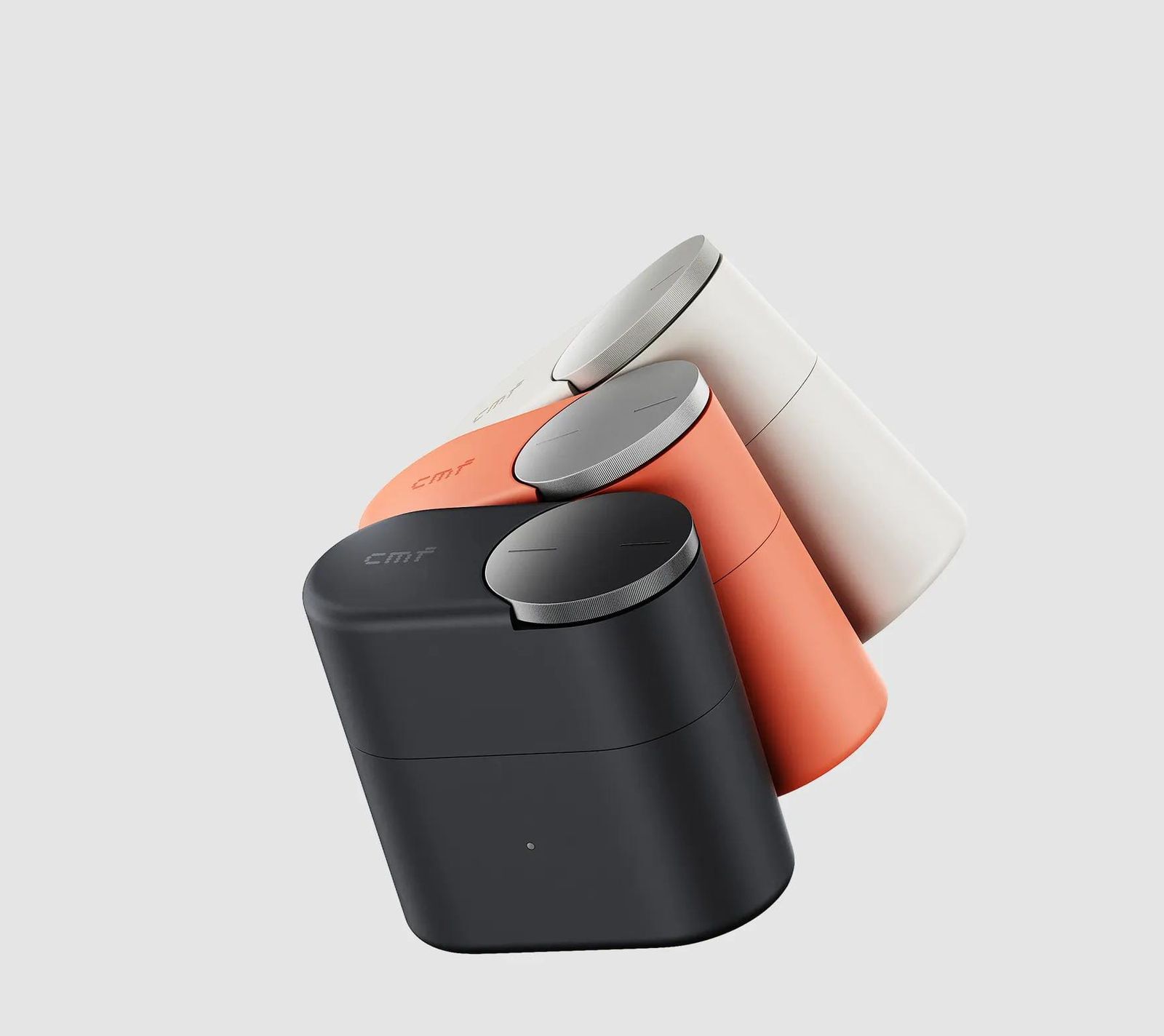
The best thing here has almost nothing to do with audio. The charging case carries a physical dial, turned for volume, clicked for playback, and held for a voice assistant, and it works while the buds are docked, turning the case into a remote for a phone in a pocket. Touch controls on earbuds are bad, and everyone knows it. They mishear taps, they fail with gloves or wet fingers, and they demand memorizing a gesture vocabulary that changes with every brand. A knob is legible to anyone who has ever used a knob. There is also a lanyard loop, which sounds trivial until you consider that the pitch for open-ear is taking things on and off constantly.
Two honest caveats. Bass is the category's structural problem, and no marketing solves it, since sealed buds create low end by sealing and removing the seal takes the bottom with it. Ultra Bass Technology is a name rather than an explanation, and processing can push perceived low end further than expected without restoring what the missing seal removed. The leakage system is the same kind of trade, pulling down mid and high frequencies so neighbors hear less, which by definition means attenuating the frequencies carrying musical detail. None of that matters much, because this is not a tool for sitting still and paying attention. It is for the hours music runs alongside something else, walking a city where traffic matters, working around people, moving through a house long enough that a sealed bud becomes a small ache. Awareness beats fidelity there, comfort beats both, and $99 is the number that makes it a daily default rather than a luxury. Available in Dark Grey, Light Grey, and Coral.