Tiny Vinyl

Tiny Vinyl

. 6 min read

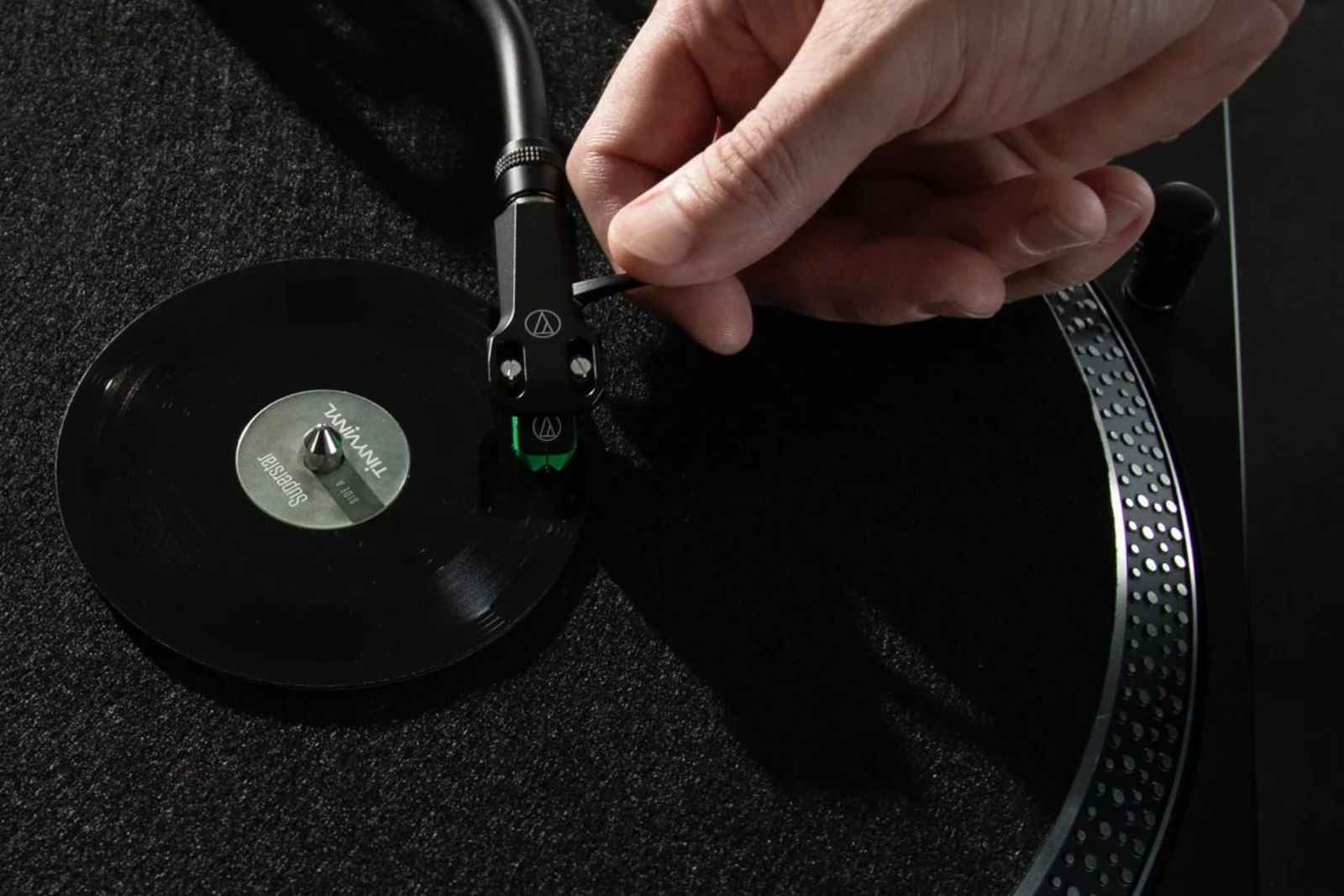
The pitch writes itself, which is usually a warning sign. Real vinyl, just tiny. Four inches across, one song per side, four minutes per side, plays on a normal turntable at 33 RPM. Fifteen grams of material against roughly 140 for a standard LP. Sequentially numbered so every copy is technically a limited edition. Twenty-six vinyl colors. Gatefold jacket, inner sleeve, the whole ritual shrunk to the size of a drink coaster.

It is adorable. That is not in dispute, and it is also not worth eight hundred words.

What's worth writing about is the thing sitting underneath the cuteness, which is that Tiny Vinyl has found a genuine gap in how the music business counts things, and that gap is the actual product.

The part nobody leads with

Tiny Vinyl sales count toward RIAA Gold and Platinum certification. They feed Luminate and Billboard. The company says so directly on its artist page, and it is buried in the middle of the pitch like a footnote.

Sit with that for a second. A four-inch novelty disc holding one song per side at $14.99 counts the same as a $35 double LP that took eight months to press. Both are one unit. The chart does not care about grams of PVC or minutes of music.

That is not a scam, to be clear. It's a format doing what formats have always done, which is exploit the definitions that already exist. The cassette revival ran a version of this play. So did the seven-inch, back when the seven-inch was the point rather than a collectible.

But it does reframe the entire proposition. For an artist evaluating this, the pitch is not "fans will find these charming." The pitch is "here is the cheapest per-unit way to move certified physical product." Everything else is packaging on that idea, and it's better said out loud than dressed in language about tactile experiences.

The physics problem

Now the part the marketing will not tell you.

A record's fidelity depends heavily on linear groove velocity, meaning how much physical groove passes under the stylus per second. On a 12-inch LP at 33 RPM, the outer edge moves fast and sounds great, and by the time the stylus reaches the inner grooves things get audibly worse. Inner groove distortion is the reason engineers have always sequenced the harsh, dense tracks early and the gentler ones last. It is a real and well-documented limitation of the format.

Now shrink the whole disc to four inches and keep the speed at 33 RPM.

Everything on a Tiny Vinyl is inner groove. The entire playable surface sits in the radius where a normal LP would already be struggling, and the innermost passages operate at linear velocities no mastering engineer would choose voluntarily. Four minutes per side at that diameter is pushing the format hard.

In practice: cymbals smear, sibilance gets crunchy, and dense mixes lose definition as the side runs out. A sparse acoustic track fares better than a loud maximalist one. Anyone pressing to this format should sequence accordingly and consider a slightly conservative master. Anyone buying one to hear a favorite song in its best possible presentation has chosen wrong, and that's fine, because that isn't what this is for.

Small records are very old news

There is a persistent framing around this product that treats miniature vinyl as an invention. It isn't.

Bubble Books paired storybooks with five-inch discs starting in 1917. Hip Pocket Records, made by Philco under Ford in the late sixties, ran roughly three and seven-eighths inches, sold in colorful sleeves with two tracks, and carried real artists from real labels. The format existed, worked, and died, mostly because the fidelity was compromised and the novelty wore off.

None of that means Tiny Vinyl will fail. Conditions are different now. Physical music in 2026 is largely a merchandise and collectibles business rather than a listening business, and a product optimized for collecting rather than listening is correctly designed for the market it's actually in. But the historical amnesia in the coverage is worth naming, because "nobody has ever done this" is doing persuasive work that "people did this and it stopped" would not.

What's actually in the catalog

The release library is the fastest way to understand what this format is for, and it is not subtle. Alanis Morissette pairing "Ironic" with "Hand In My Pocket." Miley Cyrus pairing "Party in the USA" with "Time of Our Lives." Daddy Yankee's "Gasolina." Disney catalog from Aladdin. The KPop Demon Hunters soundtrack.

These are not deep cuts. Every one of them is a song a shopper recognizes in half a second while walking past an endcap, which is exactly the point. The format is optimized for recognition, not discovery.

The K-pop side is the more interesting business. Tiny Vinyl runs an ongoing release program with the independent label hello82, and titles from Monsta X and P1Harmony have moved through hello82's shop rather than mass retail. That's a fandom with proven physical-purchase behavior and a tolerance for numbered variants, and it's a better fit for this product than a general Target shopper. Watch that lane rather than the celebrity drops if you want to know whether the format survives.

New releases post first to @tinyvinylrecords, which functions as the actual release calendar. The website lags it.

The economics for an actual indie artist

Here is where a straight answer would help and isn't available.

Minimum order is 500 units. Tiny Vinyl doesn't publish per-unit pricing, quoting case by case instead with a single all-in per-item number covering mastering and plates. Their artist page states plainly that the minimums aren't suited to personal or hobby projects, which is a more honest disclosure than most manufacturers bother with. Quotes come through info@tinyvinyl.com.

But 500 units is 500 units. A small artist is committing real money and real garage space against a format their audience may or may not want, and finds out which after the boxes arrive. The retail comparison to a $35 LP is favorable, and the Target collection does most of its business at $14.99, but a merch table is not Target and the margin at the merch table is the only number that matters.

The honest read: this works for artists with a touring audience large enough to move 500 impulse purchases in a year, or for labels running a release program where the numbered-edition angle can be marketed properly. For a project that sells forty records a year, the math is not there, no matter how good the object looks.

The player is a tell

There is now a dedicated $49.99 Tiny Vinyl player at Target. Belt drive, built-in speakers, Bluetooth out, clamshell case.

That's quietly revealing. The core claim of the format is that no special equipment is needed, and mostly that's true, with the caveat that the tonearm must reach the center of the platter and auto-stop and auto-return have to be disabled. The company covers this in its FAQ, to its credit, but that caveat rules out a meaningful number of consumer turntables, and the people most likely to buy a cute four-inch record are exactly the people least likely to own a manual deck or know what auto-return is.

So the player exists to close that gap, and its existence proves the gap was real. It also signals where this is heading: a self-contained ecosystem of small records and a small machine, sold together, which is a different business than "real vinyl for your existing setup" and a more durable one.

The green claim, carefully

Fifteen grams instead of 140 is a real reduction, and shipping weight reductions compound in a way that matters. That part earns credit without hedging.

"One hundred percent bio-attributed vinyl" deserves more scrutiny than it usually gets. Bio-attributed generally refers to a mass-balance accounting method: renewable feedstock enters a producer's overall supply chain, and an equivalent amount of output gets certified against it. It's a legitimate industrial practice and it does drive renewable feedstock adoption. It is not the same claim as "the disc in your hand is made of plants," and the two get blurred constantly.

The larger question is one no manufacturer will engage with: a product that exists to be collected rather than played is additive consumption. It is not replacing an LP purchase. It is an extra object, produced and shipped and eventually discarded, and being small does not make it net negative. Fifteen grams of something nobody needed is still fifteen grams.

Where this lands

All of the above reads harsher than the verdict warrants.

It is a well-made object solving a real problem, which is that the price of entry to physical music has gotten absurd and there was nothing between a $2 sticker and a $35 record. Filling that gap with something that spins is a better answer than another enamel pin.

Buy one to keep a small piece of a favorite artist on a desk. Don't buy one expecting it to sound like a record, because the diameter will not allow it. And any artist considering a run should get the quote, do the merch table math honestly, and be certain the purchase is chart eligibility and the object itself, because those are what the money is actually buying.


Go look

Tiny Vinyl records retail at $14.99 through Target and select artist partners. Artist and label inquiries start at a 500-unit minimum.


Comments