
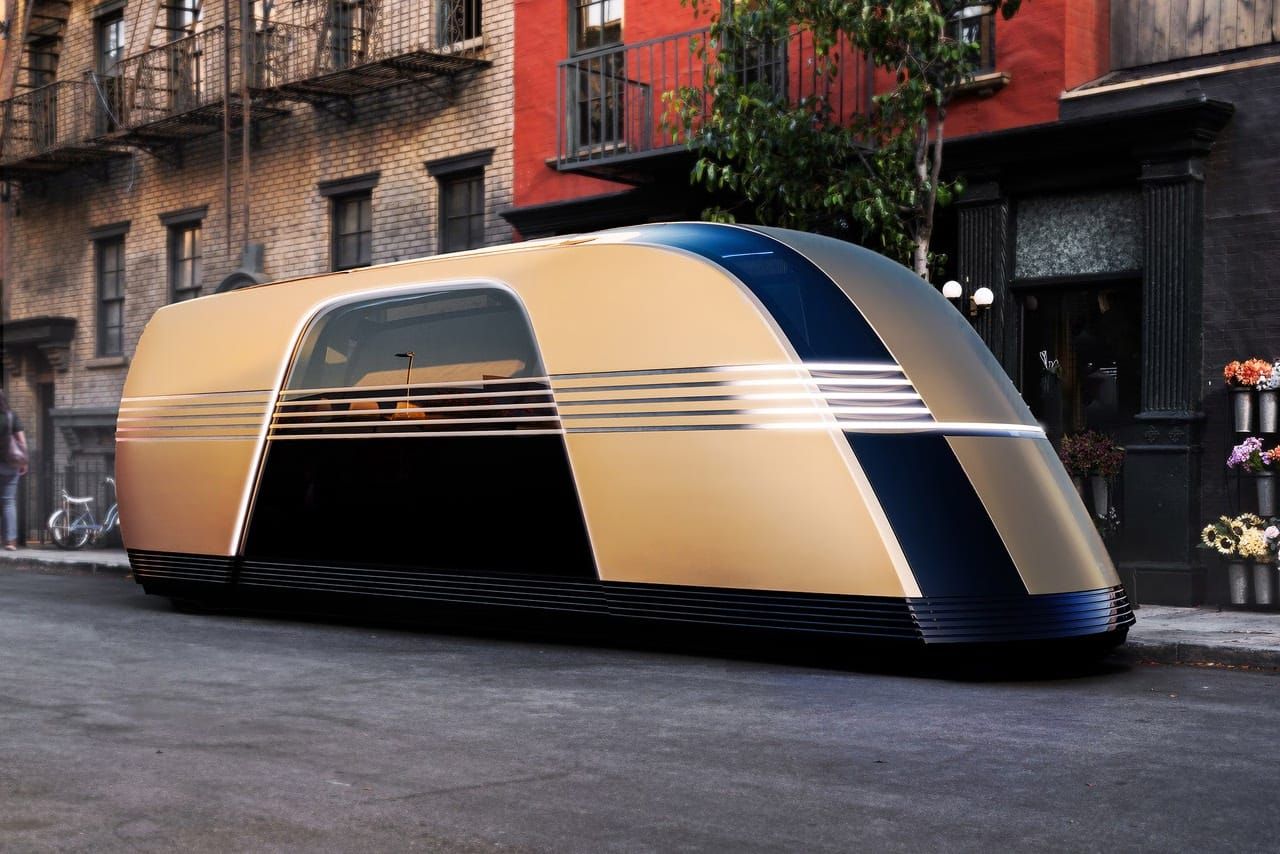
When Tesla revealed the Robovan at its "We, Robot" event in October 2024, it stole the show from the car it was meant to support. The night was supposed to be about the Cybercab, Tesla's two-seat robotaxi. Then a low, silver, windowless thing that looked like an Art Deco train car glided up to the stage, and 14 people stepped out of it. Musk's line: "We're going to make this, and it's going to look like that."
Here is what was shown, and where it stands now.
What the Robovan is
The Robovan is a fully autonomous electric van. Like the Cybercab, it has no steering wheel, no pedals, and no driver's seat. In its passenger setup it seats up to 20 (the prototype on stage had 14), and Tesla pitched it as a shape-shifter: a shuttle, a cargo van with the seats stripped out for last-mile delivery, an RV, a mobile shop, a service vehicle. Musk framed it as autonomous transport for groups or goods.
The design is the part nobody forgets. Tesla took 1920s and 1930s streamliner styling and pushed it forward: a smooth nose with no visible windshield, wheels tucked under the body, lighting strips along silver metallic sides, and a ride height so low the thing looks like it is hovering. Both ends have a trunk, and the doors slide. Musk repeated a line he has used before: "The future should look like the future."
On cost, he claimed the Robovan could operate at 5 to 10 cents per mile per passenger. For context, he pegged the Cybercab at around 20 cents per mile to operate, and a city bus at roughly a dollar per passenger mile. Like the Cybercab, it would charge wirelessly through an induction pad, with no plug.
The catch nobody put on the slide
Here is what the original hype skipped. At the reveal, the Robovan only pulled up and parked. It never drove anyone anywhere, unlike the Cybercabs, which gave rides around the mapped studio lot at low speed. Tesla showed no battery, no range, no motor specs, no dimensions, no price, and no firm release date. Until someone can examine one up close, it is a concept car wearing a very good suit. Analysts at the event called the timeline ambitious and flagged the obvious wall: a vehicle with no steering wheel has to clear autonomous-driving certification and win over regulators in every market it wants to run in.
There is one interesting counterpoint, though. The Robovan may be easier to deliver than the robotaxi, not harder. A shuttle that runs a fixed loop, like an airport route, a campus line, or a summer beach run, operates in a small, mappable area that is far simpler to automate than a car that has to go anywhere a rider asks. The autonomy stack is the same either way, but the operating problem is much smaller.
Where it stands now
Almost two years on, the Robovan has gone quiet, and not by accident. At Tesla's November 2025 shareholder meeting, the company gave its first real update since the 2024 reveal, and the takeaway was that the Robovan has been de-prioritized. There is still no confirmed launch date. Analysts now put 2028 as the earliest realistic year, and some estimates run later. The "2027" figure that floated around at launch was the Cybercab's target, not the Robovan's, which never got a firm one.
Tesla's attention in 2026 has gone to the refreshed Model Y, the Cybercab robotaxi program, and Optimus, the humanoid robot it now treats as its biggest bet. The Robovan shares its self-driving foundation with the Cybercab, so its fate is tied to that program. If the robotaxi works at scale, the Robovan becomes plausible. If it stalls, so does the van. A prediction market in April 2026 priced the odds of Tesla even opening Robovan orders before 2027 at about 17 percent. Tesla's bigger vehicle programs have a habit of landing 12 to 24 months past their first promises, the Cybertruck being the obvious example.
Musk keeps the embers warm. He replied "It's coming" to a Robovan clip on X in late 2025, and in March 2026 teased something way cooler than a minivan. There is even chatter it could be renamed the "Robus." None of that is a production line.
The verdict
The Robovan is one of the boldest vehicle concepts any carmaker has shown in years, and right now it is parked. The design is striking enough that Tesla insists it will reach production unchanged, the use case is sound, and the cost math, if it ever holds, would reshape how short-route transit works. But it sits downstream of a robotaxi program that is still proving itself, behind a robot Tesla cares about more, and up against regulators who move slowly on driverless vehicles. Watch the Cybercab. The Robovan rides on it.




%20Officially%20Launches%20in%20the%20US%2C%20but%20Skips%20Verizon)
