
The best indie games rarely need the most powerful hardware. They need a screen you want to hold, controls that fit the idea, and a store that lets small studios get noticed. That is why the handheld has become the natural home of independent games, and why the right handheld for indie players is not always the one with the biggest specs sheet. A crank, a cartridge slot or a curated release schedule can matter more than teraflops.
These five handhelds each serve indie games in a different way. Prices are from official stores at the time of writing where they were listed.
Unknowndivide may earn a commission from purchases made through links in this guide. As an Amazon Associate we earn from qualifying purchases.
Steam Deck OLED: the biggest indie library, period
If you want access to the largest catalog of independent games ever assembled, the answer is Valve's Steam Deck. Released in February 2022, it is a handheld PC running SteamOS, a Linux-based system that uses the Proton compatibility layer to play Windows games. The OLED model improved the screen and battery life, and it is the version to buy. Indie games are where the Deck shines brightest: most run beautifully, Valve's Verified program flags which titles work well, and Steam sales make a backlog cheap. It is bigger and heavier than everything else here, and it is a computer, with all the fiddling that implies. Valve sells it direct.
Nintendo Switch 2: the best-curated store for indies
The original Switch became an indie powerhouse because Nintendo's eShop gave small games a front page alongside Mario. The Nintendo Switch 2, released in June 2025, continues that role with a larger 1080p screen at up to 120 Hz in handheld mode, magnetic Joy-Con 2 controllers, more storage and backward compatibility with most of the Switch library. That last point matters most: years of indie releases are already waiting. It is the best choice for anyone who wants indies and Nintendo's own games on one device. See the Nintendo Switch 2 on Amazon.
Playdate: the indie handheld by design
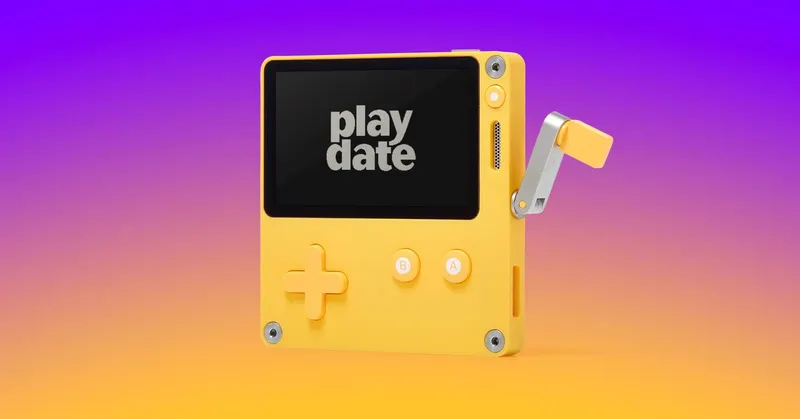
Panic's Playdate is the only console on this list built entirely around small, strange games. It has a black-and-white screen, a D-pad, two buttons and a mechanical crank that does not charge the battery, as Panic cheerfully notes, but does drive some of the most inventive control schemes in gaming. Panic lists it at $229. Games arrive through curated Seasons delivered a couple at a time, plus Panic's Catalog store and a large community scene on itch.io. Unknowndivide explained why that slow drip works in Playdate Season Three Makes the Case for Less.
Analogue Pocket: new games on old cartridges
The Analogue Pocket uses FPGA chips to recreate original hardware rather than emulating it in software, and it plays the more than 2,780 Game Boy, Game Boy Color and Game Boy Advance cartridges out of the box, with adapters for other handheld systems. Analogue lists it at $239.99. For indie fans, the hidden draw is the modern homebrew scene: new Game Boy games, many built with the free GB Studio tool, are still released on physical cartridges today. The Pocket is the best way to play them. Analogue's obsession with hardware accuracy extends to the living room with the FPGA-based console Unknowndivide covered in Analogue 3D: The N64 Rebuilt in Silicon.
Retroid Pocket Nova: Android power for less
Android handhelds are the wild card. They run the mobile versions of many indie games, game streaming apps and emulators. The Retroid Pocket line has become the enthusiast favorite, and the Nova pairs a former flagship phone chip with a 4.5-inch 120 Hz AMOLED screen, hall-effect sticks and active cooling. Unknowndivide broke down why that matters in Retroid Pocket Nova: A Flagship Phone Chip in a Handheld. It is the best choice for tinkerers who want one device for everything and do not mind setting it up.
What matters more than specs
The screen. Indie games lean on art direction rather than polygon counts, so screen quality matters more than processing power. OLED panels, like those on the Steam Deck OLED and the Retroid Nova, make pixel art and dark scenes look dramatically better. The Playdate's reflective black-and-white display is the exception that proves the rule: it has no backlight, and many of its games are designed around that.
Size and battery. A handheld you leave on the shelf plays nothing. The smaller machines here go in a jacket pocket; the Steam Deck goes in a bag. Be honest about where you play.
The store. Discovery is the hardest problem for indie developers, and every platform solves it differently. Curated stores surface fewer games but better ones, while open stores have everything and make you dig.
How to choose
Pick the Steam Deck if you already have a Steam library or want the most games for the least money per title. Pick the Switch 2 if you want the cleanest experience and Nintendo's first-party games alongside indies. Pick the Playdate if you love games as art objects and want something nobody else in the room has. Pick the Analogue Pocket if you collect cartridges or want to support the homebrew scene. Pick a Retroid if you like tinkering more than playing.
Where to find the games
Beyond the official stores, itch.io is the largest open marketplace for independent games, and it hosts a large collection of Playdate games, Game Boy homebrew and PC games that run on the Steam Deck. It is also where narrative games like Fishbowl, a game about grief from a two-person studio, find their earliest players.
The common thread is that none of these machines tries to win a spec war. The best indie handheld is the one that makes small games feel big.
More in our Desk & Everyday Carry hub.