The smartphone won. It is the camera, the wallet, the map, the newspaper and the slot machine in your pocket, and for many people that last part has become the problem. A small but growing industry now builds phones that deliberately do less: fewer apps, calmer screens, no infinite feeds. These are not nostalgia toys. The best of them are carefully designed objects that make a real argument about how much technology a person needs. Here are the four minimalist phones worth considering, plus an honest look at who should skip them entirely.
Unknowndivide may earn a commission from purchases made through links in this guide. As an Amazon Associate we earn from qualifying purchases.
Light Phone III: the purist's choice
Light, the Brooklyn startup behind the Light Phone III, describes its products as designed to be used as little as possible, and the third generation sticks to that philosophy while adding a better screen, a real camera and 5G. Announced in June 2024 as the 5G successor to the 2017 original and the 2019 Light Phone II, it has a matte black body, a 3.9 inch monochrome AMOLED touchscreen and a 50 megapixel rear camera with an LED flash. The back cover is held on with screws, giving access to a user replaceable battery. The software offers the essentials, including calls, texts, music and navigation, and deliberately leaves out social media, a web browser and email. Check Light's site for current pricing and service plans. We covered its launch in our Light Phone III story, and it remains the most uncompromising phone here.
Mudita Kompakt: the E Ink option
The Mudita Kompakt takes the calm of an e-reader and puts it in a phone. Its 4.3 inch E Ink touchscreen has an 800 by 480 resolution and a matte mineral glass cover, and it runs MuditaOS K, a custom de-Googled version of Android's open source base. The specs read like a tool rather than a toy: a 3,300 mAh battery rated for up to six days of standby, USB-C and wireless charging, an 8 megapixel camera, a 3.5 mm headphone jack, a microSD slot and IP54 dust and splash resistance. It weighs 164 grams. The North American version lists at $399 in the official store. Choose it if you want a phone your eyes can rest on.
See the Mudita Kompakt on Amazon
Punkt. MP02: the design object
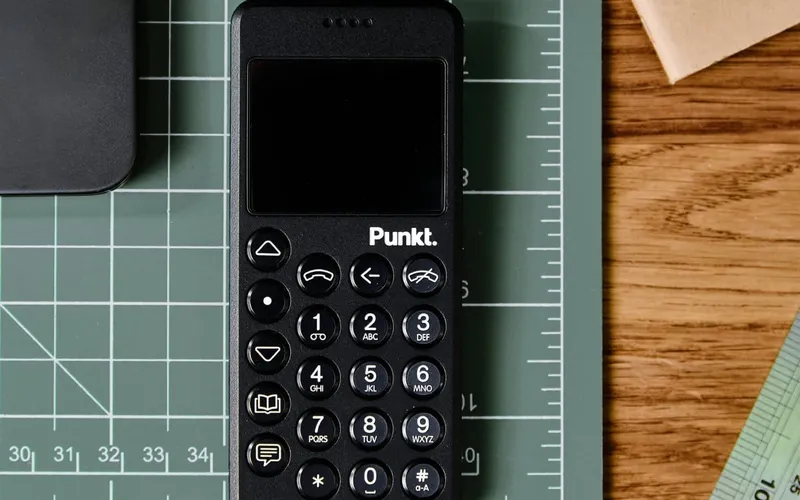
The Punkt. MP02 is the only phone here with a real keypad and the only one designed by a famous industrial designer. Jasper Morrison, the English designer known for the apparent simplicity of his work and for saying that objects should never shout, gave it its soft, rounded form. It is a 4G phone that handles calls and texts, supports Wi-Fi tethering for the days you need a laptop online, and offers encrypted messaging through Pigeon. It starts at $299. It is the phone for people who want a second device for weekends, or who have decided that a phone should be just a phone.
Minimal Phone 2: the keyboard comeback
Minimal Company's Minimal Phone 2 is the most smartphone-like device here, which is exactly its appeal for people who cannot give up banking apps or maps. It is a 4 inch phone with a physical keyboard, now touch capacitive so you can scroll and navigate without reaching for the screen, and a 3,400 mAh battery. The company switched from the e-paper display of the original model to OLED for this version and explains the decision on its journal. It ships with Android, Google Play Services and the Play Store, and Minimal Company says it will release an official de-Googled ROM that owners can install themselves. It costs $599 in pearl or onyx with 256 GB of storage, and it is scheduled to ship in December 2026, so treat it as a preorder.
What to check before you buy
Start with the network. Minimalist phones come from small companies, and carrier support varies by model and region, which is why Mudita sells a dedicated North American version of the Kompakt. Confirm that the phone works on your carrier before you order, and check whether it supports eSIM if your plan requires it. Next, list the few things you genuinely need a phone to do. For most people that means calls, texts, maps and music, plus a hotspot for the occasional laptop session. Finally, think about the camera. A phone that takes poor pictures will push you straight back to your smartphone, which defeats the point.
Who should skip all of them
A minimalist phone works best as a deliberate choice, not a punishment. If your job depends on two factor authentication apps, ride hailing or a company messaging tool, a phone without them will make your life harder, not calmer. Many people do better with a hybrid approach: keep the smartphone, but leave it in a drawer on evenings and weekends and carry one of these instead. The free version of the experiment is worth trying first. Switch your current phone to grayscale, delete the apps you open out of habit, and move everything else off the home screen. If that feels like relief rather than withdrawal, you are ready for dedicated hardware.
Related reading
If you care about longevity as much as focus, read about the Fairphone (Gen 6) arriving in the US, a smartphone built to be repaired. And for a stranger way to shrink your phone, see the elrow Miniphone Ultra, which turns an Apple Watch Ultra into a tiny handset.
The best phone may be the one you forget you are carrying.
More in our Desk & Everyday Carry hub.