Electronic music has always had a credibility problem on the page. For decades rock got the biographies and the canon while the machines got a paragraph about "bleeps." That changed in the late 1990s, when a handful of critics, DJs and historians started treating house, techno, ambient and the synthesizer itself as subjects worth serious, obsessive attention. The eight books below are the ones worth owning. Together they cover the whole story, from Victorian sound experiments to the warehouse, and every one of them will change how you hear a record you thought you knew.
Unknowndivide may earn a commission from purchases made through links in this guide. As an Amazon Associate we earn from qualifying purchases.
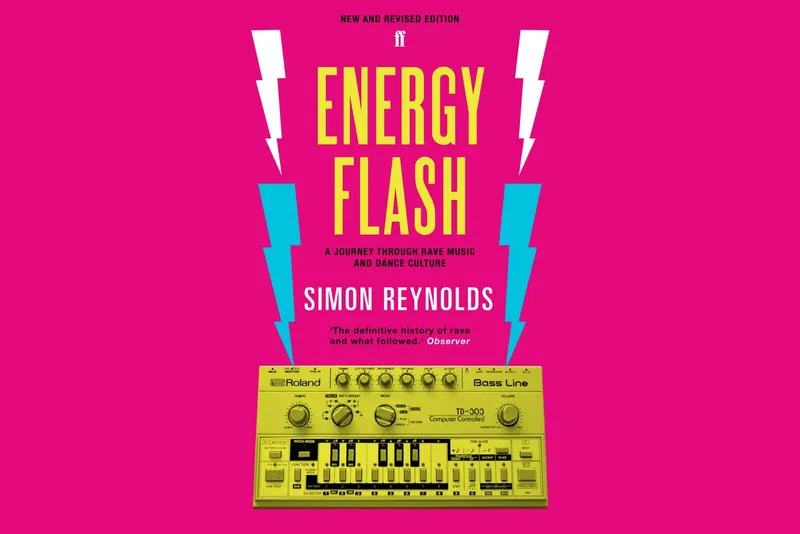
Energy Flash by Simon Reynolds
If you only read one book on rave culture, make it this one. The English critic Simon Reynolds, who started out at Melody Maker in the mid 1980s, first published Energy Flash in 1998. The American edition, retitled Generation Ecstasy, followed in 1999, and updated editions in 2008 and 2013 extended the story into dubstep and the American EDM boom. Faber describes it as the definitive chronicle of electronic dance culture, and that is not an overstatement. Reynolds traces the line from Chicago house and Detroit techno through Ibiza, Madchester and the free party scene to jungle, UK garage and grime, writing as both a fan on the dancefloor and a critic with a theory for everything. The current US paperback from Soft Skull Press runs 608 pages and never drags.
Last Night a DJ Saved My Life by Bill Brewster and Frank Broughton
Published in 1999, Bill Brewster and Frank Broughton's history of the disc jockey made a simple argument that was radical at the time: the DJ is an artist, not a jukebox. The book follows the figure from the earliest days of radio through the births of disco, hip-hop, house and techno, and in 2006 The Observer ranked it number 45 on its list of the greatest music books. A revised edition from Grove Press arrived in February 2025, a quarter century after the original, adding new stories and paying overdue attention to the women DJs who forced their way into a male dominated booth. At 672 pages it is a doorstop, but it reads like a night out told by the people who were there.
See Last Night a DJ Saved My Life on Amazon
Techno Rebels by Dan Sicko
Techno was born in Detroit and grew famous in Europe, and Dan Sicko's book exists to make sure nobody forgets the first half of that sentence. Techno Rebels: The Renegades of Electronic Funk is a compact insider's history built on interviews, firsthand anecdotes and artist profiles, focused squarely on the city that incubated the sound. The updated and expanded edition from Wayne State University Press, published in 2010 with a foreword by Bill Brewster, runs just 176 pages. It is the quickest read on this list and the best primer on why Detroit still matters.
Altered State by Matthew Collin
Where Reynolds writes about the music, Matthew Collin writes about the people and the chemistry. Altered State: The Story of Ecstasy Culture and Acid House tracks the scene's origins through psychedelic subcultures, underground gay discos and the Balearic idyll of Ibiza, then follows the money, the myths and the criminal underside that the blissed out image tends to hide. Irvine Welsh called it a "marvellous piece of work." The updated 2010 edition from Serpent's Tail is the one to find, and it pairs perfectly with Energy Flash as the social history of what was, in Britain at least, the most spectacular youth movement of its century.
Analog Days by Trevor Pinch and Frank Trocco
Before the dancefloor there was the machine. Analog Days: The Invention and Impact of the Moog Synthesizer, published by Harvard University Press, tells how an engineering student at Cornell and an avant garde musician working out of a California storefront set off a revolution in sound. Those two figures are Robert Moog and Don Buchla, and the book goes back to the 1960s and early 1970s, when the synthesizer was an experimental instrument and a concert could turn into a happening. The late Trevor Pinch, a Cornell sociologist and part time musician, brings real rigor to the story, built on interviews with the pioneers themselves. Anyone who has lost an evening to a patch cable, or to the modern instruments that still carry the Moog name, should read it. For a sense of how strange early electronic instruments could be, see our piece on Sound Workshop's revival of a forgotten 1930s synthesizer.
Ocean of Sound by David Toop
David Toop is a musician, sound artist and longtime writer for The Wire and The Face, and a former member of the new wave band The Flying Lizards. His 1995 book Ocean of Sound is less a history than a drift. It begins in 1889 at the Paris exposition, where Debussy first heard Javanese gamelan, and wanders from the Amazon rainforest to Tokyo by way of Brian Eno, Sun Ra, Erik Satie, Kate Bush, Kraftwerk and Brian Wilson. It remains the essential book on ambient sound and the art of listening. Serpent's Tail reissued it in 2018.
Future Days by David Stubbs
West Germany after the Second World War was a country estranged from its own recent history, and out of that vacuum came Faust, Neu!, Cluster, Ash Ra Tempel, Amon Düül II, Can and Kraftwerk. David Stubbs's Future Days argues that these bands, drawing on Stockhausen, Eastern mysticism and the repetition of industry and the autobahn, shaped not only rock but hip-hop and electronic music. The US edition, published by Melville House in 2015 and subtitled Krautrock and the Birth of a Revolutionary New Music, runs 512 pages. It is the best explanation of where Kraftwerk came from and why their influence never stopped spreading.
Mars by 1980 by David Stubbs
Stubbs's follow up zooms all the way out. Mars by 1980: The Story of Electronic Music charts the whole arc, from the earliest mechanical experiments of the late nineteenth century through avant garde composition, Stevie Wonder and Giorgio Moroder, the BBC Radiophonic Workshop, Depeche Mode, Pet Shop Boys and Laurie Anderson, right up to today's underground. Faber published the paperback in 2019. Read it as the wide angle survey that puts every other book here in context. It also makes a good case for oddball software milestones like Music Mouse, which belong in the same lineage of mavericks building new instruments from whatever technology was at hand.
Where to start
Start with Energy Flash if you came to electronic music through clubs, Ocean of Sound if you came through headphones, and Analog Days if you care more about the instruments than the records. Read Techno Rebels in a single afternoon, then put on something from Detroit. If you want more reading once you are done, the Boards of Canada tribute book is a fine example of how fans now document this music, and the strange history of Soviet bone music is a reminder that people will go to extraordinary lengths to hear the sounds they love.
The machines finally have their literature. It is time to read it.
More in our Electronic Music Labels hub.