Hans Rudolf Giger grew up in Chur, a small Swiss town, obsessed with skulls and mummies in a way that unsettled his neighbors long before it made him famous. He trained in architecture and industrial design in Zurich, not fine art, and it shows in the work that followed: airbrushed paintings where human bodies fuse into machinery with the precision of technical drawings, a style he eventually just called biomechanical. His actual breakout came in 1973, when the prog band Emerson, Lake and Palmer commissioned him for the cover of Brain Salad Surgery, a metallic skull that unfolds to reveal the face of his own partner at the time, Li Tobler, complete with a lobotomy scar he painted onto her. It's still on most lists of the best album covers ever made, and it wasn't even his strangest idea yet.
Four years later he published Necronomicon, a book of his paintings that found its way to screenwriter Dan O'Bannon, who pushed Ridley Scott to hire Giger for a small science fiction film called Alien. One lithograph, Necronom IV, became the basis for the creature, and the design that came out of it, elongated skull, no visible eyes, an inner jaw that strikes independently of the outer one, remains one of the two or three most recognizable monsters film has ever produced. Giger won the Oscar for visual effects in 1980, at which point he was already deep into a second career most moviegoers never connected to the first. Debbie Harry hired him for her 1981 solo album KooKoo, a cover so unsettling the London Underground refused to display the promotional posters. Metal bands lined up next, Celtic Frost, Danzig, Carcass, the Swiss project Triptykon founded by his own longtime collaborator Tom Fischer. The Dead Kennedys used one of his paintings as a fold-out poster inside Frankenchrist, and the resulting obscenity charges against singer Jello Biafra actually went to trial in California, a fight the band won but one that helped shape the PMRC-era battles over what music could legally include.
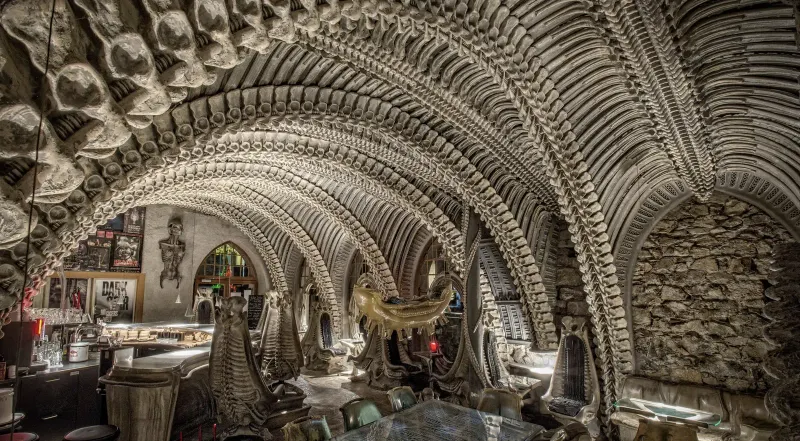
By the time Giger died in 2014, at 74, following a fall in his Zurich home, he'd stopped painting almost entirely and moved into three dimensions instead, designing an entire bar inside a four-hundred-year-old castle in Gruyères, vertebral arches crisscrossing the ceiling, chairs with backrests shaped like pelvic bones, the whole room built to feel like standing inside something that used to be alive. It opened in 2003 next to the museum he'd already built to house his own collection, and both are still running exactly as he left them. This March, a selection of his work went up at the New Museum in New York as part of the exhibition marking the building's expansion, framed explicitly around how prescient his fusion of body and machine now reads in an age actually building the thing he spent fifty years painting. Most artists get reassessed after they're gone. Giger mostly just gets caught up to.
Dark Star: H.R. Giger's World, official trailer
Related: Nathan Kostechko x UAG: A Memento Mori Collector's Box · Thomas Hooper's Temple Sonar A Print From the Artist the Whole World Wears
More in our Design & Art hub.