Before he was anyone's producer, Mark Ellis was a middling bass player in a mod revival band called the Lambrettas, the kind of gig that teaches you what you're not going to be. What he actually had, it turned out, wasn't a player's hands, it was a listener's ear, and the way he found that out was by taking a job as a runner in a London recording facility not long after leaving school, not yet twenty. He moved between rooms at Morgan Studios and Battery Studios, picking up apprenticeships along the way at Marcus and Trident, doing the unglamorous work runners do. The name, the story goes, comes from that era: being the one who never stopped supplying tea and sandwiches to a room recording The Cure while everyone else's attention flagged. It's a small detail, but it's the whole method in miniature: notice what the room needs before anyone asks, and keep supplying it.
That habit of paying closer attention than his job required is what actually moved him up. He went from runner to house engineer inside a few years, then freelance by 1981, the same year he landed his first real credit as assistant engineer on New Order's Movement, a debut album by a band figuring out who they were after Joy Division. The following year he engineered Ministry's first album, With Sympathy, a strange, glossy synth-pop record from a band that would later become something much harder, and a strange place for someone who'd end up as one of industrial music's defining producers to start. Neither record made him famous. Both taught him what a room full of people still finding their sound actually needs from the person behind the desk.
The real education came through Some Bizzare, Stevo's label for the art-damaged fringe of British post-punk, where Flood found himself engineering and mixing for Cabaret Voltaire, Psychic TV, and Marc Almond's side project Marc and the Mambas. This wasn't chart music. It was confrontational, half-improvised, built by people who didn't think in verses and choruses, and it forced him to develop an ear that could find structure in material that resisted it. That ear is what got him noticed by Mute Records, and Mute is where he stopped being an engineer and became a producer for the first time. His first true production credit was Nick Cave and the Bad Seeds' From Her to Eternity, followed by The Firstborn Is Dead, records built on discomfort and restraint rather than polish. That's the actual origin point, not the tea-and-name story, not the eventual Grammy: the moment Mute trusted a former runner to shape the record instead of just capturing it, on an artist who needed someone willing to let the ugliness stay in the mix.
Everything that came after was that same instinct applied at greater scale. Erasure's Wonderland and The Circus, still with Mute, showed he could do the same thing for pop songwriting that he'd done for Nick Cave's chaos. By 1987 he was engineering U2's The Joshua Tree, and three years later, in 1990, he was behind two records at once that had no business sounding related: Depeche Mode's Violator, which took a band built on clean synth-pop and gave it real weight, and his engineering work on U2's Achtung Baby, which took a band that had just made the biggest rock record of the decade and helped them blow it up on purpose. He's talked about that period less in technical terms than emotional ones, saying the job was making a band feel safe enough in the room to risk failing in front of each other, since you can't force what worked on the last record to work again.
The same year, he was producing Nitzer Ebb's Ebbhead and the Charlatans' Between 10th and 11th, and not long after, Curve's Doppelganger, three more genres run through the same method: find the tension the artist hasn't fully committed to, and build the mix around committing to it. That method is audible in exactly how he tracks a voice, standing the singer next to him in the control room rather than isolated in a booth, often on a single handheld mic, because a performer sings differently when it feels like a room instead of a wall. It's how Trent Reznor's raw, full-throated take on "Closer" became one of the most recognizable vocal moments in industrial music, not through processing but because the take itself was allowed to be a performance. On the Broken and The Downward Spiral sessions with Reznor, he was building loops inside an Akai S1000 and triggering them off an Alesis SR-16, chasing the groove built into a cheap drum machine's trigger response rather than its stock sounds, a very specific kind of ear that had been sharpening since the Some Bizzare days.
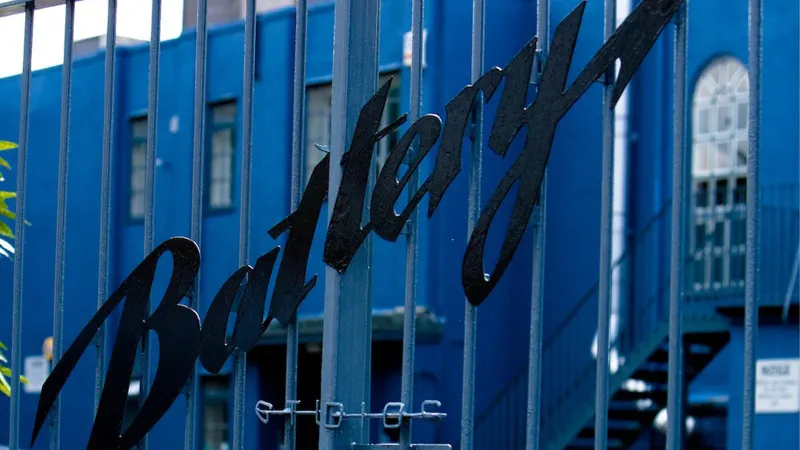
None of it happens alone. Alan Moulder, his engineering partner since the early 1980s, is the other half of nearly everything from that period forward, and what they've described about the partnership is less a working relationship than a shared nervous system, decades in, able to settle an argument with a glance. Flood tends to lead the recording, Moulder the mix, and the disagreements between them, constant by their own account, are never personal, because neither is trying to win, just trying to hear the song a way they hadn't yet. Flood has said leaving everything to be fixed in the mix is the kiss of death, that a room full of extraordinary musicians deserves real decisions made while recording, not deferred. Eventually the two of them built a room for that philosophy themselves, the Willesden Green complex they first ran as Assault & Battery, now operated in partnership with Miloco as Battery Studios, the same space where much of this catalog actually got made.
What rarely comes up next to the client list is that Flood also plays, for no one but himself. In 1994 he formed Node with fellow producer Ed Buller, classically trained composer Dave Bessell, and synth player Gary Stout, an all-analog, fully improvised project built around vintage modular synthesizers, closer to Tangerine Dream's Berlin School than to anything on his production resume. The debut was recorded live to DAT with almost no overdubs, partly built from a session staged inside Paddington Station during rush hour. Then it went quiet for nineteen years, no falling out, just four people with demanding day jobs who let the band exist only when it wanted to. When Node reconvened in 2014 for Node 2, with film composer Mel Wesson stepping in for Stout, the whole method was the same as it had always been: nobody interfering in what anyone else is doing, just playing and letting the tape sort out what worked. It's the exact same trust in instinct he learned to apply to other people's records, minus the pressure of a deadline, running on no one's clock but his own.
He has one more rule that closes the loop on everything before it: never label a song as the single while it's being made, because the moment that happens, everyone tightens up trying to protect it, and the pressure kills the thing worth protecting. It's a small piece of studio philosophy, but it explains why a catalog built across four decades and a dozen genres still sounds like it was made to be true first and marketable second.
What seems to matter most to him now isn't the Grammy or the twenty-million-selling records. He's told a story about running into Johnny Marr and mentioning a song he'd always felt was well written but poorly produced, and Marr telling him that same song had shaped his own son's life. Flood's read on that wasn't pride; it was humility about what the work is actually for: if it changes even one person, the job got done. He's said as much himself, plainly: he's just a bloke from the suburbs. Everything before that sentence, from a runner keeping a room awake with tea to a producer whose name quietly sits behind some of the most important records in modern rock, comes down to the same instinct: notice what the room needs before anyone has to ask, and keep supplying it.
Flood's profile at Beggars Music
Related: Lightship 95: The Recording Studio Built Inside a Ship