
Arturia's Freak synths are the strangest best-sellers in music gear. The MicroFreak has a flat circuit board where the keys should be. The MiniFreak has two digital engines feeding real analog filters. The new MiniFreak 49 adds full-size keys and a glowing touch pad in the middle of the panel. All three come from the same French company, share the same oddball sound and cost between 349 and 799 euros. Here is what separates them, who each one is for, and which Freak to buy.
The quick answer
- MicroFreak (349 euros): the cheapest way into the Freak sound. One digital oscillator, one analog filter, a 25-note touch keyboard and up to four notes at once. Best as a first synth or a second, weird one.
- MiniFreak (599 euros): the real polyphonic synth. Six voices, two engines, analog filters on every voice, three effects slots and proper 37-note keys. The best value of the three.
- MiniFreak 49 (799 euros): the same sound engine with 49 full-size semi-weighted keys, an XYZ touch matrix for performance and more knobs. Buy it if you play keys with two hands.
A synth built from borrowed code
The most interesting thing about the Freaks is where their sounds come from. Arturia, a company based in Grenoble in France, built its name on software copies of vintage synths, then won over hardware buyers with small analog machines like the MiniBrute. When it released the MicroFreak in 2019, it did something unusual: it licensed sound engines from other people.
Seven of the MicroFreak's oscillator modes come from Mutable Instruments, a small Eurorack module maker whose designs, including the Plaits oscillator, were published as open source. Three more were designed with Noise Engineering, a Los Angeles modular company. Arturia added its own engines on top, from wavetables and Karplus-Strong plucked strings to granular modes that chop sounds into tiny grains. The result was a pocket synth with sounds no other cheap synth could make, and the MiniFreak and MiniFreak 49 inherited the same toolkit.
The other shared idea is controlled chaos. Every Freak has Spice and Dice buttons that randomize a running sequence, so a pattern you have played a hundred times can suddenly mutate into something new. It is the most Freak feature of all, and the fastest way to get unstuck.
Side by side
| MicroFreak | MiniFreak | MiniFreak 49 | |
|---|---|---|---|
| Arturia price | 349 euros | 599 euros | 799 euros |
| Released | 2019 | 2022 | 2026 |
| Voices | Mono, or 4-note paraphonic | 6-voice polyphonic, 12-voice paraphonic | 6-voice polyphonic, 12-voice paraphonic |
| Sound engines | One digital oscillator, 17 modes | Two digital engines, 31 modes in total | Two digital engines, 30+ modes |
| Filter | One analog multimode filter (LP, BP, HP) | Analog filter and VCA per voice | Analog filter and VCA per voice, plus audio-rate filter FM |
| Effects | None | 3 slots, 13 effects including vocoder | 3 slots, 13 effects including vocoder |
| Keyboard | 25-note flat PCB with poly aftertouch | 37 slim keys, velocity and aftertouch | 49 full-size semi-weighted keys, velocity and aftertouch |
| Performance controls | Pressure-sensitive keys, Spice and Dice | Two touch strips | XYZ touch matrix, aluminum wheels |
| Sequencer | Polyphonic, with 4 modulation tracks | 64 steps, 4 modulation lanes | 64 steps, 4 modulation lanes, chord and scale modes |
| Software twin | No | MiniFreak V plugin, free for owners | MiniFreak V plugin, free for owners |
Specs and prices are from Arturia's official product pages in November 2026. US street prices vary with sales, so check the shop links below.
MicroFreak: small, cheap and strange
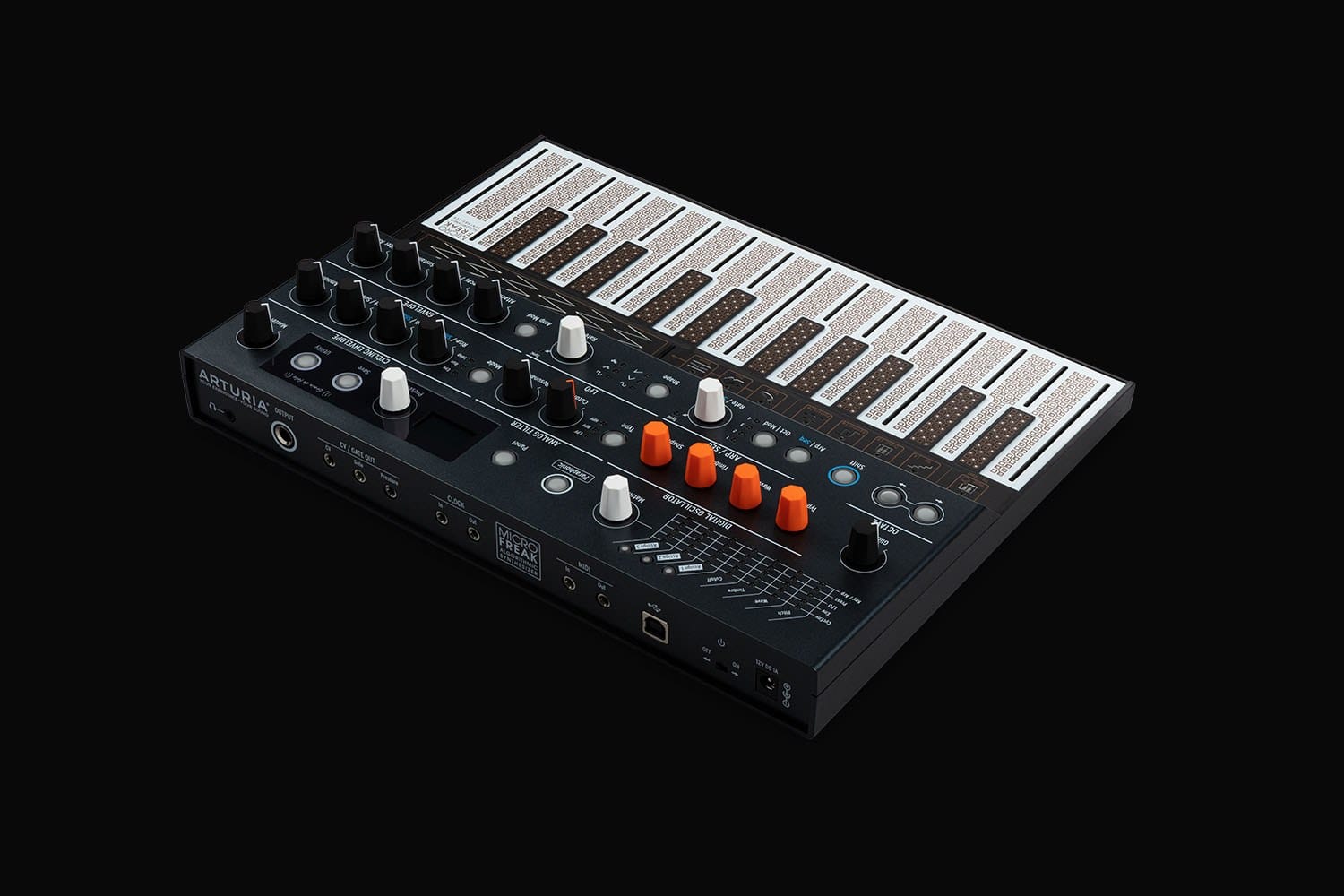
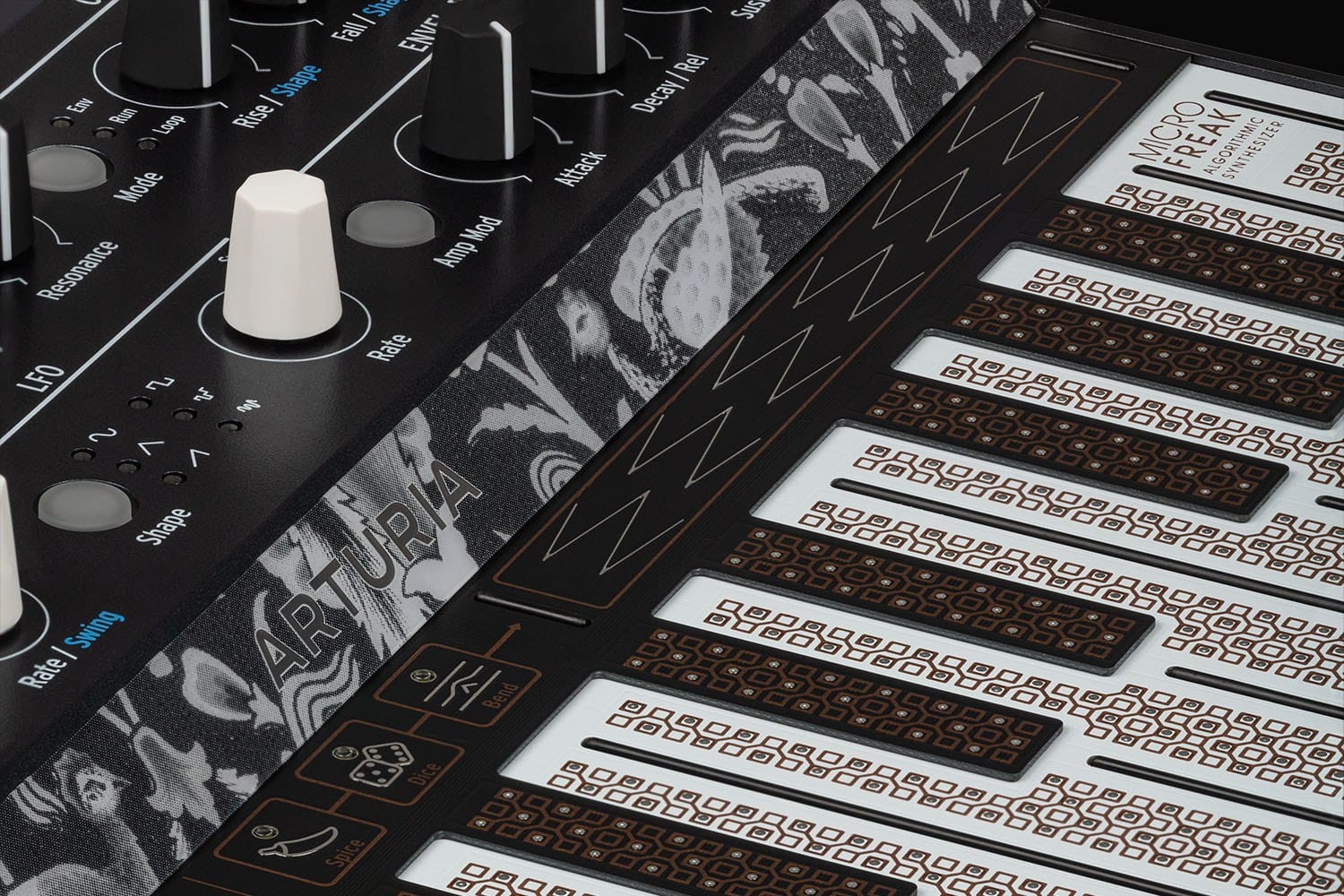
The MicroFreak is still the most unusual synth Arturia makes. Its sound starts in one digital oscillator and passes through a self-oscillating analog filter, then into envelopes, an LFO and a modulation matrix with five sources and seven destinations. Arturia lists 17 oscillator modes, and it is the variety that makes the MicroFreak feel bigger than its price: speech synthesis, wavetables, physical modeling and granular textures all live in one small box.
The keyboard is the part people either love or hate. It is a flat circuit board with printed keys and no moving parts, and it reads pressure separately on every key, which is called polyphonic aftertouch and is normally found on synths costing several times more. That makes it brilliant for drones and expressive leads and awkward for fast chords. It also has USB, MIDI and CV outputs, so it can drive modular gear or software as a controller.
The limits are clear. There are no effects, so it sounds dry on its own, and it can only play four notes at once in paraphonic mode, sharing one filter. It is a sound design toy and a sequencing machine, not a keyboard for playing songs.
MiniFreak: the one most people should buy
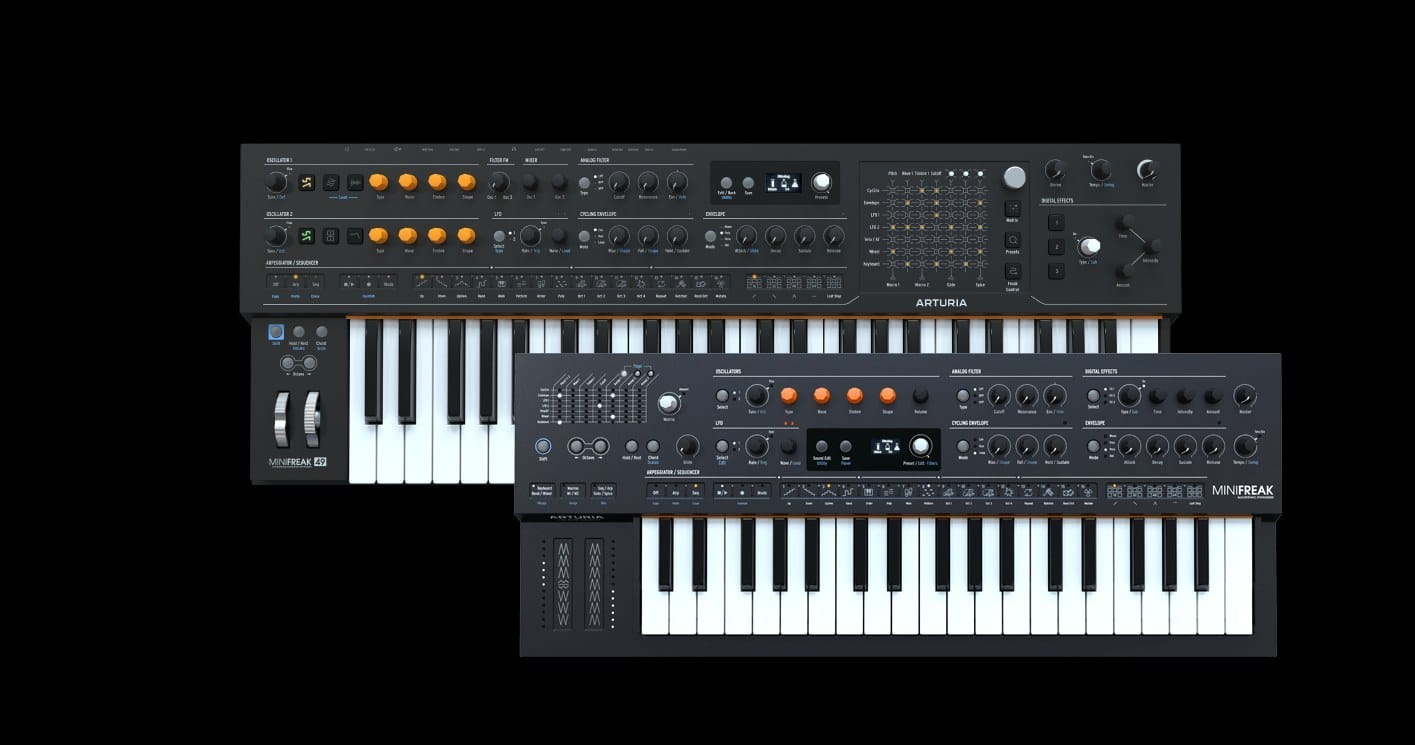
The MiniFreak takes the MicroFreak idea and doubles it. There are two digital engines instead of one, and Engine 2 can process Engine 1 or your own voice through the audio input. Each of the six voices gets its own analog filter and VCA, so chords sound full rather than squeezed through one filter. Three stereo effects slots, each with 13 algorithms including chorus, distortion, reverb and a vocoder, make every patch ready for a mix.
The 37 slim keys respond to velocity and aftertouch, and two touch strips handle pitch and modulation. The 64-step sequencer and arpeggiator keep Spice and Dice. And there is a detail that is easy to miss: registered owners get MiniFreak V, a plugin version of the same synth, free. Patches move between hardware and software, so you can sketch on the couch and finish in your DAW.
MiniFreak 49: the performance version
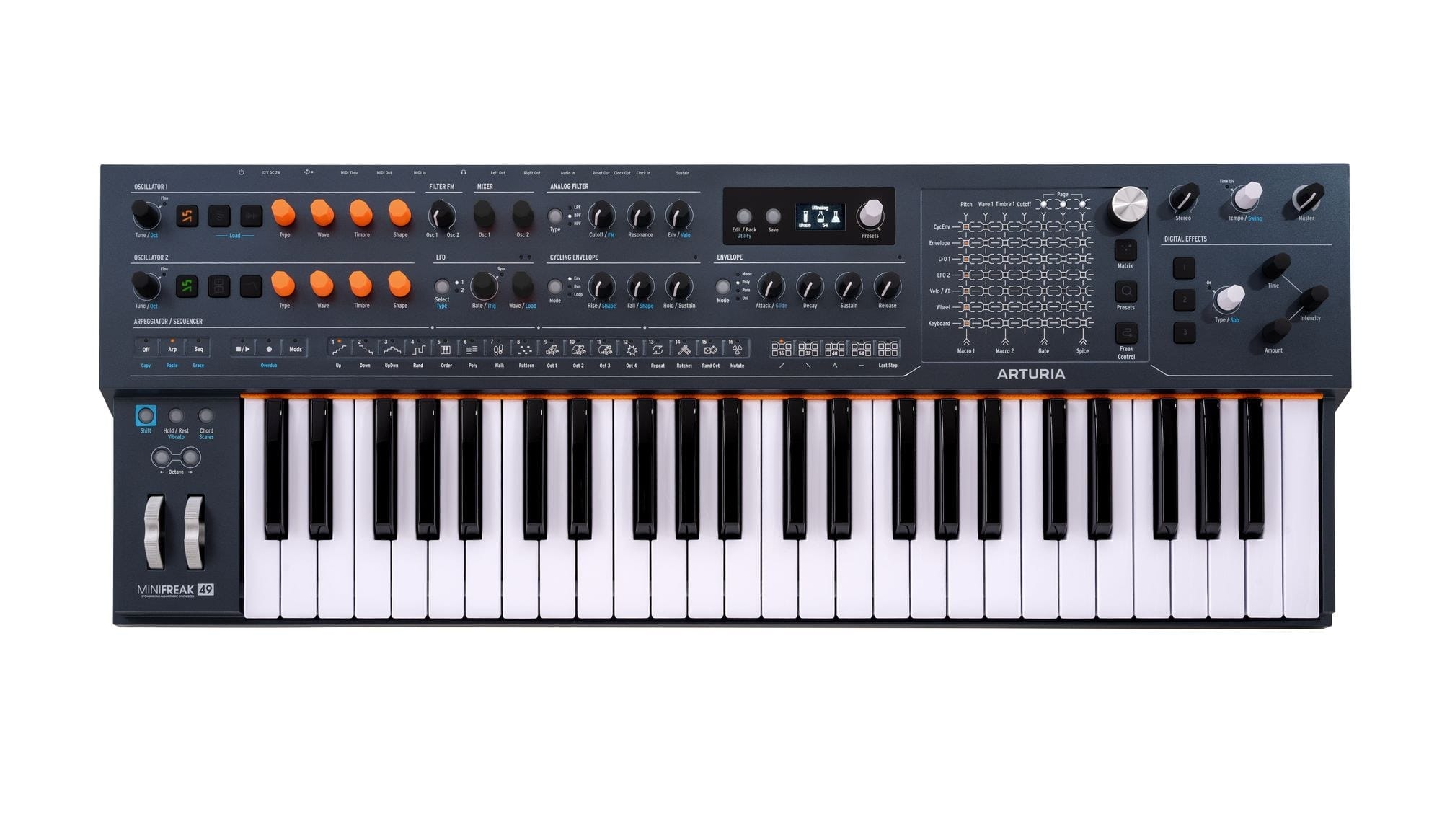
The MiniFreak 49, released this year, keeps the MiniFreak's six-voice hybrid engine and wraps it in a bigger instrument. The headline is 49 full-size semi-weighted keys with velocity and aftertouch, which make two-handed playing and real chords comfortable. In the middle of the panel sits an XYZ touch matrix that Arturia calls Freak Control: slide a finger to morph two or four parameters at once, press harder for a third, and hold the gesture when you lift your hand. The same pads browse presets and edit sequencer steps.
It also adds features the smaller model lacks: audio-rate filter FM from either engine, which gives a harder, more metallic edge, chord and scale modes, a larger screen and more dedicated knobs for both engines. It plays the original MiniFreak's presets, so nothing is lost if you upgrade.
Which one to buy
- Your first hardware synth, on a tight budget: the MicroFreak. It teaches synthesis and still sounds unique.
- You want chords, pads and effects in one box: the MiniFreak.
- You play keys properly or perform live: the MiniFreak 49.
- You already own a polyphonic synth and want something odd: the MicroFreak, as a sound design and sequencing toy.
- You mostly work in a DAW: the MiniFreak, for the free MiniFreak V plugin.
Not sure whether you need a polyphonic synth at all? Our monophonic vs polyphonic synths guide explains the difference. For a deeper look at the two Freaks we have covered before, read our MicroFreak guide and our MiniFreak 49 launch story. If you are building a whole setup, our best synthesizers for beginners list and Elektron comparison cover the alternatives.
Our call
Our call: buy the MiniFreak. It is the sweet spot of the range: a genuine six-voice polyphonic synth with analog filters on every voice, built-in effects and a free plugin twin, for 250 euros more than the MicroFreak and 200 less than the 49. Choose the MiniFreak 49 only if you will really use full-size keys and the touch matrix on stage or for two-handed playing. Choose the MicroFreak if money is tight or you want a strange second synth, and accept that it is a sound design box rather than a keyboard.
Arturia MiniFreak (37 keys): our pick, six voices, two engines, analog filters and effects. Check price
Arturia MiniFreak 49: full-size semi-weighted keys and the XYZ touch matrix for players. Check price
Arturia MicroFreak: the cheapest Freak, with a poly aftertouch touch keyboard. Check price
Arturia MicroFreak Vocoder Edition: the MicroFreak bundled with a gooseneck mic for its vocoder mode. Check price
Arturia MiniFreak 49 at Arturia: buy direct from the maker. Shop it at Arturia
More synths, samplers and studio gear: browse our Home Studio hub.
Prices are Arturia's own store prices in euros in November 2026. Specifications are from Arturia's official MicroFreak, MiniFreak and MiniFreak 49 pages.
Unknowndivide may earn a commission from purchases made through links in this post. As an Amazon Associate we earn from qualifying purchases.