Revivals of rare synthesizers usually follow a script. A boutique builder buys a few tired units, measures every resistor, and sells a faithful copy to people who mostly want the famous name on the panel without the vintage repair bills. The AnalogFX Larynx works the other way. It is not a clone of the Synton Syrinx, but a keyboard instrument built on the company's own SER-2020, which reimagines what made that early-1980s Dutch synth sound so strangely human. Its first batch of 50 units became available on October 1.
The lineage runs through one man. Felix Visser, the founder of Synton, spent decades building Dutch electronic instruments, from the Syntovox vocoders to synthesizers, before he died in December 2025. His first Syrinx design dates to 1973 and never reached production. The Syrinx that did ship arrived in 1982 as a monophonic analog machine with no MIDI and no presets, built around three switchable filters and a touch-sensitive bend pad. It landed just as digital FM was reshaping what players wanted, Synton eventually went out of business, and surviving units are now rarely seen outside collections.
AnalogFX, based in Deventer in the Netherlands and led by founder Marc Stroobach, picked up that thread with the SER-2020, a compact semi-modular desktop that the company describes as inspired by the Syrinx rather than copied from it. AnalogFX lists Aphex Twin, Air and Depeche Mode among the original's admirers, which explains the appetite for any route to that sound. The Larynx is the next step: the same voice with a keyboard under it, announced in April and demonstrated at Superbooth in May. Like the Flexur, it treats an obscure instrument as a starting point, not a museum piece.
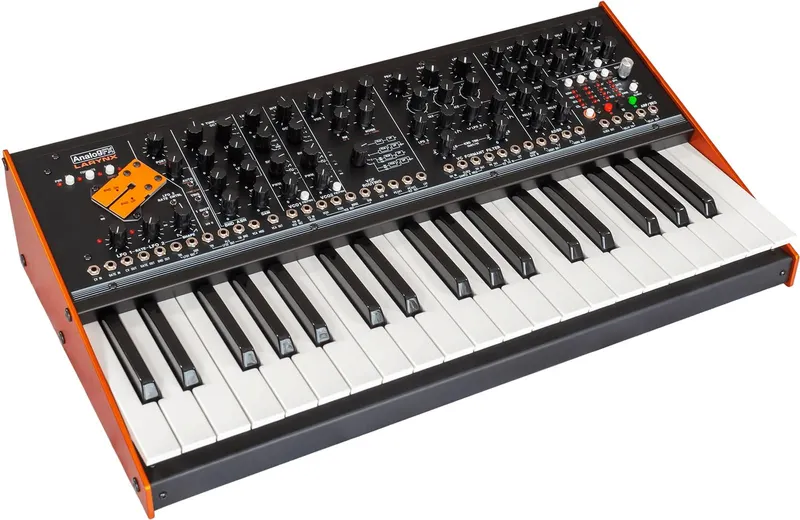
What makes the Larynx interesting is not the keyboard, but the filter. Two CEM3340-based oscillators, a sub oscillator, a ring modulator and a noise generator feed three CEM3350-based filters: a 24dB lowpass and two independent resonant peak filters. Set the two peaks apart and you get formants, the resonant bands your mouth shapes to make vowels, which is why the Syrinx always sounded closer to a throat than a circuit. A new Formant Mode stores 16 preprogrammed human voice settings, so you can call up a vowel instead of hunting for it with two cutoff knobs.
The playing surface follows the same logic. The 37-key keybed is velocity sensitive with channel aftertouch, and there are no pitch or mod wheels; instead, an orange Touch'n'Bend controller, descended from the Syrinx's bend pad, modulates the oscillators, filters and amplifier in real time. Two ADSR envelopes, two LFOs, sample and hold, auto glide and MPE support handle the rest. The analog core runs monophonic or duophonic, and a digital five-voice Chord Mode sits on top for anyone who wants harmony without pretending the Larynx is a polysynth.
The additions over the desktop are modest but telling. A stereo delay with its own CV inputs can be swept by both LFOs, so it doubles as a chorus. An arpeggiator and a 16-step sequencer with 16 pattern memories sit on the right of the panel, and the front carries CV inputs and outputs for Eurorack. Around the back you get MIDI in and out, USB MIDI, a pedal input, stereo line outputs and headphones. At 530 by 296 millimetres and 7.25 kilograms, it is a desk instrument rather than a backpack one, and Stroobach says the goal was an instrument "that feels alive under your hands."
The first production run is limited to 50 units, built in batches in the Netherlands and sold through the AnalogFX shop and select dealers at a suggested €1,249 including 19 percent VAT. AnalogFX's product page advertises a 10 percent early adopter discount on the first batch, and Synth Anatomy reported an introductory price of €1,124.09 at launch, so treat that lower figure as unofficial until you see it at checkout. AnalogFX has not published US pricing. For a very different idea of where boutique hardware is heading, our look at the ASM Leviasynth Desktop makes a useful counterpoint.
Buy Larynx from AnalogFX · Find an AnalogFX dealer
More in our Home Studio hub.