Musicians tend to treat field recorders as a filmmaker's tool, something for dialogue and room tone. That is a mistake. A pocket recorder is the most useful instrument most musicians never buy: a sketchbook for song ideas, a sampler's best friend, a way to capture rehearsals that actually sound like the room, and a source of textures no plugin can fake. Some of the most celebrated records of the past two decades started as recordings made somewhere other than a studio.
The technology has also changed in a way that matters more to musicians than to anyone. Almost every recorder below now records in 32-bit float, which means you can barely clip a recording even if you set the levels badly. Prices are from each manufacturer's official US store at the time of writing.
Unknowndivide may earn a commission from purchases made through links in this guide. As an Amazon Associate we earn from qualifying purchases.
Why 32-bit float changes everything
A traditional 16-bit or 24-bit recorder forces you to set input gain before you press record. Set it too low and the recording is noisy; set it too high and a sudden loud moment distorts permanently. 32-bit float recording captures such a huge dynamic range that a take recorded too hot can be turned down afterwards without damage, and a quiet one can be raised cleanly. For musicians recording a drummer one moment and a whisper the next, it removes the most common way to ruin a take. You still need to place the mic well. You no longer need to babysit the meter.
Zoom H1essential: best for song sketches
The Zoom H1essential is the simplest recorder worth owning. It has a built-in stereo X/Y microphone pair, records in 32-bit float and can double as a USB audio interface. Zoom lists it at $109.99. Keep it on a music stand or in a gig bag and use it for voice memos that sound far better than a phone. The essential series also added accessibility features for blind and low-vision users, a genuinely overdue idea in audio gear. See the Zoom H1essential on Amazon.
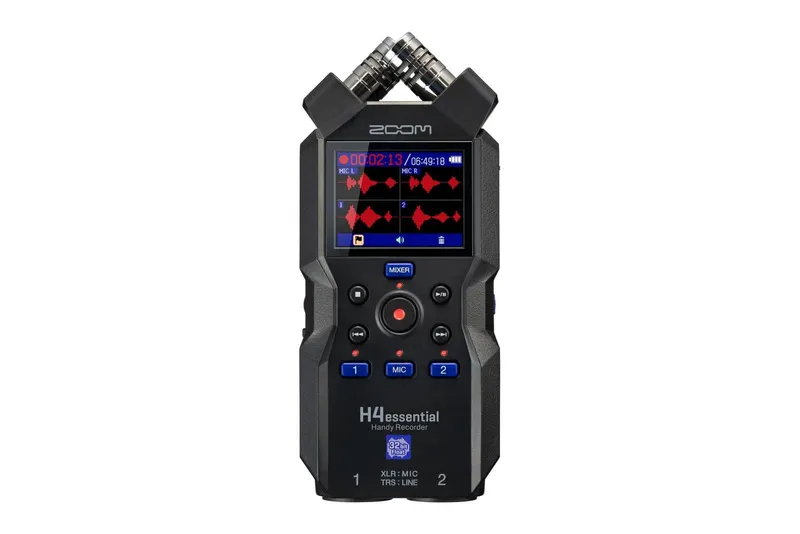
Zoom H4essential: best all-rounder
The H4essential is where a pocket recorder becomes a small studio. It records four tracks in 32-bit float, combining its X/Y mics with two XLR/TRS combo inputs for external microphones or instruments. That means you can capture a room in stereo while recording a vocal mic and a guitar DI at the same time. Zoom lists it at $219.99, and for most musicians it is the one to buy. See the Zoom H4essential on Amazon.
Zoom H6essential: best for recording a band
The H6essential scales up to six tracks of 32-bit float, with four XLR/TRS combo inputs and included X/Y mics rated up to 135 dB SPL, which is loud enough for a drum kit at close range. Its updated capsule system lets you swap the microphone on top for a different type. Zoom lists it at $329.99. If you want to multitrack a rehearsal and mix it later, this is the cheapest serious way. See the Zoom H6essential on Amazon.
Zoom F3: best for mic snobs
The Zoom F3 is the opposite of an all-in-one. It is a tiny, sturdy metal box with two locking XLR inputs and 32-bit float recording, built for people who already own good microphones and want to put them somewhere awkward. Zoom lists it at $299.99. Pair it with a stereo pair of small-diaphragm condensers and it will outperform any handheld recorder's built-in mics.
TASCAM DR-07XP: best adjustable stereo mics
The TASCAM DR-07XP is a 2-channel 32-bit float recorder with a USB-C audio interface and adjustable microphones that can be positioned for different stereo widths. That flexibility matters more than it sounds: a narrow pattern focuses on a source, while a wide one captures a room or a landscape. It is a strong alternative to the H1essential for anyone who records ambience more than voice memos. See the TASCAM DR-07XP on Amazon.
Teenage Engineering TP-7: best designed
The TP-7 is the luxury option, a field recorder Teenage Engineering built to record, edit, trim and layer sound with as little friction as possible. It listed at $1,499 on Amazon at the time of writing, several times the price of any Zoom here, and it does less in raw specifications. It has an internal microphone and speaker, Bluetooth and a USB-C audio interface. Its appeal is the design and the workflow, and that matters for one reason: it is the recorder you will want to carry, and the one you carry is the one that captures the idea. See the TP-7 on Amazon.
How musicians actually use them
Sampling. Field recordings are the raw material for samplers. A recorder plus a box like the Torso Electronics S4 turns a train platform or a kitchen into an instrument.
Recording in unusual spaces. Rooms shape sound, and the best ones are rarely studios. Tim Hecker built much of Ravedeath, 1972 around a church pipe organ in Reykjavík, and studios like the floating Lightship 95 exist because a space can become part of the record.
Rehearsals and demos. A recorder placed well in a rehearsal room captures how a band actually sounds together, which is often more useful than a perfectly separated multitrack. Put it at ear height a few feet back from the drummer, not on the floor next to the bass amp, and the balance mostly takes care of itself.
Buy the H4essential if you only buy one. Then take it everywhere, because the best sound you will ever record is the one you were not expecting.
More in our Home Studio hub.