Unknowndivide may earn a commission from purchases made through links in this post.
The Civivi Baklash is a knife that looks right the moment you see it. It has a clean, slightly upswept blade, a straightforward G10 handle and none of the angular styling that dates so many modern folders. It sits between compact and full size, which makes it a practical everyday carry (EDC) knife for people who want a real working blade without going big.
The specs
We checked two versions on Civivi's site, the C801C and the C801H. Both share the same core dimensions:
- Overall length: 8.10 inches
- Blade length: 3.5 inches
- Blade thickness: 3 millimeters
- Handle length: 4.6 inches
- Handle thickness: 13 millimeters
- Weight: 110 grams
- Steel: 9Cr18MoV
- Grind: hollow
- Handle: black G10 with a G10 back spacer and stainless steel liners
- Pivot: caged ceramic ball bearing
- Lock: liner lock
- Clip: reversible stainless steel
- Designer: Civivi
The C801C blade is hardened to 58 to 60 on the Rockwell hardness C scale (HRC). The C801H has a black stonewashed blade rated at 57 to 59 HRC and pairs it with blue liners, which add a little color when you look at the knife from the side.
The blade
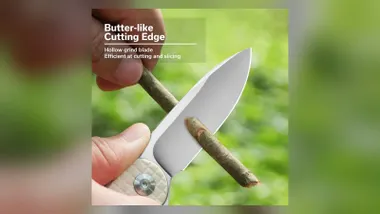
A 3.5 inch blade is a sweet spot for many people. It is long enough to handle bigger cutting jobs, from breaking down cardboard to slicing food at a campsite, yet the knife still feels manageable in hand. The hollow grind thins the blade behind the edge, which helps it bite into material and slice cleanly. At 3 millimeters thick at the spine, the blade has enough backbone for everyday utility without feeling like a pry bar.
The steel is 9Cr18MoV, a stainless steel that Civivi uses across many of its knives. As a stainless steel, it is a forgiving choice for a blade that will see food prep and damp weather.
Opening and locking
The Baklash is a flipper. A small tab on the spine of the blade sticks out above the handle when the knife is closed, and a push with your index finger sends the blade open. The caged ceramic ball bearing pivot is what makes that motion light and consistent. Rather than grinding against washers, the blade rides on a ring of ceramic balls.
A stainless steel liner lock holds the blade open. When you are done, you push the liner aside with your thumb and fold the blade closed. It is one of the most common and intuitive locks in modern folders. If you want to understand how it compares with other mechanisms, our guide to pocket knife lock types walks through the main options.
The handle
At 4.6 inches long and 13 millimeters thick, the handle gives most hands a full grip. Civivi uses G10 for the scales and for the back spacer, which closes the spine of the handle. G10 is a fiberglass laminate that is light and largely unaffected by water, and its texture gives your fingers some purchase. The clip is reversible, so left handed users can set it up for their side.
How it fits in Civivi's lineup
If you are comparing Civivi models, the Baklash sits between the Elementum, with its 2.96 inch blade, and the Praxis, with its 3.75 inch blade. It is larger and more capable than the Elementum but noticeably lighter and shorter than the Praxis. For many buyers, that middle position is exactly the point.
Outside Civivi, the Benchmade Bugout is a lighter knife with a similar blade length, while the Kershaw Leek is slimmer and more dressy.
Who it suits
The Baklash suits people who want one knife that can do a bit of everything, from office tasks to camp chores. It is a good choice for someone who finds compact knives too small but does not want the length of a full size folder. Check local laws before you carry, since a 3.5 inch blade is above the limit in some places. If that is not a concern, it is a well proportioned, easy to use knife.
Where to buy
For more pocket tools and carry gear, browse our everyday carry hub.