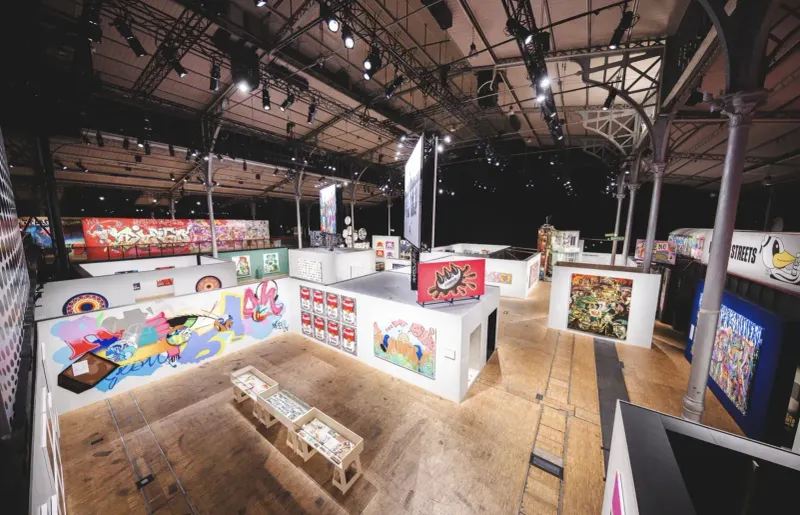
Every write-up of Beyond the Streets Paris leads with the same handful of names, Shepard Fairey's fifty-piece career survey, Futura 2000, JonOne's mural at the entrance, the usual canon that treats graffiti as something invented on New York subway trains in the late 1970s. Buried inside the same 3,600 square meters is a tribute section built specifically around Paris's own history in the movement, and the figure it centers on has a real claim to a title none of the American names can touch: Gérard Zlotykamien started painting in the street, illegally, in 1963. That's a full decade before graffiti culture existed in New York in any form people would recognize.
He calls his work Éphémères, thin, ghostly silhouettes that read as shadows or masks, and for years he made them with a paint applicator improvised from an enema bulb before switching to spray cans. The shape isn't abstract. Zlotykamien was born in Paris in 1940 to a Jewish family; his parents were deported to concentration camps when he was two, and he was placed with a family that treated him badly before being reunited with his parents after the war. In 1970, working near Les Halles, he began painting his silhouette figures specifically as a reference to the shadows of Hiroshima's victims, burned into walls by the blast, the only trace some of them left behind. He kept a day job selling at Galeries Lafayette while doing this on the side, illegally, for decades, with essentially no recognition.
That changed slowly. Later street artists, Invader among them, have said openly that Zlotykamien never got the credit his timeline actually earns him. A proper gallery relationship didn't arrive until later in his career, a full retrospective ran in Paris in 2023, and the Centre Pompidou finally acquired eight of his works into its permanent collection in 2024, sixty-one years after his first illegal painting. Beyond the Streets Paris, running now through August 23 at La Grande Halle de la Villette, folds his work into its dedicated Paris section alongside Brassaï's photography and the tag culture of the Catacombs, treating the French side of this history as more than a footnote to Los Angeles and New York for once. If you're only going to look up one name before you walk through those 3,600 square meters, it's the one most of the coverage isn't leading with.
Beyond the Streets Paris, tickets and exhibition info
Related: Travis Chapman Art · H.R. Giger: The Man Behind Alien, an ELP Album Cover, and His Own Bar
More in our Design & Art hub.