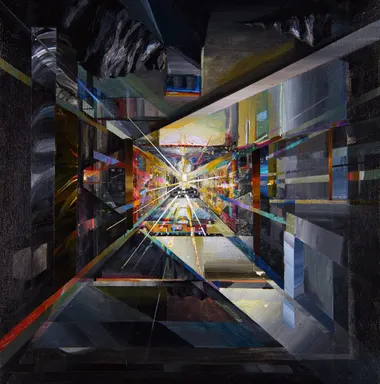

Rust is the rare form of damage we've agreed to find beautiful. We pay extra for it on leather, denim, and barn wood; we photograph it on abandoned machinery; we call it patina when we want to sound refined about decay. The Sanctity of Rust, the new album from Texas electronic composer Hollan Holmes on Spotted Peccary Music, takes that idea all the way down: twelve tracks that treat corrosion not as ruin but as a record, every shade of orange and violet on old metal a note in a story about survival. Holmes calls the album "a celebration of endurance and the honor of growing old," and for once, the concept and the sound are the same thing.
Holmes comes out of the Berlin school lineage, the sequencer-driven tradition of Tangerine Dream and its descendants, and his stated inspirations run from Jean-Michel Jarre and Steve Roach to Rush and Pink Floyd. But this record roughs up that heritage on purpose. The palette blends what the artist describes as raw, mechanical sound design with lyrical piano and Rhodes, and the production story reads like a controlled corrosion experiment: FM synthesis, stacked distortion layers, custom samples, and more acoustic elements than he's ever used, all in service of making pristine electronics sound weathered without sounding broken.
The gear list tells the same story in hardware. Modern software (Arturia Pigments, Omnisphere, Native Instruments) pushed past its intended behavior for the grit, and true vintage machines, a Korg MS20 and an Oberheim Matrix 12, supplied the warmth and unpredictability that only circuits with some age on them produce. Instruments that have themselves endured, making an album about endurance. The one guest is Bill Porter's electric guitar on the title track, a single human voice of sustain inside the machinery.
The inspiration source is concrete rather than cosmic: the weatherworn machinery and forgotten relics of old farmland, equipment that outlived its work and kept standing. You can hear the album's whole thesis in the track titles alone, which move from "The Unstoppable March of Time" through "Triumph Over Tragedy" and "Battle Scars" to a closer named "Here at The End of All Things." This is ambient music with a spine: an argument that what time does to a thing is not the opposite of what the thing is, but its completion.
Holmes deliberately buries melodies inside melodies, engineering the record so that details surface across repeated plays, the way patterns emerge in rust the longer you stare. That design rewards the format he's selling: the download is a 24-bit/96kHz studio master, also on CD, and this is exactly the kind of record where the resolution isn't audiophile theater; the buried layers are the content. Play it on real speakers, at night, more than once.
It's also worth saying where this record sits in a career. The Sanctity of Rust follows Sacred Places (2024), Emerald Waters (2022), and Milestones (2020) in a run of remarkable consistency stretching back over a decade, all of it self-composed, self-performed, and self-mixed, down to the album photography, which is Holmes's own. Mastering by Howard Givens at Spotted Peccary keeps him inside one of the last great curated homes for this music, a label that has spent decades treating ambient electronic work as a craft tradition rather than a mood category.
Listen: The Sanctity of Rust on Bandcamp, released April 17, 2026, via Spotted Peccary Music.
Related: Sam Rosenthal The Width of Shadows
More in our Electronic Music Labels hub.