
Nikon makes two cameras that look like they came out of a 1982 camera bag. The Z fc and the Zf both borrow the shape, dials and logo of the FM2, one of the most loved film SLRs Nikon ever built, and both hide modern mirrorless guts behind the brass and leatherette. From across a room they are almost twins. In the hand they are very different cameras, and the price gap between them is more than $1,200. Here is how they compare, where each one wins, and which retro Nikon to buy.
The quick answer
- Buy the Zf if you want the best camera of the two by a long way: a full-frame 24.5MP sensor, 8 stops of in-body stabilization, weather sealing and the same processor as Nikon's flagship Z9. From $1,999.95 at Nikon USA.
- Buy the Z fc if you want the look for less, or a light camera for travel and everyday snaps. It has a smaller APS-C sensor and no in-body stabilization, but it weighs 265 grams less and starts at $759.95.
- Buy neither if you only care about image quality per dollar. The Z5II gives you the Zf's sensor size and resolution, stabilization and weather sealing for $1,599.95, in a plain modern body.
A film camera shape from 1982
To understand why these cameras exist, start with the FM2. Nikon released the all-mechanical 35mm SLR in 1982, and in Nikon's own words it was loved by professionals and enthusiasts alike for its rugged build, its functionality and its affordable price. It needed a battery only for the light meter, so it kept shooting in the cold and in places where electronics gave up. Plenty of people still use one today.
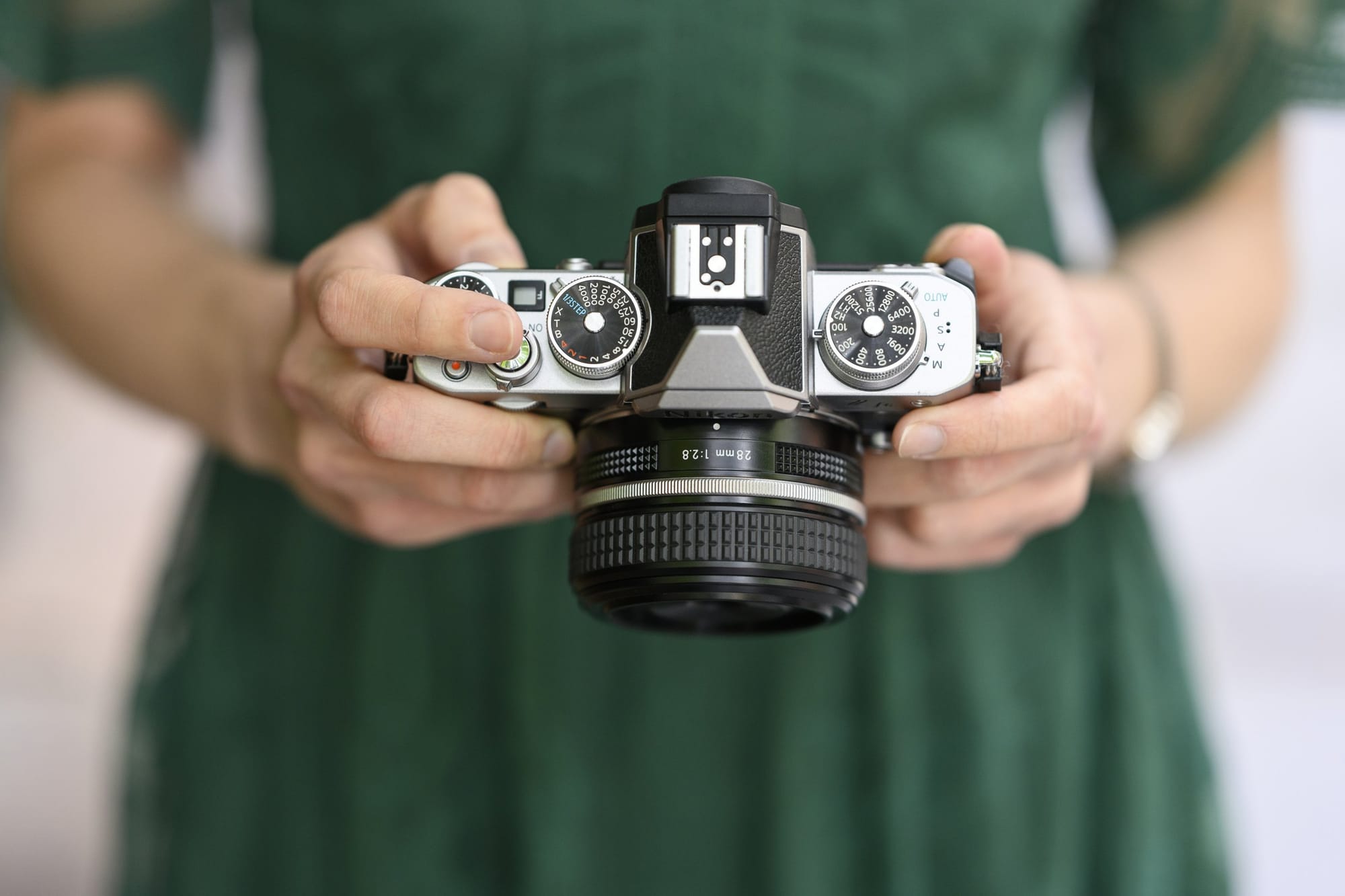
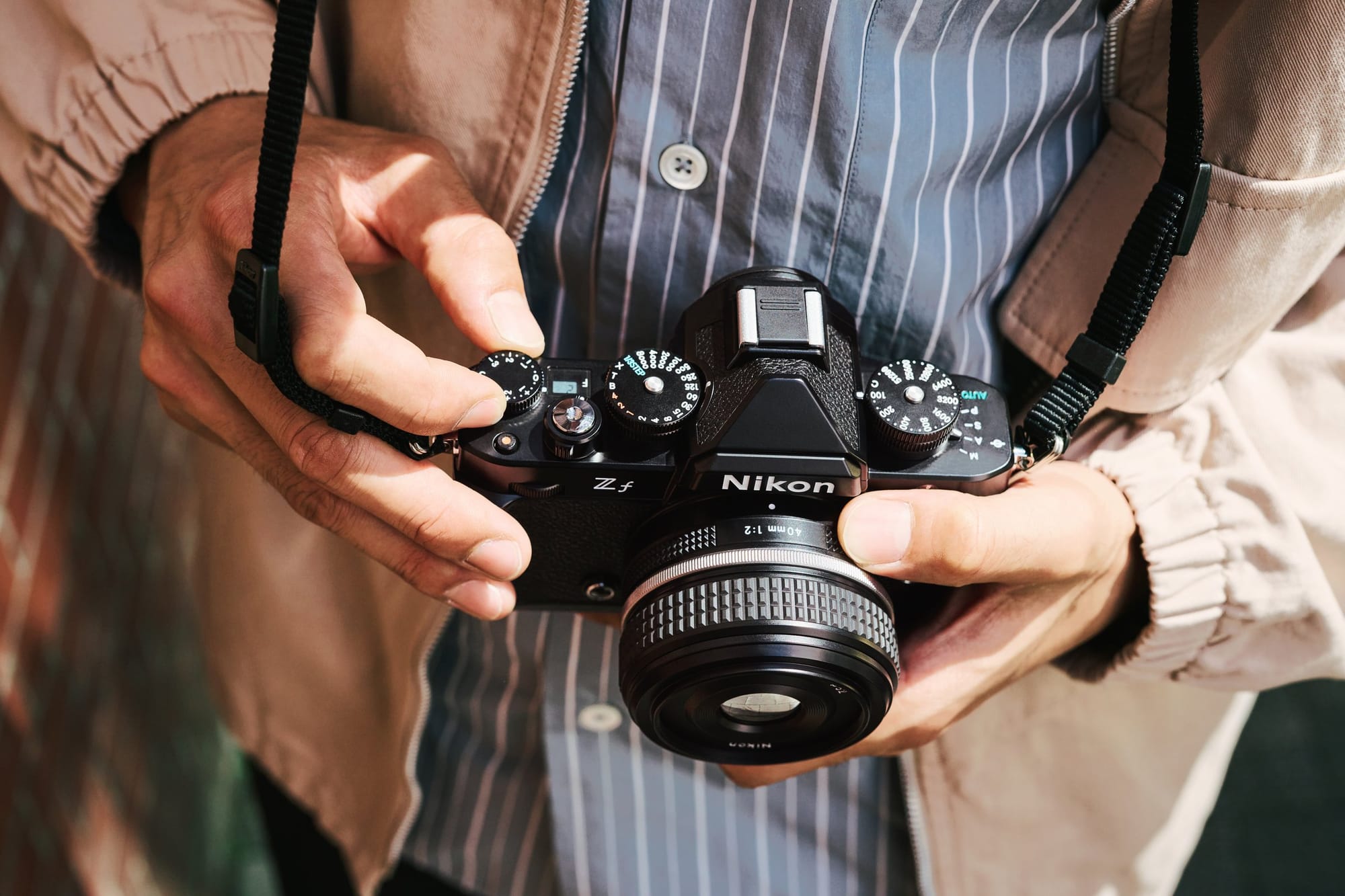
When Nikon moved to mirrorless with the Z mount in 2018, its cameras looked like every other modern camera: black, rounded and full of buttons. The Z fc, announced on June 29, 2021, was the first Z camera to break from that. Nikon copied the FM2's body size, its dial positions, the balance of black and silver, the pentaprism hump and the Nikon logo it used in the 1970s and 1980s. Even the viewfinder eyepiece is round, like the original.
The name is a small history lesson too. Nikon says the "f" refers to models of symbolic importance in its history, and to the word fusion: old-school mechanical controls meeting modern image quality. The "c" stands for casual, because Nikon wanted the camera to be carried and used by anyone, anywhere. Two years later, on September 20, 2023, Nikon put the same idea around a full-frame sensor. That camera is the Zf.
The specs side by side
| Nikon Zf | Nikon Z fc | |
|---|---|---|
| Announced | September 2023 | June 2021 |
| Sensor | Full frame, 24.5MP backside-illuminated | APS-C (DX), 20.9MP |
| Processor | EXPEED 7 (same as Z9 and Z8) | EXPEED 6 |
| In-body stabilization | Yes, up to 8 stops | No, lens VR only |
| ISO range | 100 to 64,000 | 100 to 51,200 |
| Top shutter speed | 1/8000 s | 1/4000 s |
| Burst | 14 fps mechanical, 30 fps electronic | Up to 11 fps |
| Autofocus | 299 points, 9 subject types, down to -10 EV | Eye detection for people, dogs and cats |
| Video | 4K/30p oversampled from 6K, 4K/60p in DX crop, 10-bit N-Log | 4K/30p full width, no crop |
| Viewfinder | 3.69 million dot OLED, 0.8x | OLED, 100% coverage |
| Rear screen | 3.2 in vari-angle touchscreen | 3.0 in vari-angle touchscreen |
| Card slots | SD (UHS-II) plus microSD | One SD |
| Weather sealing | Yes | Not claimed |
| Weight (with battery and card) | About 710 g | About 445 g |
| Nikon USA price | From $1,999.95 | From $759.95 |
Specs are from Nikon's official specification pages and Nikon USA's store in November 2026. Both cameras use the same Z mount, so every NIKKOR Z lens fits both, and with Nikon's FTZ II adapter you can mount roughly 360 older F-mount lenses.
Where the Zf pulls ahead
The sensor. A full-frame sensor is about 2.3 times the area of the Z fc's APS-C chip. In practice that means cleaner pictures at night, shallower depth of field from the same lens, and wide-angle lenses that actually stay wide. On the Z fc, a 28mm lens frames like a 42mm, because of the 1.5x crop.
Stabilization. This is the difference that matters most for the kind of person who buys a retro camera. Many Zf and Z fc owners want to mount old manual-focus Nikkor lenses through an adapter. Those lenses have no stabilization of their own, so on the Z fc every shot is handheld with nothing helping you. The Zf stabilizes the sensor itself by up to 8 stops, and it was the first camera to use what Nikon calls focus-point VR, which concentrates the correction on the spot you focused on rather than the center of the frame.
The engine. The Zf shares its EXPEED 7 processor with the Z9 and Z8, which brings their subject detection for people, animals, birds, cars, bikes, trains and planes. It also brings pre-release capture, which keeps buffering frames for up to a second before you fully press the shutter, and pixel shift shooting that merges 32 frames into a 96MP file on a computer.
The details. The dials, shutter button and power switch on the Zf are machined brass, which Nikon chose so they would wear in and age with use. There is a dedicated black and white position on the photo and video switch, with Flat and Deep Tone Monochrome profiles, so you can commit to monochrome the way you would by loading Tri-X. Firmware version 3.0 added a Film Grain effect you can tune for size and strength. The body is sealed against dust and drips to a level Nikon compares to the Z8.

Where the Z fc wins
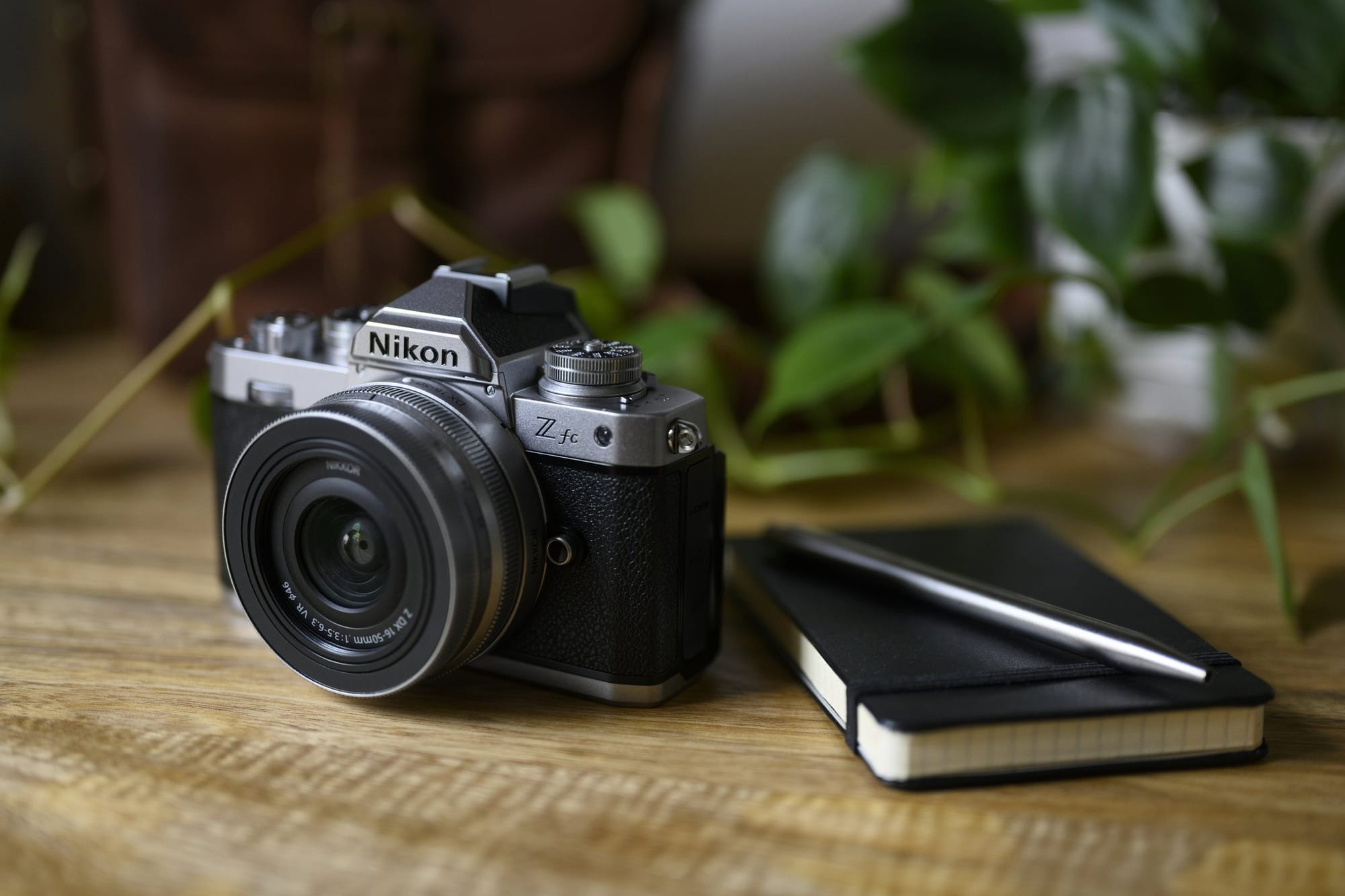
Size and weight. The Z fc is 445 grams ready to shoot, against 710 grams for the Zf, and it is about a centimeter narrower and shorter. With the NIKKOR Z 28mm f/2.8 (SE) pancake lens on the front it fits in a jacket pocket, which is a big part of the FM2 spirit. The Zf with a lens on it is a proper camera bag camera.
Price. At $759.95 for the body, the Z fc is less than half the price of the Zf. That leaves room for a second lens, or for a vintage Nikkor or two. For a first interchangeable-lens camera, that matters more than any spec in the table.
Video without a crop. The Z fc records 4K at 30p using the full width of its sensor, and its screen flips forward for vlogging. The Zf records sharper 4K oversampled from 6K, but its 4K at 60p needs a crop. If you mainly film yourself at a desk or on the street, the Z fc does the job, and it works as a high-quality webcam over USB-C with Nikon's free software.
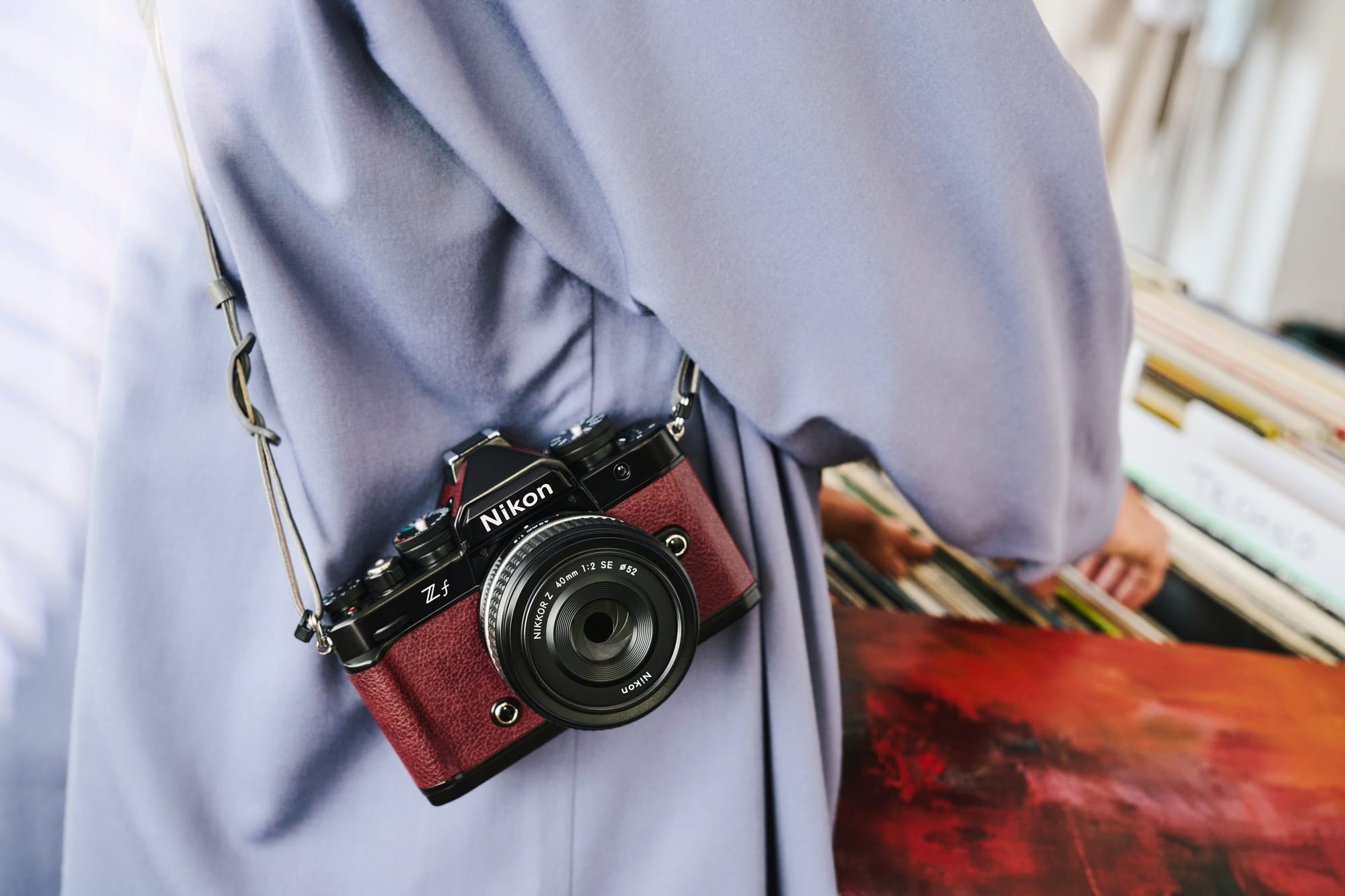
The colors. Both cameras come in a run of premium leatherette finishes. Nikon USA currently lists the Z fc in black and silver plus a set of limited colors, and the Zf in black or silver top plates with leatherettes such as Sepia Brown, Moss Green, Indigo Blue and Sunset Orange.
What neither one does well
Neither camera has a real grip. The flat FM2-style front looks great, but with heavier lenses your fingers start to ache. Nikon lists an optional SmallRig grip for the Zf, and third-party grips exist for both. Neither is a sports camera either: the shutter dial is lovely, but it is slower to use than a modern command dial when the light changes fast. And the Z fc's single card slot and lack of weather sealing mean it is not the camera for paid work in the rain.
The third option: the Z5II
If you are choosing between these two because you want full frame on a budget, look at the Z5II first. Nikon USA lists it at $1,599.95, $400 less than the Zf, with the same 24.5MP full-frame resolution, 7.5 stops of in-body stabilization, weather sealing and pre-release capture. It looks like a normal modern mirrorless camera and has normal modern controls. You give up the brass dials, the monochrome switch and the reason most people want a Zf in the first place. If that reason is not the look, the Z5II is the smarter buy.
Which one to buy
- You want one camera for the next ten years: the Zf. The full-frame sensor and stabilization will not feel dated any time soon.
- You want to use old manual Nikkor lenses: the Zf, because stabilization and full frame let those lenses behave the way they did on film.
- You are new to interchangeable-lens cameras: the Z fc with the 16-50mm kit lens. Learn on it, and put the money you saved into a good prime.
- You travel light or shoot mostly for social: the Z fc with the 28mm (SE) pancake lens.
- You want full frame and do not care about the look: the Z5II.
If you are still deciding between a retro mirrorless camera and a fixed-lens compact, read our Ricoh GR IV vs Fujifilm X100VI comparison. And if what you really want is the FM2 itself, our guide to film cameras you can still buy new and our Canon AE-1 Program guide cover the film side, while Kodak Tri-X 400 is the film to put in it.
Our call
Our call: buy the Zf. It is the rare retro camera that is not a compromise. The full-frame sensor, 8 stops of stabilization and the Z9's autofocus brain make it a better camera than most plain-looking rivals at its price, and the brass dials and monochrome switch make you want to pick it up. The Z fc is the right buy only if $2,000 is out of reach or you want something light enough to carry every day without thinking. In that case it is still a joy, and the best-looking camera you can get for under $800.
Nikon Zf body (from $1,999.95 at Nikon USA): our pick, full frame with brass dials and 8 stops of stabilization. Check price
NIKKOR Z 40mm f/2 (SE): the heritage-style prime Nikon designed to match the Zf, small and sharp. Check price
Nikon Z fc body (from $759.95 at Nikon USA): the lighter, cheaper way into the look. Check price
Nikon Z fc with NIKKOR Z DX 16-50mm: the best first kit, with a retracting zoom that keeps it pocketable. Check price
Nikon Z5II body ($1,599.95 at Nikon USA): full frame and stabilization for less, without the retro styling. Check price
Nikon Zf at Nikon USA: buy direct to choose a body and leatherette color. Shop it at Nikon
More cameras, film and darkroom guides: browse our Leica and Film Photography hub.
Prices are from Nikon USA's online store in November 2026 and change often, especially around holiday sales. Specifications and history are from Nikon's official specification pages and its 2021 and 2023 launch announcements.
Unknowndivide may earn a commission from purchases made through links in this post. As an Amazon Associate we earn from qualifying purchases.