
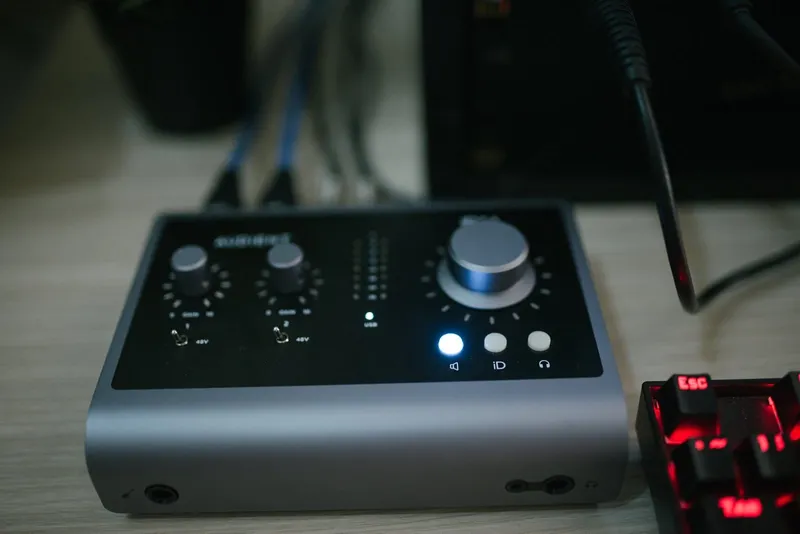
The usual advice for a first home studio is to buy a bundle: an interface, a microphone, a pair of headphones and a cable, all in one box, all from one brand. It is convenient, and it is usually a mistake. Bundles are built to hit a price, and the weakest piece tends to be the one you end up replacing first.
A better approach is to buy a small number of proven parts, one at a time, starting with whatever you need to make the music you already make. Producers who work in the box need a good interface and honest speakers before they need a microphone. Songwriters need a microphone before they need a keyboard. The seven pieces below are the ones that keep turning up in working rooms, and almost all of them have been in production long enough to prove they last.
Unknowndivide may earn a commission from purchases made through links in this guide. As an Amazon Associate we earn from qualifying purchases.
Focusrite Scarlett 2i2 4th Gen: the interface to start with
Focusrite was founded in 1985 by Rupert Neve, and the Scarlett range is how most people first meet the company. The 2i2 is the one to buy: two inputs for a microphone and an instrument, two outputs for speakers and a headphone socket. The fourth generation added 69dB of gain, enough for quiet dynamic microphones, along with Auto Gain, which sets your levels for you, and Clip Safe, which pulls the gain down before a loud take distorts. It records at up to 24 bit and 192kHz and connects over USB-C. Around $225 on Amazon, it is the most sensible first purchase in this list.
See the Focusrite Scarlett 2i2 4th Gen on Amazon
Shure SM57: the microphone that never dies
Shure introduced the SM57 in 1965, and it has been on the lectern at the White House since Lyndon Johnson's time. It is just as much a fixture in front of guitar amps and snare drums. It is a dynamic microphone, so it needs no phantom power, it shrugs off loud sources, and it ignores much of the room around it, which is useful when the room is a bedroom. It is not the most detailed microphone for vocals, but it is the one that will still work after being dropped, stepped on and lent out. Around $109.
Audio-Technica AT2020: the first condenser
When you want more detail on vocals and acoustic instruments, you want a condenser microphone, and the AT2020 is the one most people start with. Audio-Technica introduced it in 2004 at $169, and it has become cheaper since, not more expensive. It is a cardioid condenser, so it picks up mostly what is in front of it, and it needs phantom power, which the Scarlett provides. It is brighter and more open than the SM57, and it rewards a quiet room and a pop filter. Around $119 on Amazon.
See the Audio-Technica AT2020 on Amazon
Yamaha HS5: the honest speakers
Yamaha's white cone woofers are a direct line back to the NS-10, the bookshelf speaker that ended up on the meter bridge of studio after studio in the 1980s. The HS5 carries that look and that intent. It uses a 5 inch woofer and a 1 inch tweeter, each with its own amplifier, 45 watts and 25 watts, and it is tuned to be flat rather than flattering. Mixes made on HS5s tend to translate to car stereos and earbuds, which is the whole point of a monitor. They sell for around $400 a pair on Amazon.
See the Yamaha HS5 (pair) on Amazon
PreSonus Eris 3.5 2nd Gen: monitors for a small desk
Not every room can take a pair of 5 inch monitors, and not every budget can either. The Eris 3.5 is the small option that still behaves like a studio speaker. The second generation uses a 3.5 inch woven composite woofer and 50 watts of Class AB amplification, and it puts a headphone output on the front, which is handy when the interface sits out of reach. There is no Bluetooth on this model, so it stays a monitor rather than a party speaker, though PreSonus sells a Bluetooth version if you want one. Around $100 a pair.
See the PreSonus Eris 3.5 2nd Gen on Amazon
Akai MPK Mini IV: the controller for a backpack
The MPK Mini has been the default small controller for years, and the fourth version, released in October 2025 at $99, keeps the same formula. You get 25 keys, eight pads for drums and samples, and proper pitch and modulation wheels in place of the old joystick. It also adds a 5 pin MIDI output, so it can play hardware synths without a computer in the middle. It fits on a crowded desk or in a bag, and for beat makers who mostly program drums and short lines, it may be the only keyboard they need. Still $99 on Amazon.
See the Akai MPK Mini IV on Amazon
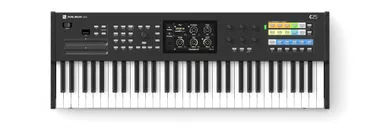
Novation Launchkey 49 MK4: the controller for players
If you play keys rather than tap them, step up to the Launchkey 49. The MK4 has semi weighted keys, 16 pads and a set of tools for people who think in chords: Chord Map, Fixed Chord and 30 scales that keep you in key while you search for an idea. It has 5 pin MIDI out and a standalone mode, so it can drive a synth or drum machine with the laptop closed, which makes it as useful next to a Torso S4 as it is next to a DAW. Around $280.
See the Novation Launchkey 49 MK4 on Amazon
How to build it
Buy in this order: interface, then monitoring, then whatever input you use most. If you sing or play guitar, that means a microphone. If you program, that means a controller. Add a pair of closed back headphones early, since you will need them the moment you record anything with a microphone. Our guide to the best studio headphones covers the pairs that suit a home room.
Then stop buying for a while. The gear above will take you a long way, and the classics that sit at the top of every wish list, like the Roland RE-201 Space Echo, are more fun once you know what your room and your songs need. Specifications are on the official pages for the Scarlett 2i2, SM57, AT2020, Yamaha HS series and MPK Mini IV. Everything here is available on Amazon at the links above.
More in our Home Studio hub.


.jpg)
