

Make Noise builds its instruments in a workshop on Haywood Road in Asheville, North Carolina, and two of them have become modern classics on desks far from any modular rack: the 0-Coast and the Strega. They share the same small steel case, the same power plug and the same habit of covering their panels in strange symbols and lines. Beyond that they are opposites. The 0-Coast is a playable synthesizer you can run from any keyboard. The Strega is an experiment in drones, decay and texture, designed with Alessandro Cortini, the Italian synthesist known for his work with Nine Inch Nails and his own long-form electronic records. Here is how the Make Noise 0-Coast vs Strega compare, and which one to buy first.
The quick answer
- Buy the 0-Coast if you want a synth you can play right away. It works without a single patch cable, takes MIDI (Musical Instrument Digital Interface) from a keyboard or computer, and covers bass, leads and plucks as well as weirder sounds.
- Buy the Strega if you make ambient, drone, noise or industrial music and want sounds that evolve on their own. It is less a keyboard instrument than a living sound source, with a delay and filter at its heart and touch plates you play with your fingers.
- Own both eventually. Make Noise designed the Strega to be played from the 0-Coast or the 0-CTRL sequencer, and the 0-Coast sounds new when it is patched through the Strega.
The synth with no coast
To understand the 0-Coast, you need two names from the 1960s. On the East Coast, Robert Moog built synthesizers around oscillators and filters, the sound most people picture when they hear the word synth. On the West Coast, Don Buchla built instruments around complex oscillators, wave shaping and low pass gates, which give a plucky, organic decay. Make Noise says the 0-Coast uses techniques from both camps but is loyal to neither, hence "no coast synthesis."
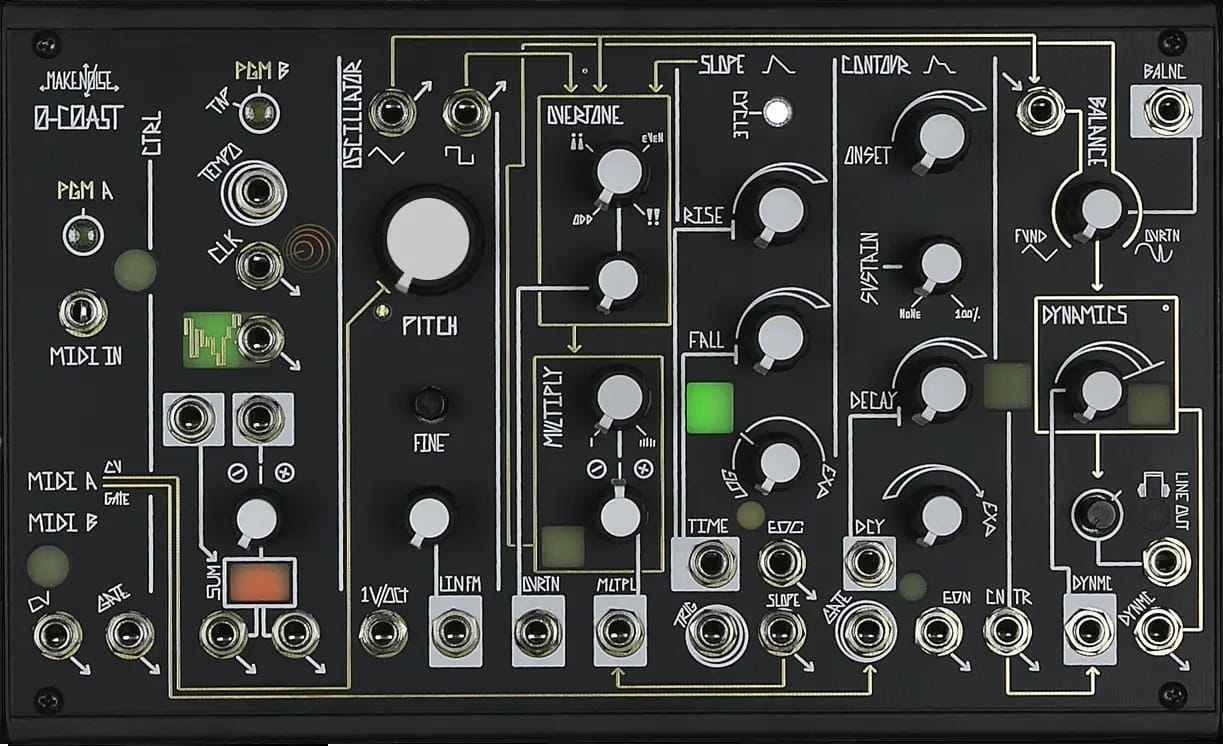
In practice that means a single voice that is already wired together inside, so it plays as a normal monophonic synthesizer the moment you plug in a keyboard. Its Overtone and Multiply circuits fold and animate the oscillator into bright, shifting timbres, and its Dynamics circuit is a transistor-based low pass gate, the Buchla-style trick that makes notes ring and fade like a struck object. There are two channels of MIDI to control voltage (CV), a built-in arpeggiator, an input for outside audio, and 13 patch sources and 14 destinations if you want to rewire it. It all fits in a case 5.5 by 9 inches and three quarters of an inch thick.
Make Noise 0-Coast vs Strega, side by side
| 0-Coast | Strega | |
|---|---|---|
| What it is | Single-voice semi-modular synthesizer | Experimental tone, delay and filter instrument |
| Designed by | Make Noise | Tony Rolando of Make Noise with Alessandro Cortini |
| Playable without cables | Yes, as a monosynth | Yes, it makes sound on its own, but patching is the point |
| MIDI built in | Yes, two channels of MIDI to CV and gate | No, play it from the 0-CTRL, the 0-Coast or other CV gear |
| Patch points | 13 sources, 14 destinations | 7 sources, 13 destinations, plus touch plates |
| External audio in | Yes | Yes, for processing other sounds |
| Best at | Bass, leads, plucks, sequences, learning synthesis | Drones, decaying textures, noise, sound design |
| Case | Steel, 5.5 x 9 x 0.75 in | Steel, 5.5 x 9 x 0.75 in |
| Works with Eurorack | Yes | Yes |
Details are from Make Noise's product pages and manuals. Make Noise sells both through authorized dealers rather than directly, so prices vary by store.
The Strega: an object left in the sea
Strega is Italian for witch, and the instrument leans all the way into the idea. Its panel is drawn like an alchemist's diagram, and its sections have names such as Activation, Tonic, Agitation, Time and Filter. Make Noise founder Tony Rolando describes it in the manual as an audio alchemical experiment: spill the tonic into time and let time decay through the filter. In plain terms, the Strega generates tones, feeds them into a delay, and lets the repeats decay through a filter, with a looping function generator to keep everything moving.
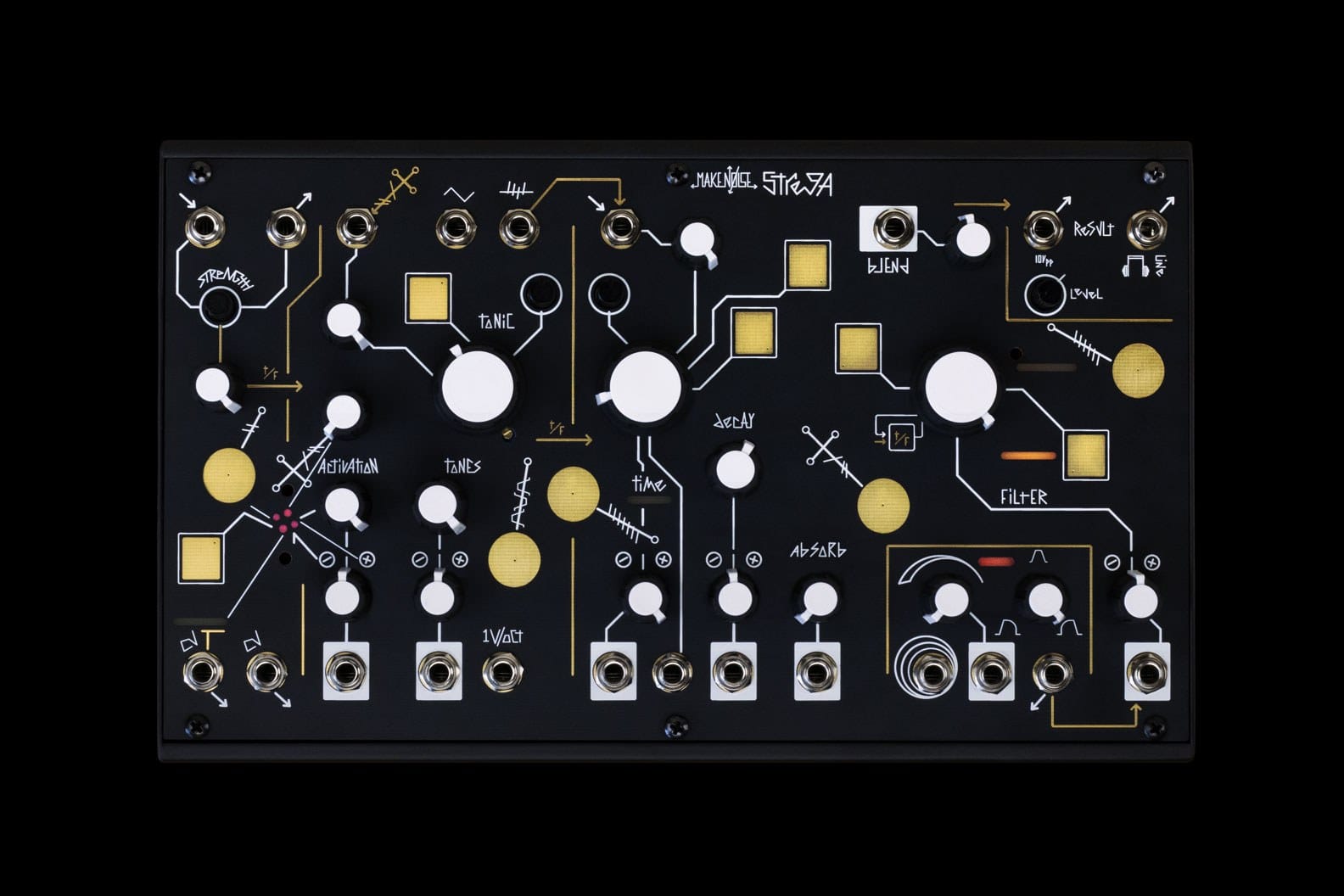
Cortini's own description, also in the manual, is the best one: he calls it the auditory equivalent of an object left in the sea for decades, with smoothed edges, mutated colors and softer textures. The gold touch plates, which Make Noise calls Touch Bridges and Gateways, let you make temporary connections with your fingers instead of cables, so you can play the Strega by hand like a bowed instrument. It can also process external sounds, so a drum machine, a guitar or the 0-Coast becomes raw material for it. What it does not do is behave like a normal keyboard synth. There is no MIDI jack, and the manual asks you to approach it with an openness to results that might be outside your control.
The third box: 0-CTRL
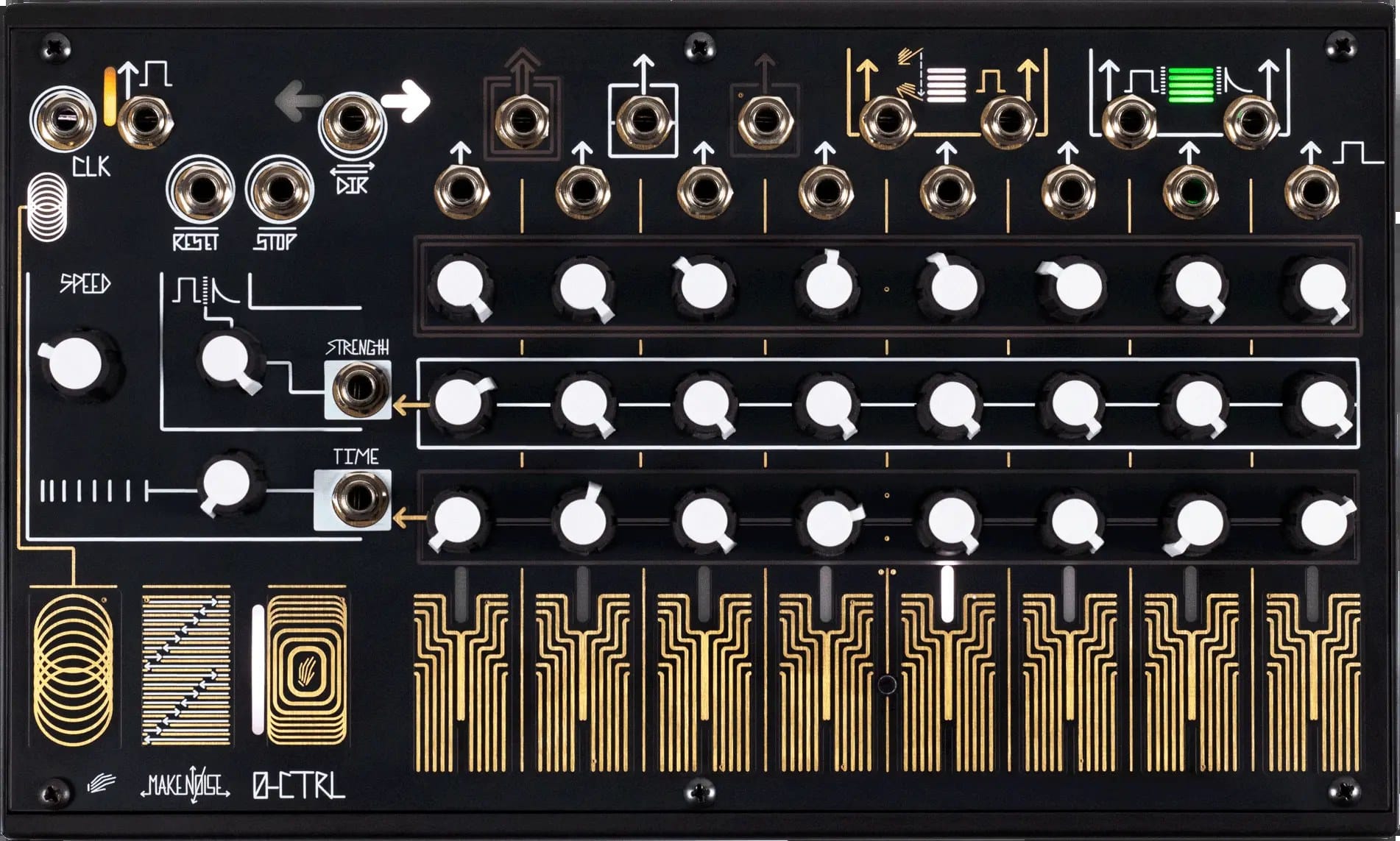
If you buy the Strega first, you will want something to play it with. That is the 0-CTRL, a fully analog controller and step sequencer in the same case, with touch plates for pitch, strength and time per step and no menus at all. Make Noise designed the three boxes as a family, and the Strega even ships with a Y cable so one power supply can run it alongside a 0-Coast or 0-CTRL.
Which to buy, by buyer
- Your first hardware synth: the 0-Coast. It plays from any MIDI keyboard and teaches real synthesis. Our modular signal flow explainer is a good companion.
- Ambient and drone producers: the Strega. It makes evolving, decaying textures that are hard to get from a plugin.
- Industrial and noise artists: the Strega, run hard with the External Substance input and the feedback paths, or the 0-Coast with heavy Overtone and Multiply.
- Live performers who want melody: the 0-Coast, with its arpeggiator and MIDI input.
- Planning a Eurorack system later: either, since both speak Eurorack voltages. Start with our modular synth starter guide.
Our call
Our call: buy the 0-Coast first, then add the Strega. The 0-Coast is the more complete instrument on its own: it plays from a keyboard, it covers far more musical ground, and it makes the Strega better when you patch the two together. Buy the Strega first only if you already know you want drones and textures more than notes, and budget for the 0-CTRL to play it. Both are buy-once instruments that hold their place on a desk for years.
Make Noise 0-Coast: our pick, the playable no-coast monosynth with MIDI. See it at Make Noise
Make Noise Strega: the drone and texture instrument designed with Alessandro Cortini. See it at Make Noise
Make Noise 0-CTRL: the analog sequencer and touch controller that plays both. See it at Make Noise
Where to buy: Make Noise sells through authorized dealers worldwide. Find a Make Noise dealer
For music made with this kind of gear, browse our Industrial hub and Ambient hub, and if Cortini's day job got you here, dig into the Nine Inch Nails live archive.
Design details, quotes and specifications are from Make Noise's official product pages and manuals.


