
Few pedals have shaped ambient music as much as Strymon's reverbs. Walk into a room where someone is making slow, glowing guitar drones or washing a synth pad into the distance, and there is a good chance a blue Strymon box sits at the end of the chain. The Southern California company now sells three big reverbs side by side: the compact blueSky V2, the original BigSky that became a pedalboard standard, and the BigSky MX that replaced it at the top. They overlap more than the prices suggest, and the right one depends on how deep you want to go. Here is how the BigSky, BigSky MX and blueSky compare, and which one to buy.
The quick answer
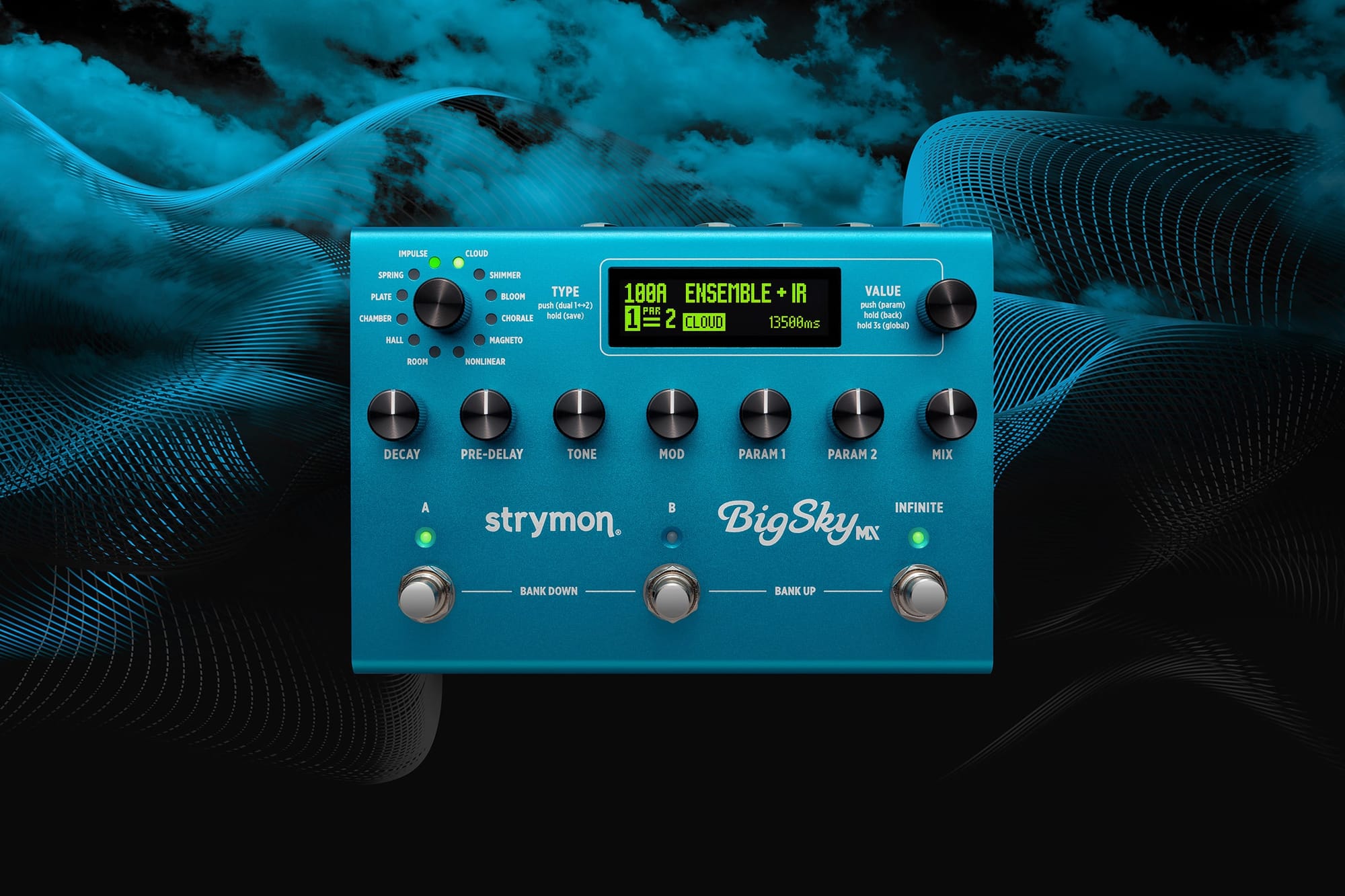
- Buy the BigSky MX if reverb is your instrument: 12 reverb machines, two reverbs running at once, a convolution engine that loads impulse responses and a dedicated Infinite footswitch for endless pads.
- Buy the blueSky V2 if you want three gorgeous reverbs, a Shimmer knob and stereo in and out in a small box, without menus.
- Buy the original BigSky if you want the classic 12-machine BigSky sound, including its famous Cloud, Bloom and Swell voices, and do not need dual reverbs or impulse responses.
How Strymon ended up with three skies
The first blueSky arrived in 2010 as a compact studio-grade reverb, at a time when most reverb pedals were either cheap and grainy or huge and expensive. The original BigSky followed in 2013 and turned into one of the most common sights on serious pedalboards, largely because of sounds like Cloud, a dense wash drawn from late 1970s studio techniques, and Shimmer, which adds pitch-shifted voices to the tail. The blueSky got a full second version in 2022 with a new processor and a dedicated Shimmer knob, and the BigSky MX landed in 2024 as a ground-up rebuild of the flagship.
Here is the part most buyers miss: Strymon still makes and sells the original BigSky alongside the MX, for less. So the question is not old versus new. It is whether you will use what the MX adds.
BigSky vs BigSky MX vs blueSky, side by side
| blueSky V2 | BigSky | BigSky MX | |
|---|---|---|---|
| Reverb types | 3: plate, room, spring | 12 machines, including Cloud, Bloom, Swell, Shimmer, Chorale, Magneto and Nonlinear | 12 machines, including new Impulse and Chamber, rebuilt Hall, Plate, Room, Spring and Shimmer |
| Reverbs at once | 1 | 1 | 2, in series, parallel or split |
| Impulse responses | No | No | Yes, stereo, up to 10 seconds, 22 included |
| Shimmer | Dedicated knob, different per reverb type | Shimmer machine | New frequency-based Shimmer plus the classic voice |
| Footswitches | 2 (On and Favorite) | 3 (A, B, C) | 3 (A, B and a dedicated Infinite) |
| Presets | 300 over MIDI (1 Favorite on the pedal) | 300 | 300 |
| Stereo | Stereo in (switch) and out | Stereo in and out | Stereo in and out with Class A JFET preamps |
| Display | None | LED readout | OLED screen |
| MIDI | Over USB or the expression jack | 5-pin DIN in and out | USB-C, TRS and DIN |
| Power needed | 9V, 300 mA | 9V, 300 mA | 9V, 500 mA |
Specifications and prices are from Strymon's official product pages in November 2026. All three use 24-bit, 96 kHz converters and let you choose true bypass or buffered bypass.
BigSky MX: the reverb workstation
The MX runs on a three-core 800 MHz processor, and Strymon put that power into three things. First, new algorithms: Impulse and Chamber were built for the MX, and Spring, Plate, Hall, Room and Shimmer were rewritten from scratch, with the original BigSky voices still available inside each. Second, two reverbs at once. You can run a short room into a long cloud, put a spring on the left and a hall on the right, or blend a shimmer under a plate, then pan each engine separately. Strymon also kept the classic time-based shimmer that Brian Eno made famous as a Classic voice beside its new frequency-based Shimmer. Third, impulse responses. The Impulse machine is a convolution reverb that loads recordings of real spaces and gear, ships with 22 stereo files including Strymon's own captures of vintage studio units, and lets you reverse, gate, stretch and freeze them.

For ambient players, the small details matter as much as the headline features. The Bloom machine gains a Harmonics engine that adds a soft, wind-instrument-like chord under the tail. Chorale adds a tenor or baritone choir. Cloud's Ensemble feature, which can swell a synthetic string section under a single guitar note, now responds more naturally to how hard you play. And the dedicated Infinite footswitch lets you hold a pad forever while your other two switches stay free for presets. The trade-off is depth: this is a menu-driven instrument, and you get the most from it with Strymon's free Nixie 2 editor on a computer.
BigSky: the original, still on sale
The original BigSky keeps its 12 machines, including two the MX does not list as separate machines: Swell, which fades the reverb in behind your notes like a volume pedal on the wet signal, and Reflections, a small-room model that calculates 250 reflections based on where your amp sits in the room. It has 300 presets, stereo inputs and outputs, an expression input, a Cab Filter for playing straight into a mixer and the same press-and-hold Infinite Sustain or Freeze on its preset switches.
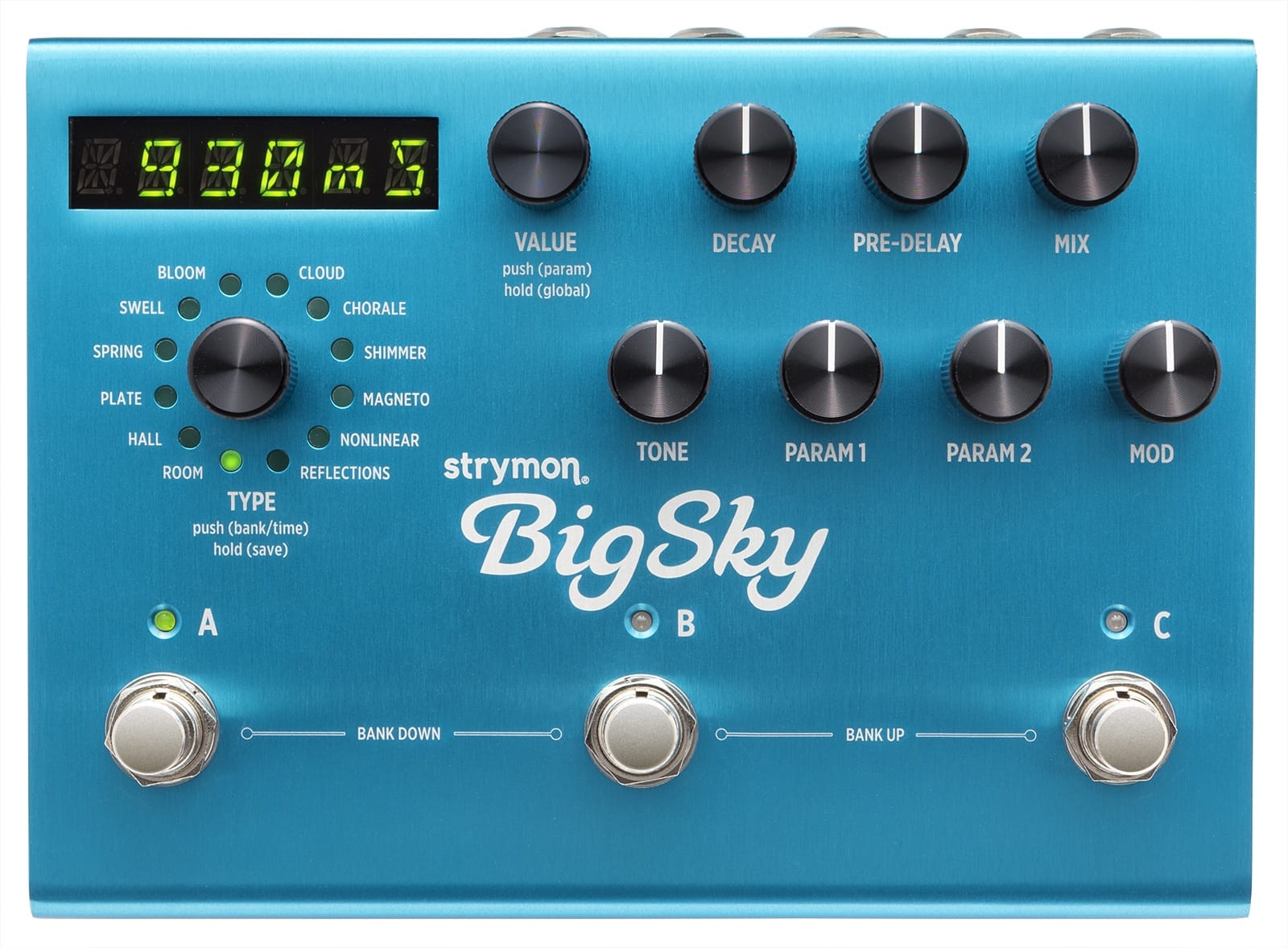
What it lacks is the MX's newer brain. It runs one reverb at a time, has no impulse responses, and its LED readout is more cryptic than the MX's OLED screen. If you love the classic BigSky sound and play one big wash at a time, it is still a great pedal, and the saving over the MX is real.
blueSky V2: the one with no menus
The blueSky V2 takes the opposite approach. It offers three reverbs, plate, room and spring, and makes each one stretch from realistic to huge. Its trick is the Shimmer knob, which behaves differently for each type: octave-up on the plate, an octave plus a fifth on the room and an octave down with a slow wobble on the spring. A three-way Mod switch adds light or deep movement, Low and High knobs shape the tail, and a Favorite footswitch recalls one saved sound.
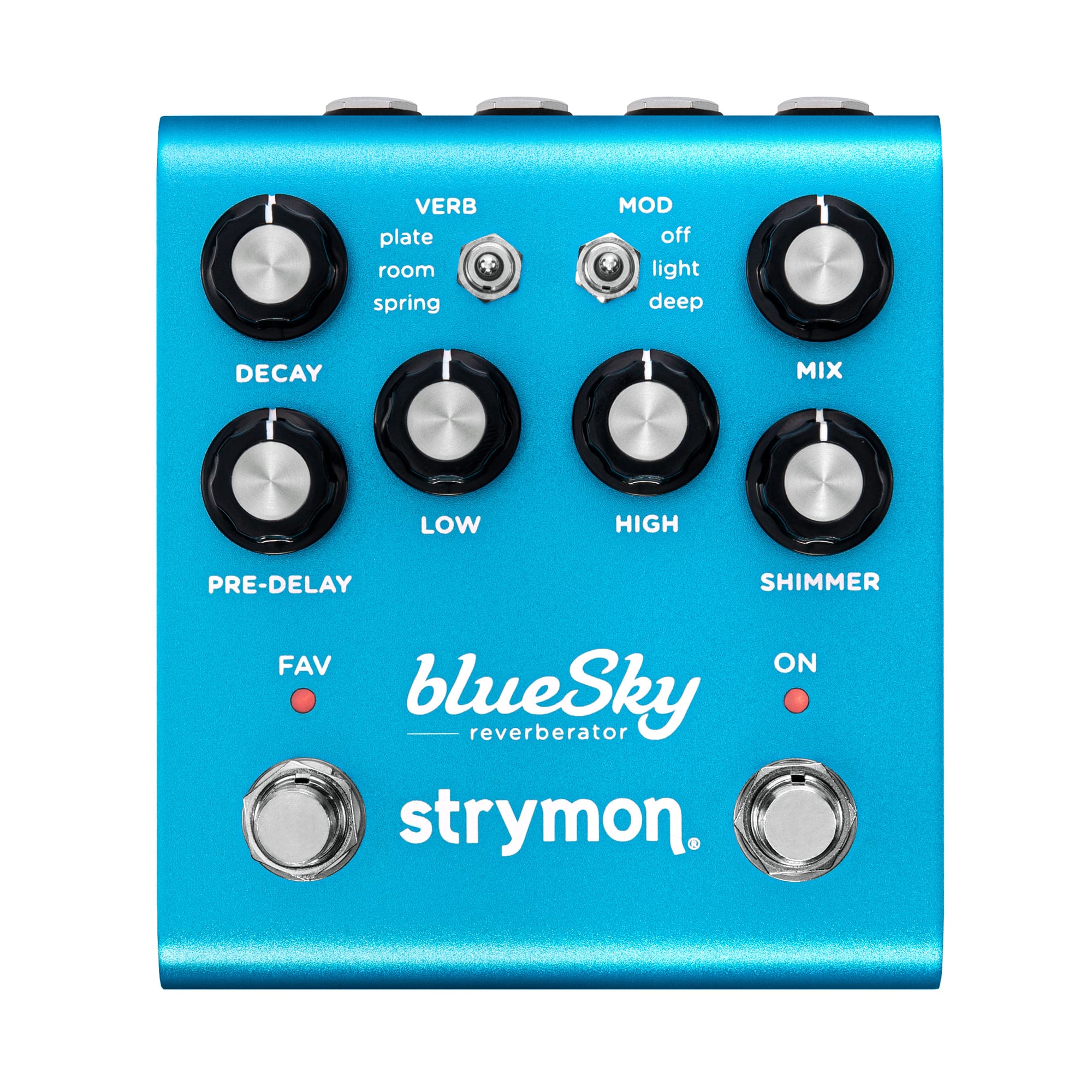
It is the easiest of the three to love on day one. Everything is on the panel, it takes up much less pedalboard space, and the 520 MHz processor gives it very long, smooth tails. You can still reach 300 presets over MIDI if you want them later. What you give up is variety: no Cloud, no Bloom, no Swell and no freeze footswitch.
Which Strymon reverb to buy, by buyer
- Ambient guitarist building long, evolving drones: the BigSky MX. Two reverbs at once and a dedicated Infinite switch are made for this.
- Synth and drum machine player in a home studio: the BigSky MX, for stereo inputs, impulse responses and USB-C MIDI control from your computer.
- Guitarist who wants one beautiful reverb that is always on: the blueSky V2.
- Small pedalboard: the blueSky V2. At 4 inches wide it is a little over half the width of the BigSky pedals.
- Fan of the classic BigSky Cloud and Swell sounds on a tighter budget: the original BigSky.
- Still choosing between brands: our Eventide H90 vs H9 Gen 2 vs H9 Max guide and Mood MKII vs Microcosm comparison cover the other big ambient boxes.
Our call
Our call: buy the BigSky MX. For ambient music, two reverbs at once and a dedicated Infinite footswitch change how you play, and the impulse engine opens up sounds the other two cannot make. It costs the most of the three, but it is the last reverb pedal most people will need. Buy the blueSky V2 if you want great reverb without menus, and pick the original BigSky only if you specifically want its classic voices for less.
Strymon BigSky MX: our pick, with two reverbs at once, impulse responses and an Infinite footswitch. Check price or buy at Strymon
Strymon blueSky V2: three reverbs and a Shimmer knob with no menus. Check price or buy at Strymon
Strymon BigSky: the original 12-machine BigSky with Cloud, Bloom and Swell. Check price or buy at Strymon
For more on the original pedal, read our Strymon BigSky guide, see our best reverb pedals for ambient music, and find records and gear for slow, spacious music in our Ambient hub.
Prices and specifications are from Strymon's official product pages in November 2026 and can change.
Unknowndivide may earn a commission from purchases made through links in this post. As an Amazon Associate we earn from qualifying purchases.