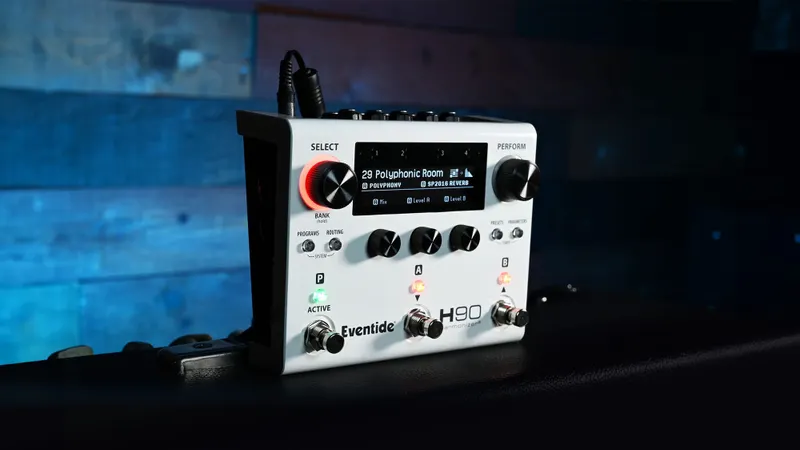
Every ambient guitarist and synth player eventually lands on the same question. Eventide's Harmonizer pedals have the reverbs everyone wants, Blackhole, Shimmer, SpaceTime, the kind of endless wash that turns one chord into a whole piece, but there are three of them now, and the price runs from $499 to $999. For years the answer was simple: the small H9 Max or the big H90. Then Eventide released the H9 Harmonizer Gen 2, put the entire H90 sound library inside the small box, and quietly broke the old rule. Here is how the H90, H9 Gen 2 and H9 Max compare today, and which one to buy.
The quick answer
- Buy the H9 Gen 2 ($599) if you want Eventide's full modern sound library, including the granular and vocal effects, on a small pedalboard or a studio desk. For most players this is now the one.
- Buy the H90 ($999) if you want two effects running at once with real routing: two mono inserts or one stereo insert for other pedals, six footswitches in Perform mode and two expression inputs. It is a pedalboard brain, not just a pedal.
- Buy the H9 Max ($499) only if you want the classic 52 algorithms for the lowest price and are happy editing mostly from the app.
The company that invented the Harmonizer
Eventide is the New Jersey company behind the H910 Harmonizer, which it calls the world's first digital effects processor. That box, with its mix of pitch shifting, delay and modulation, is on records by AC/DC, David Bowie, Frank Zappa and Van Halen, and it was inducted into the TECnology (Technical Excellence and Creativity) Hall of Fame in 2007. The word Harmonizer is still an Eventide trademark, which is why every one of these pedals carries it.
The lineage matters because all three pedals here are descendants of Eventide's studio racks. The H90, Eventide says, uses architecture derived from its flagship H9000 Harmonizer, a studio processor that sells for $5,999 and up. The pedals are, quite literally, a way to put rack-unit studio effects on the floor.
Eventide H90 vs H9 Gen 2 vs H9 Max, side by side
| H9 Max | H9 Gen 2 | H90 | |
|---|---|---|---|
| Price at Eventide | $499 | $599 | $999 ($1,099 for the limited H90 Dark) |
| Algorithms | 52 | 74 plus, including the full H90 and H9 Max libraries | 74, including all 52 from the H9 Max |
| Presets | 99 on board, 500 plus through the app | 1,000 plus | Hundreds of factory Programs |
| Two effects at once | No | Not advertised | Yes, in series or parallel, with spillover |
| Footswitches | 2 | 2, plus HotKnob and HotSwitch macros | 6 programmable footswitch functions in Perform mode |
| Controls and screen | One knob, small display | 3 Quick Knobs, button pads, 2.5 inch display | 5 push knobs, 7 buttons, high-resolution OLED display |
| Inserts for other pedals | No | No | Two mono or one stereo |
| Expression and aux | 1 input | 1 expression, 1 aux | 2 inputs, each for expression, aux switches or CV |
| Power | 9V DC, 500 mA | 12V DC, 1 A | 12V DC, 1 A |
| Size | 118 x 133 x 50 mm | About 5.25 x 5 x 2.7 inches, 1.33 lb | 170 x 136 x 68 mm |
Specifications and prices are from Eventide's official product pages and online store in November 2026. All three have stereo inputs and outputs, MIDI (Musical Instrument Digital Interface) control and instrument or line-level operation, so they work with guitars, synths and studio sends alike. CV means control voltage, the signal modular synths use, which only the H90 lists for its expression inputs.
H9 Gen 2: the new sweet spot
The H9 Gen 2 is the reason this comparison has changed. Eventide describes it as the next generation of the H9, with modern processing and the complete H90 algorithm lineup in a compact format. That means the effects that used to be the main reason to buy an H90 are now in the small box too: Cosmic Web, Glitch, GrainMod and Stutter, the granular algorithms Eventide added to the H90, plus Polyphony, Prism Shift, Wormhole, the SP2016 Reverb and the Quadravox vocal harmonizer. Eventide lists more than 1,000 presets.
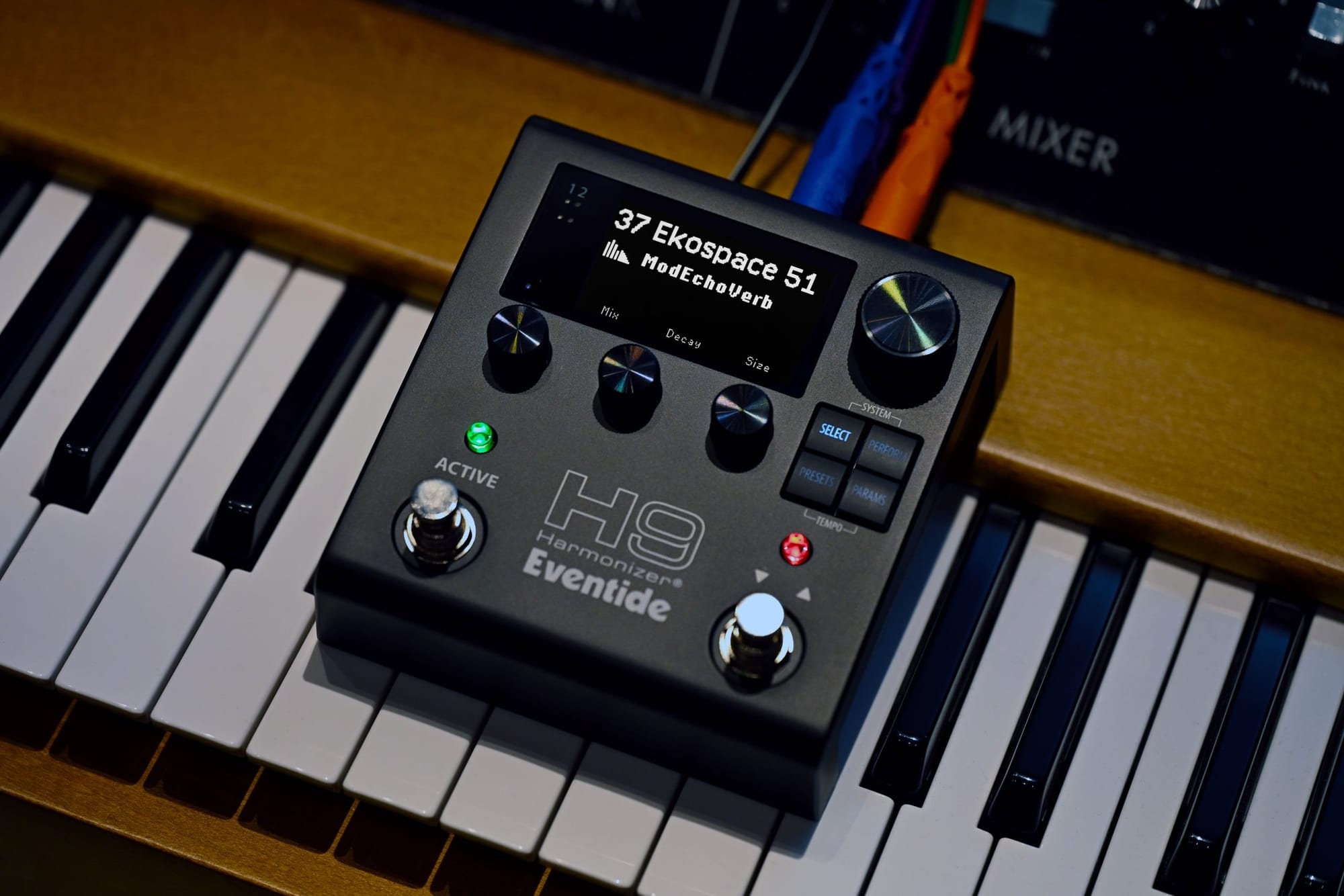
The interface is also far friendlier than the original H9. Instead of one knob and a tiny readout, the Gen 2 has a 2.5 inch display, three Quick Knobs and button pads, and four modes for selecting, performing, browsing presets and editing parameters. Eventide's pitch is that it feels less like a menu-driven processor and more like an instrument, and that is the right goal for a pedal that sits under your feet. You can still plug it into Eventide's Control app over USB-C for deeper editing and preset lists.
What it does not do is the H90's party trick. Eventide's H90 page is built around running two algorithms at once with routing between them, and the H9 Gen 2 page does not advertise that. It also has two footswitches instead of the H90's six-switch Perform mode, and no insert loops for your other pedals.
H90: the pedalboard brain
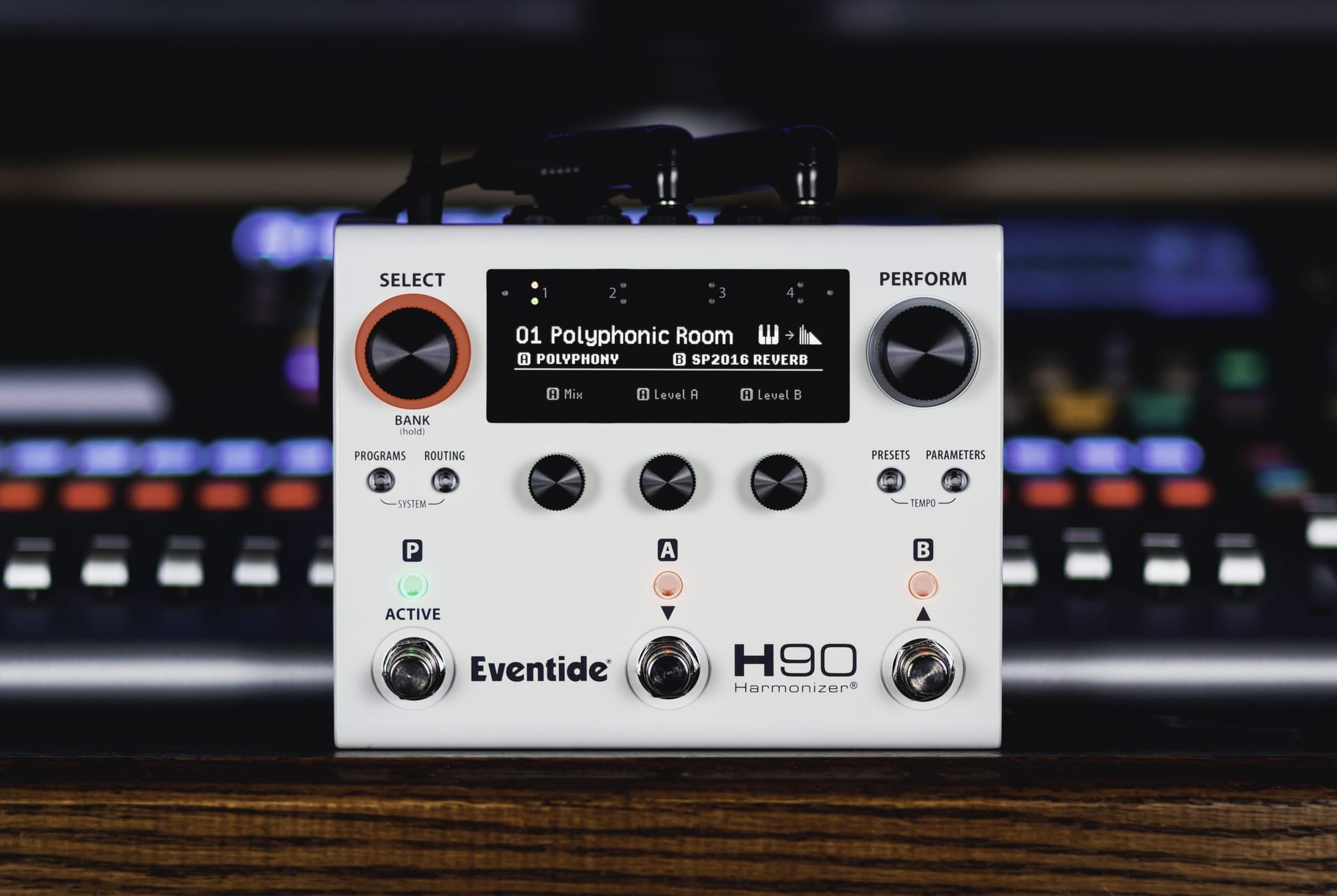
The H90 is for players who want one box to run an entire board. Every Program can hold two algorithms in series or in parallel, so you can stack, say, a pitch effect into Blackhole the way Eventide's own Shoegazer Program does, or run a delay and a reverb side by side. Spillover between Programs means reverb tails keep ringing when you switch sounds, which matters a lot for ambient sets where the tail is the music.
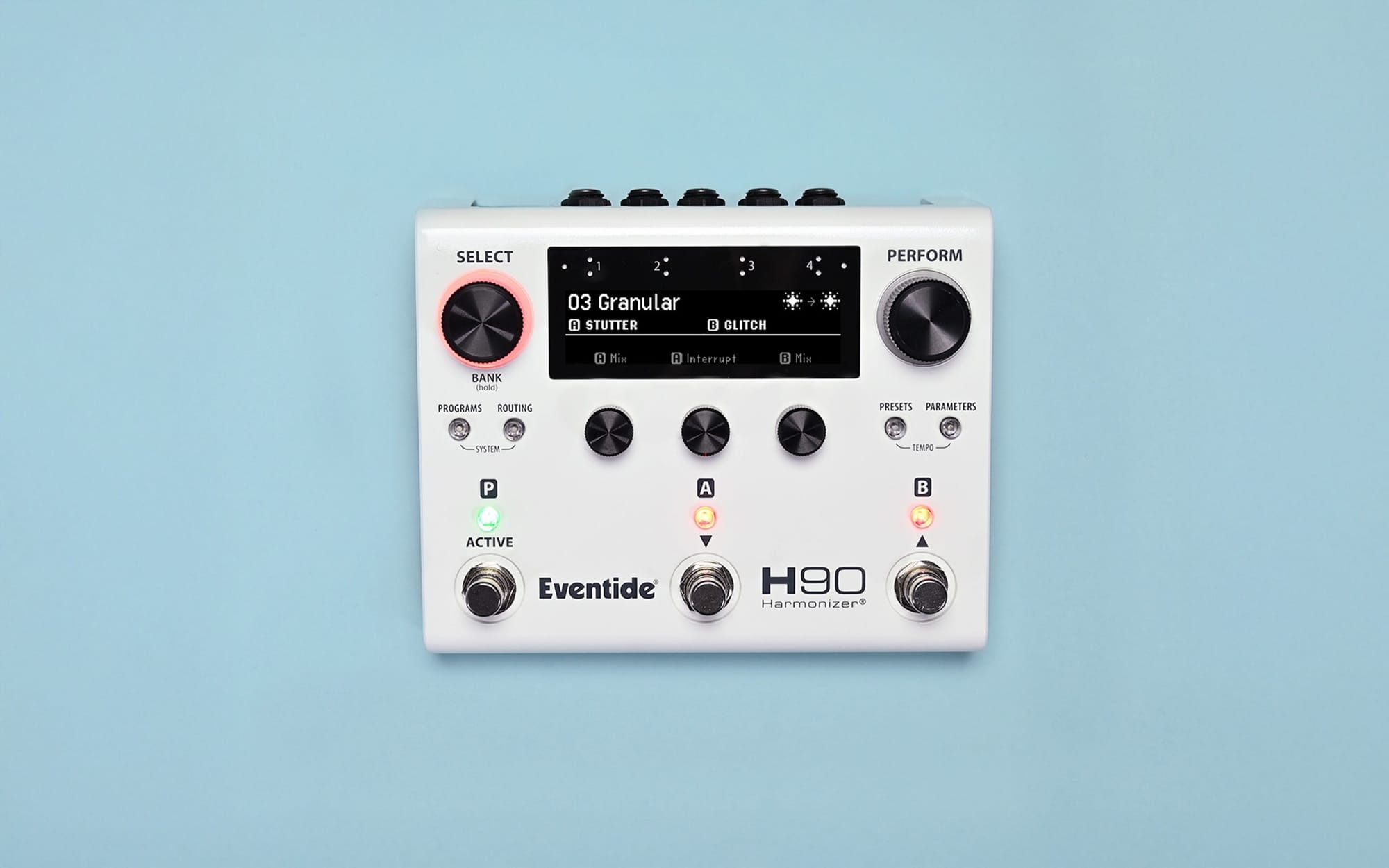
The routing is the other half. Two inserts, usable as two mono loops or one stereo loop, let you place your favorite drive or fuzz pedals anywhere in the H90's chain. The four-cable method puts some effects before your amp and some in its effects loop, and you can even process two separate stereo instruments at once, a synth and a guitar, for example. Add six programmable footswitches in Perform mode, freeze and repeat functions, two expression inputs and Bluetooth editing from an iPad, and it is easy to see where the extra $400 goes. If you will not use the routing, though, you are paying for features that sit idle.
H9 Max: the classic on a budget
The H9 Max is the original modern Eventide pedal, and still a great-sounding one. It runs 52 algorithms, every effect from Eventide's Factor and Space series pedals plus some made only for the H9, with 99 presets on board and more than 500 available through the H9 Control app on phones, tablets and computers. Players from Aerosmith's Brad Whitford to Dweezil Zappa are listed on its page.
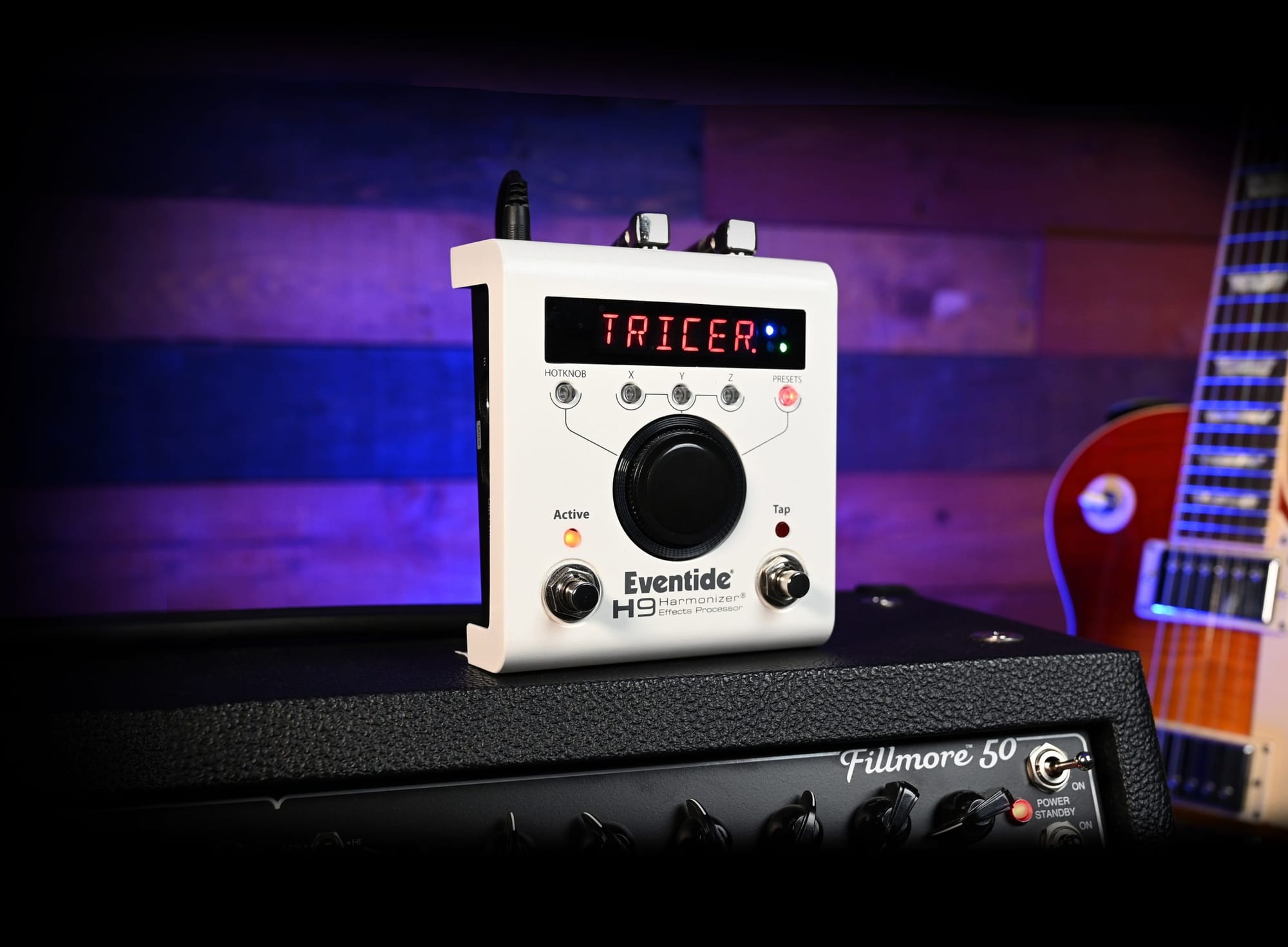
The catch is the price gap. At $499, the H9 Max is only $100 below the Gen 2, and it misses the granular, vocal and polyphonic algorithms, the bigger screen and the extra knobs. Editing on the pedal itself is famously fiddly with one knob, so most owners live in the app. Buy it only if the budget really stops at $499, or if you find one used.
Which Eventide to buy for ambient
- Ambient guitarist with a small board: the H9 Gen 2. Blackhole, Shimmer, SpaceTime and the granular effects in one compact pedal.
- Synth player or home studio: the H9 Gen 2 on a desk, fed from a synth at line level, is the best $599 reverb and delay box we can think of.
- Ambient live sets and big boards: the H90, for two effects at once, spillover tails and the inserts.
- Tight budget: the H9 Max, ideally used, or look at a single-purpose reverb in our best reverb pedals for ambient list.
Our call
Our call: buy the H9 Gen 2. It gives you the whole modern Eventide sound library, including the granular and vocal effects that used to be H90-only, in a small pedal with a proper screen, for $400 less than the flagship. Step up to the H90 only if you need two effects at once, insert loops and six footswitches for live work, and skip the H9 Max new now that the Gen 2 costs just $100 more.
Eventide H9 Harmonizer Gen 2 ($599 at Eventide): our pick, the full H90 library in the compact pedal. Shop it at Eventide
Eventide H90 Harmonizer ($999 at Eventide): two effects at once, inserts and six-switch Perform mode. Shop it at Eventide
Eventide H90 Dark Harmonizer ($1,099 at Eventide): the same H90 in all black, a limited run while supplies last. Shop it at Eventide
Eventide H9 Max Harmonizer ($499 at Eventide): the classic 52 algorithms for the lowest price. Shop it at Eventide
More ways to build a wash: compare the two looper pedals in our Mood MKII vs Microcosm guide, read about the tape machine that started it all in our Roland RE-201 Space Echo story, and browse more in our Ambient Music Hub.
Prices are from Eventide's US online store in November 2026 and change often. Specifications and history are from Eventide's official product pages.
Unknowndivide may earn a commission from purchases made through links in this post.