

If you make ambient music with a guitar, a synth or a voice, sooner or later someone tells you to buy one of two pedals: the Chase Bliss MOOD MKII (Mark II) or the Hologram Electronics Microcosm. Both take a few seconds of whatever you play and turn it into something that keeps going after you stop, a shimmer, a stutter, a slowly rotating cloud. Both run in stereo, sync to MIDI (Musical Instrument Digital Interface) clock and sit at the experimental end of the pedalboard. But they think about sound in opposite ways. MOOD is two small machines that talk to each other. Microcosm is a library of granular effects with a proper looper bolted on. Here is how to pick.
The quick answer
- Buy MOOD MKII if you want a pedal you play like an instrument, catching fragments as you go and bending their speed, pitch and texture by hand. It is $399.
- Buy Microcosm if you want more distinct sounds out of the box, a 60-second looper for building whole pieces live, and presets you can save and recall on stage. It is $469.
- Buy both only if ambient is your main job. They do different things well and stack nicely, MOOD into Microcosm.
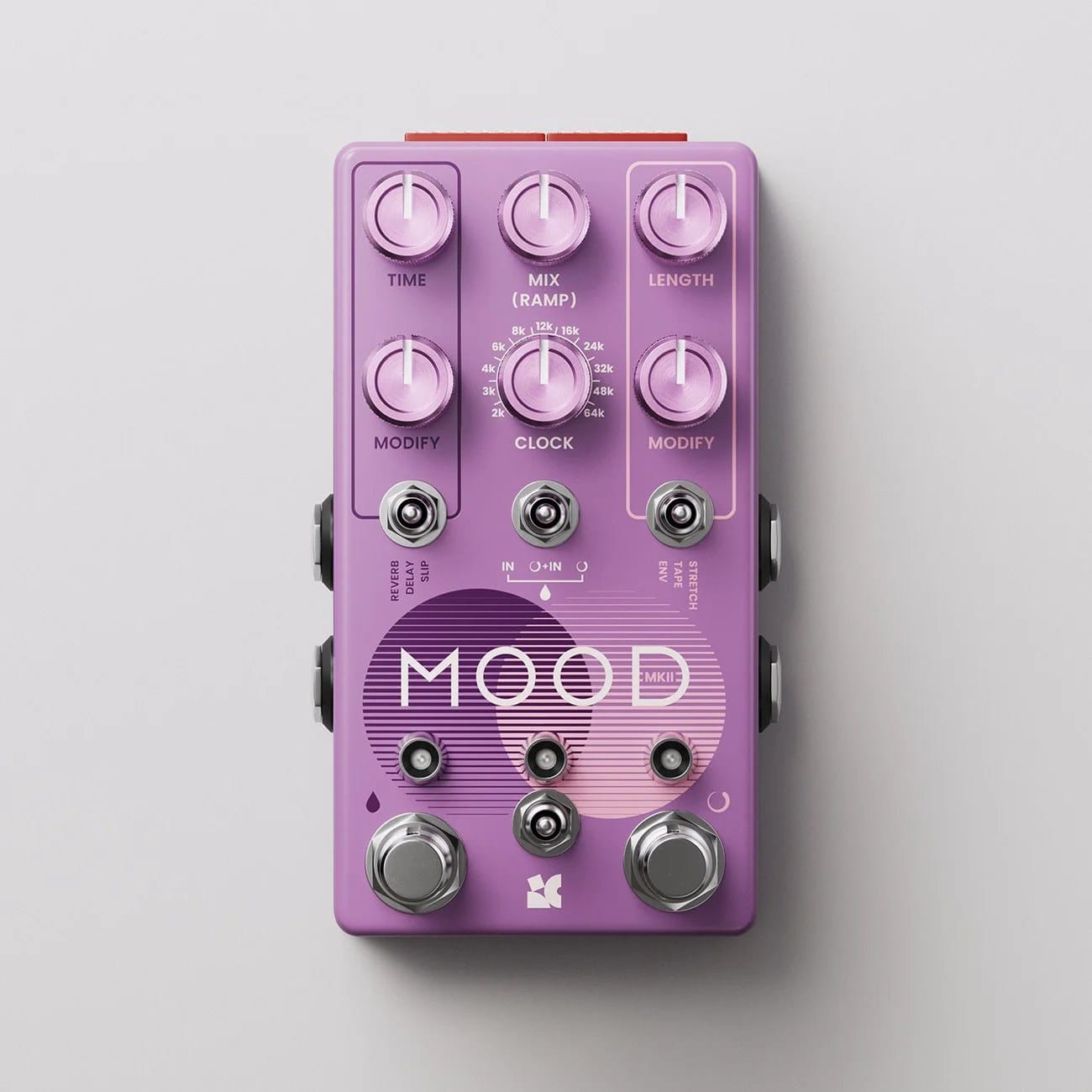
Chase Bliss MOOD MKII: two channels that listen to each other
Chase Bliss calls MOOD MKII a different kind of multi-effect, and the description fits. One half is the Micro-Looper, which is always listening: it records continuously in the background, so when you press the footswitch you capture what you just played rather than what you are about to play. The maker compares it to fishing. The other half is the Wet Channel, a set of real-time effects that can process the loop, your live signal or both.
Each half has three modes. The Wet Channel offers Reverb (which turns into an ambient pad when frozen), Delay (a looping echo) and Slip, an odd sampling mode that warps playback speed and direction. The Micro-Looper offers Env, which lets your playing interrupt and slice the loop, Tape, a straightforward tape-style looper with speed and direction control, and Stretch, which slows a loop to a crawl as you turn the knob. Either channel can be frozen or flipped: the Wet Channel can become a held pad, and the looper can act like a delay.
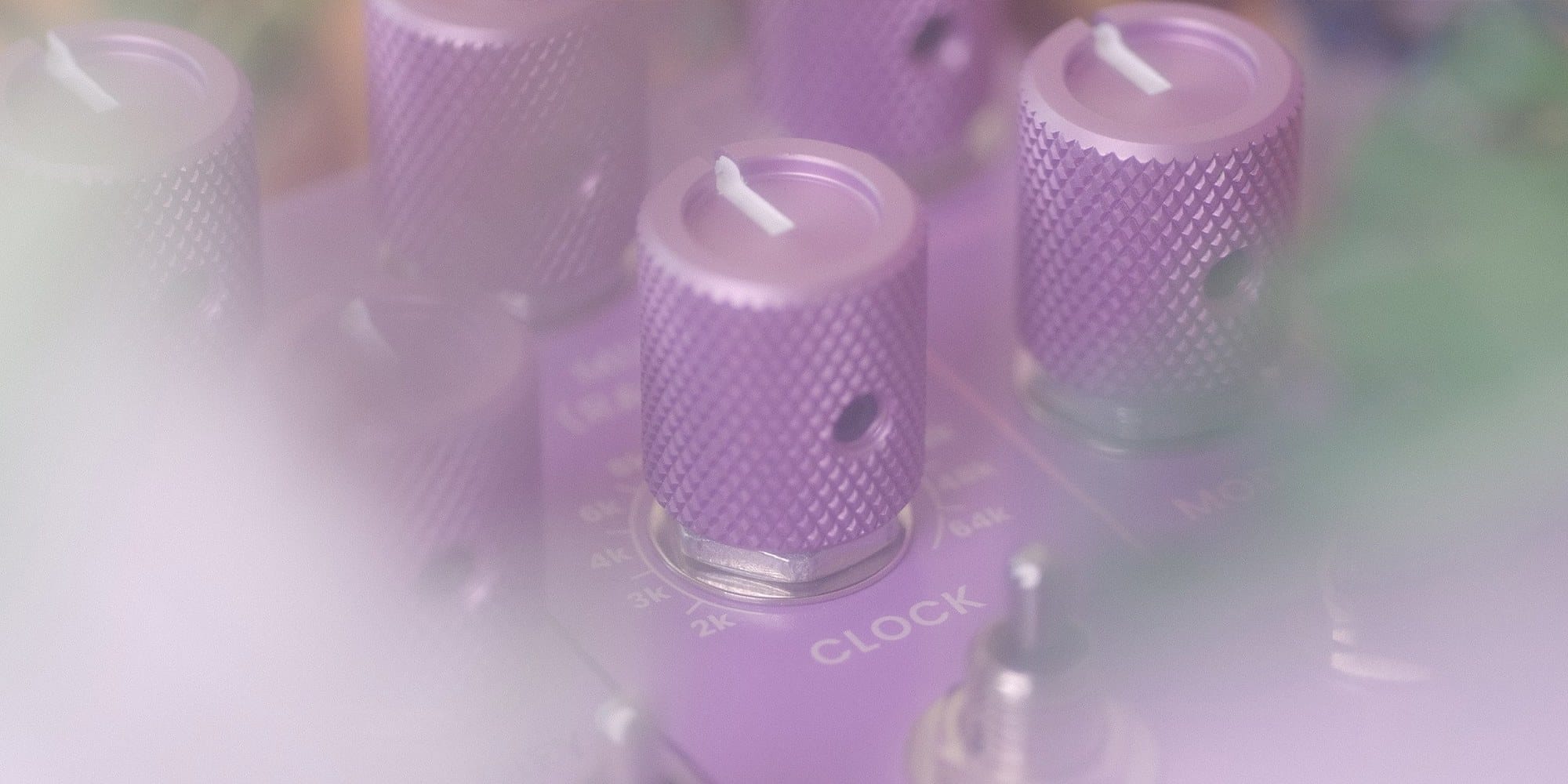
The secret weapon is one knob. Clock sets the sample rate of both channels at once and moves in harmonized musical steps, so you can halve the speed of a loop and the reverb it is running through together, and drop into deliberate grit and aliasing at the bottom of its range. Chase Bliss calls it tone, length and quality in one control. The pedal was designed with Drolo FX and Old Blood Noise Endeavors.
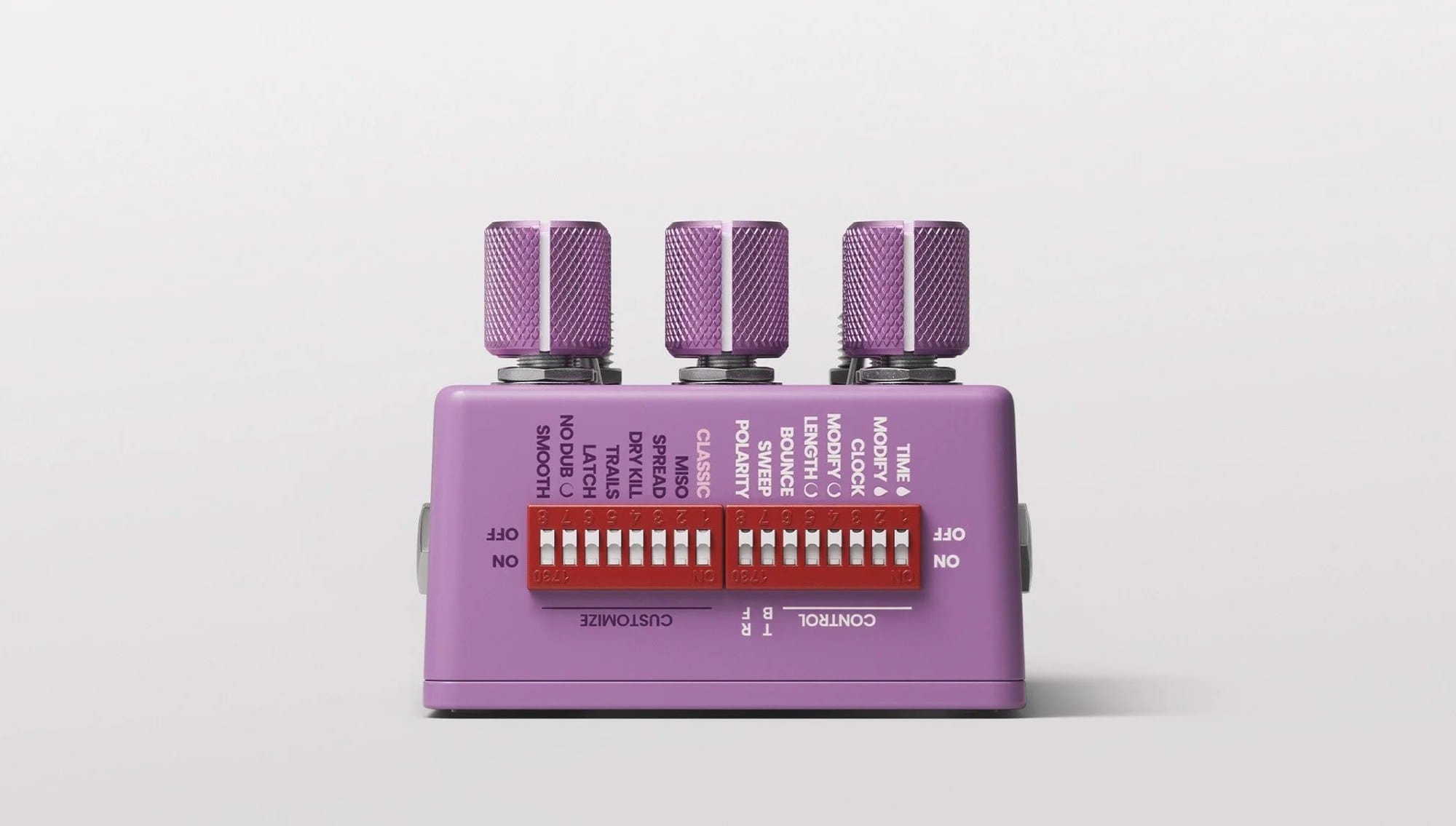
MKII added what the first MOOD was missing: stereo, overdubbing, freezing, syncing and fading, plus cleaner sound, with a Classic Mode for players who liked the original's rougher edges. You can now play it from a keyboard over MIDI, sync it to clock and reach every parameter, including hidden ones set by the row of dip switches on the back. There is control voltage (CV) and expression input, internal modulation called ramping, analog dry thru and buffered bypass with trails. The catch: only two presets, stored on a three-way toggle.
Hologram Microcosm: a granular library with a real looper
Hologram Electronics describes Microcosm as a granular effects pedal that rearranges and reinterprets your sound through sampling, pitch shifting, delay and looping. Granular means it chops incoming audio into tiny grains and replays them in new orders, speeds and pitches. Microcosm groups 11 effects into four banks, each with four preset variations, for 44 starting points.
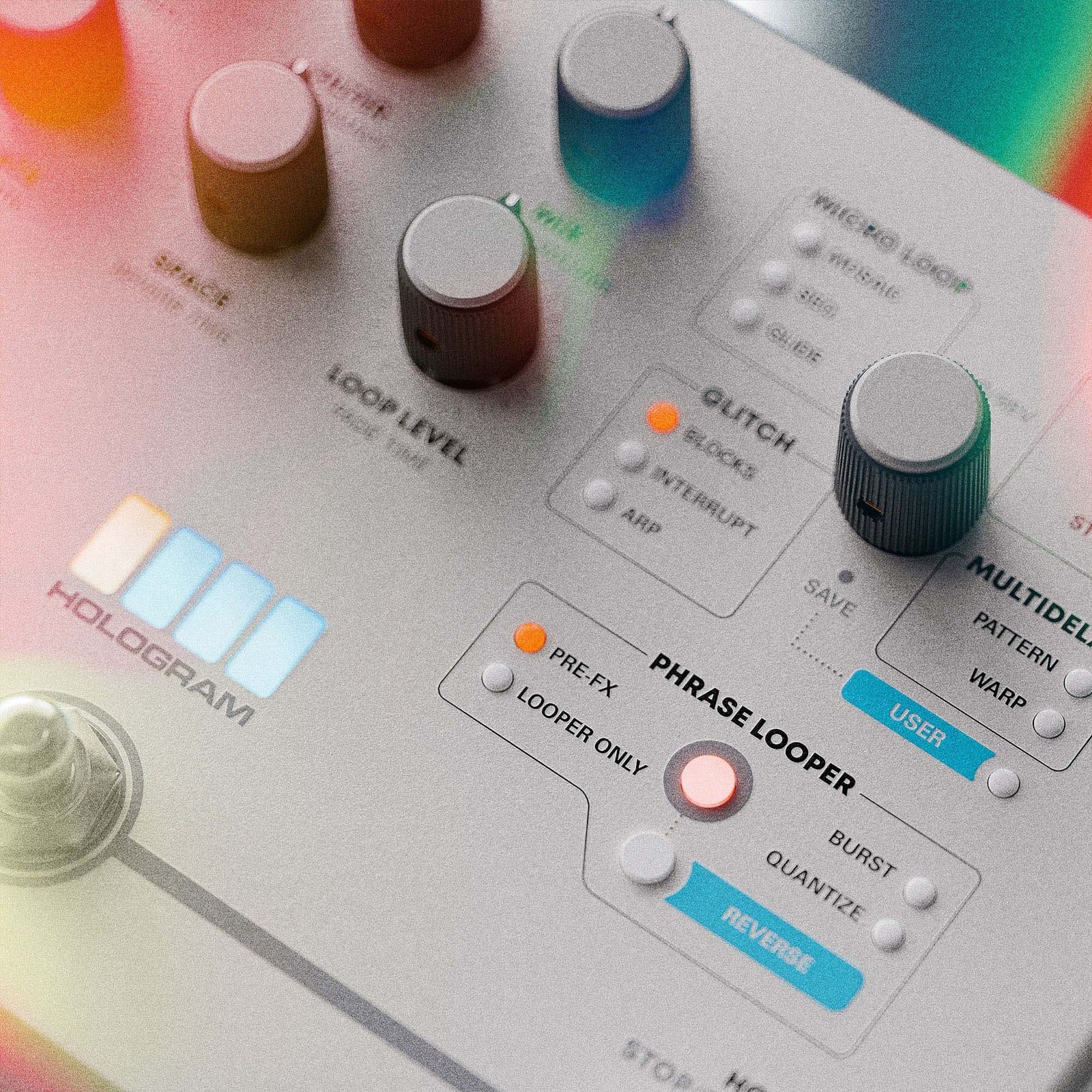
The Micro Loop bank holds Mosaic (overlapping loops at different speeds), Seq (samples rearranged into new rhythms) and Glide (short loops that drift in pitch). Granules holds Haze, an instant wash, Tunnel, for hypnotic drones, and Strum, for pointillist textures built from your recent notes. Glitch holds Blocks, Interrupt and Arp, which turns samples into arpeggios. Multi Delay holds Pattern and Warp. On top sit a stereo reverb with four styles, pitch modulation, a resonant lowpass filter, a reverse switch and a Hold sampler that freezes the effect indefinitely.
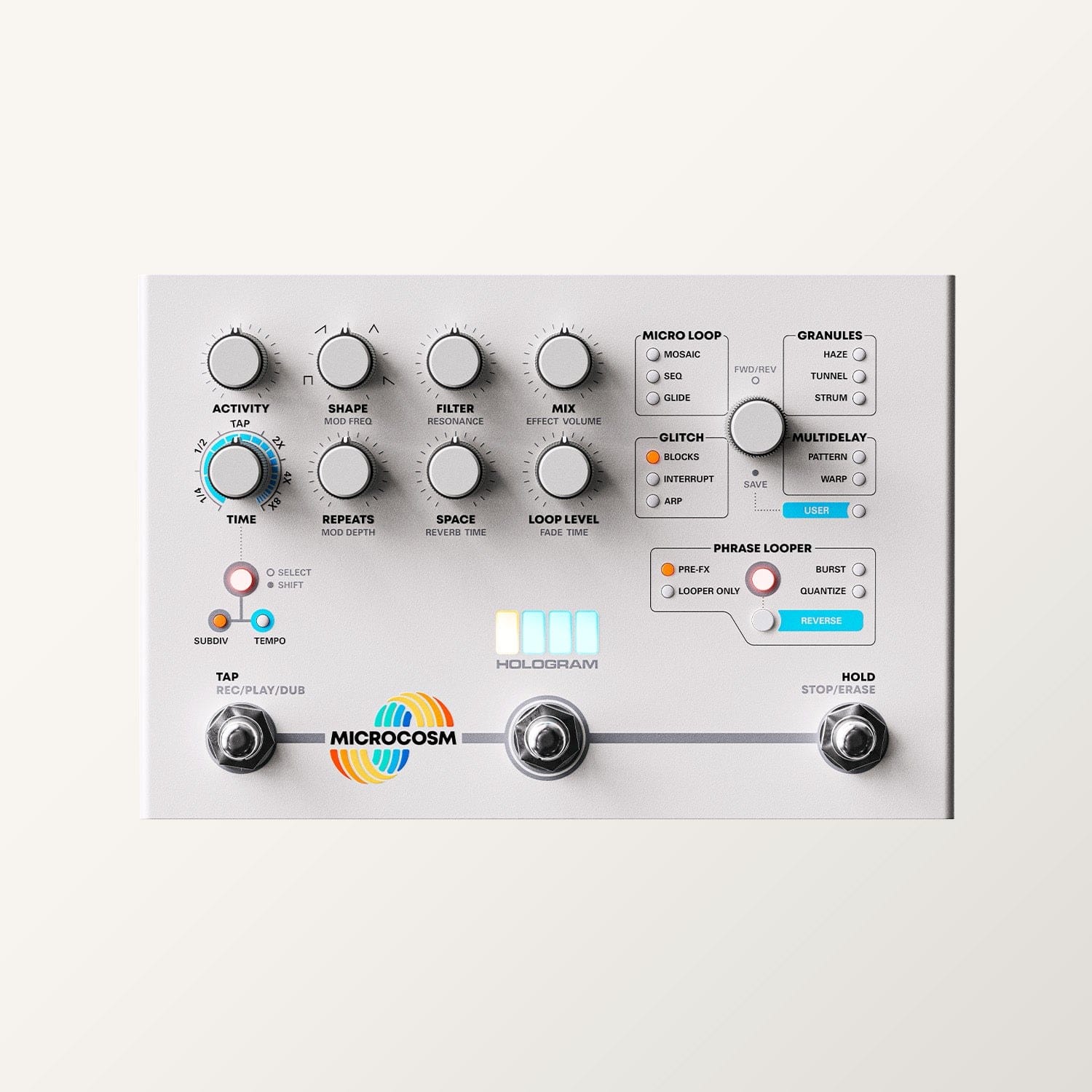
The bigger difference is the phrase looper. Microcosm records up to 60 seconds, before or after the effects, with infinite overdubs, reverse playback, fades and undo, and it can run completely independent of the effects bank. Add 16 user preset slots that save loops as well as settings, MIDI in, out and thru, tap tempo, expression input, a choice of true or buffered bypass, and instrument or line level inputs, and you have a pedal that can carry a whole ambient set. It measures 7.1 by 4.7 by 2.0 inches and comes with its own 9-volt supply.
MOOD MKII vs Microcosm compared
| Chase Bliss MOOD MKII | Hologram Microcosm | |
|---|---|---|
| Price at the maker | $399 | $469 |
| Core idea | Always-listening micro-looper plus a spatial effects channel | Granular, glitch and delay effects plus a phrase looper |
| Effect modes | 3 wet (Reverb, Delay, Slip) and 3 looper (Env, Tape, Stretch) | 11 effects in 4 banks, 44 preset variations |
| Long looper | No, short micro-loops set by the Clock knob | Yes, 60 seconds with overdubs, reverse and undo |
| Freeze | Freeze the Wet Channel into a pad | Hold sampler freezes the effect |
| Presets | 2 | 16, with loops |
| Stereo | Yes | Yes |
| MIDI | Note, program change, control change, clock | In, out and thru, clock sync |
| Other control | CV, expression, ramping, dip switches | Expression, tap tempo |
| Bypass | Buffered with analog dry thru, trails | True bypass or buffered with trails |
| Best for | Hands-on sound design, players who improvise | Building and performing full ambient pieces |
How to choose
Think about the last time you played something you loved and lost. MOOD is built for that moment, because the looper was already recording. It rewards fiddling: the Clock knob, the freeze switches and the interplay between channels make it feel less like a preset box and more like an instrument with its own personality. It is also the one that sounds best on synths and drum machines, thanks to stereo in and out and deep MIDI, including playing it from a keyboard.
Microcosm is the more complete tool for performing. The 60-second looper lets you lay down a chord bed, layer a melody and let granular effects chew on both, then save the whole thing to a preset for the next show. If you want twenty very different textures in your first afternoon with the pedal, Microcosm gets you there faster.
A word on what comes before them. Neither replaces a good reverb, and the classic ambient chain still runs a delay into a big reverb at the end. Our guide to the best reverb pedal for ambient covers that end of the board, and our explainer on analog vs digital delay covers the repeats.
Our call
Our call: buy Microcosm if this is your first ambient looper, and MOOD MKII if you already have a looper and want something stranger. Microcosm does more on day one: more sounds, a real 60-second looper and 16 presets, for $70 more. MOOD MKII is the deeper and more personal pedal, and the always-listening looper with that Clock knob is a way of making music you will not find elsewhere, but its short loops and two presets mean it works best alongside a looper rather than as your only one. Either way, put it near the end of the chain, run it in stereo if you can, and leave room for happy accidents.
Hologram Electronics Microcosm ($469): our pick for a first ambient looper, with 11 granular effects, a 60-second looper and 16 presets. Shop it at Hologram Electronics
Chase Bliss MOOD MKII ($399): the pick for improvisers who want to catch and bend fragments by hand. Shop it at Chase Bliss
Need records to play along to? Start with our ambient music starter guide. More like this: browse every related post in our Ambient Music Hub.
Prices are from each maker's own online store in mid-November 2026 and can change.