
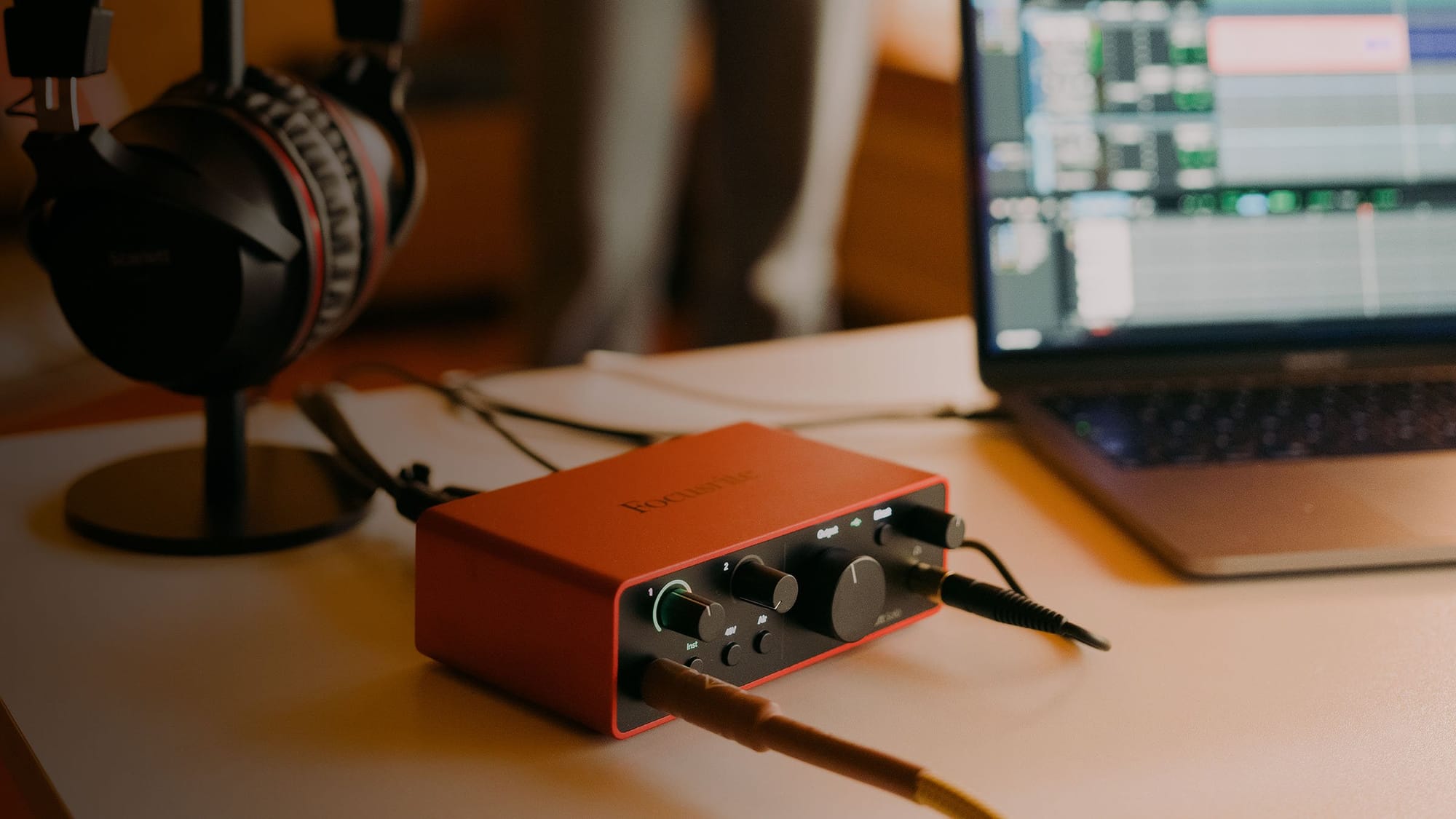
Ask anyone where to start recording at home and you will hear the same word: Scarlett. Focusrite's red boxes sit on more bedroom desks than any other interface, and the 4th generation lineup gives you three obvious choices at three prices. They share the same converters, the same 120 decibel output dynamic range and the same software bundle, so the decision is not really about sound. It is about how many things you want to plug in at once, and how much help you want getting your levels right. Here is how the Scarlett Solo, 2i2 and 4i4 compare, and which one to buy.
The quick answer
- Buy the Scarlett Solo if you only ever record one source at a time, like a vocal or a guitar, and want the cheapest way in. $169.99 at Focusrite.
- Buy the Scarlett 2i2 if there is any chance you will record two things at once, such as a voice and a guitar, two mics for a podcast or a stereo synth. It also adds Auto Gain and Clip Safe, which the Solo lacks. $239.99 at Focusrite.
- Buy the Scarlett 4i4 if you have synths, drum machines or a MIDI keyboard to connect, or you want separate mixes for headphones and speakers. $339.99 at Focusrite.
From George Martin to your desk
Focusrite did not start with cheap interfaces. In Focusrite's own history, the company began in 1985 with a one-off commission from Sir George Martin, the Beatles' producer, who wanted a no-compromise microphone preamp. The result was the ISA 110, and its circuit has been evolving inside Focusrite gear ever since. Through the late 1980s and 1990s the company built consoles and high-end studio processors, and it even supplied the preamp circuitry for the first compact USB interface made for Pro Tools.
The Scarlett range arrived in 2012, in the bold red cases it still wears, and it is a big reason home recording now looks the way it does. The 4th generation is the latest version, and Focusrite says its converters are the same ones used in its flagship interfaces. For its 40th anniversary, Focusrite even made a 2i2 in the classic ISA blue.
The specs side by side
| Scarlett Solo | Scarlett 2i2 | Scarlett 4i4 | |
|---|---|---|---|
| Mic preamps | 1 | 2 | 2 |
| Instrument (high impedance) inputs | 1 dedicated | 2, on the front | 2, on the front |
| Line inputs | 1 | 2 | 4 (2 extra on the back) |
| Mic preamp gain range | 57 dB | 69 dB | 69 dB |
| Auto Gain and Clip Safe | No | Yes | Yes |
| Air modes | Yes | Yes | Yes |
| Line outputs | 2 | 2 | 4 |
| MIDI in and out | No | No | Yes |
| Loopback | Yes | Yes | Yes |
| Conversion | 24-bit/192 kHz | 24-bit/192 kHz | 24-bit/192 kHz |
| Power | USB bus powered | USB bus powered | USB bus powered (needs 1.5 A) |
| Weight | 382 g | 595 g | 798 g |
| Focusrite US price (Nov 2026) | $169.99 | $239.99 | $339.99 |
Specs are from Focusrite's official product pages. All three connect over USB-C, work on Mac and Windows, and include Pro Tools Intro+, Ableton Live Lite, Cubase LE and Focusrite's Hitmaker Expansion bundle of plugins and instruments.
Scarlett Solo: one thing at a time
The Solo has one microphone preamp and one dedicated guitar input, and you can use both at the same time. That covers a singer-songwriter recording a vocal and an acoustic guitar with a pickup, or a producer tracking one synth. It has independent controls for headphones and speakers, Focusrite's Air mode for a brighter, more forward sound on vocals and guitars, and Loopback, which lets you record audio from other apps straight into your digital audio workstation (DAW) to make samples.
What it lacks matters, though. The Solo's preamp has 57 decibels of gain against 69 on the bigger models, which can leave quiet dynamic microphones a little short. And it does not have Auto Gain or Clip Safe, the two features that make the 4th generation so beginner-friendly.

Scarlett 2i2: the sweet spot
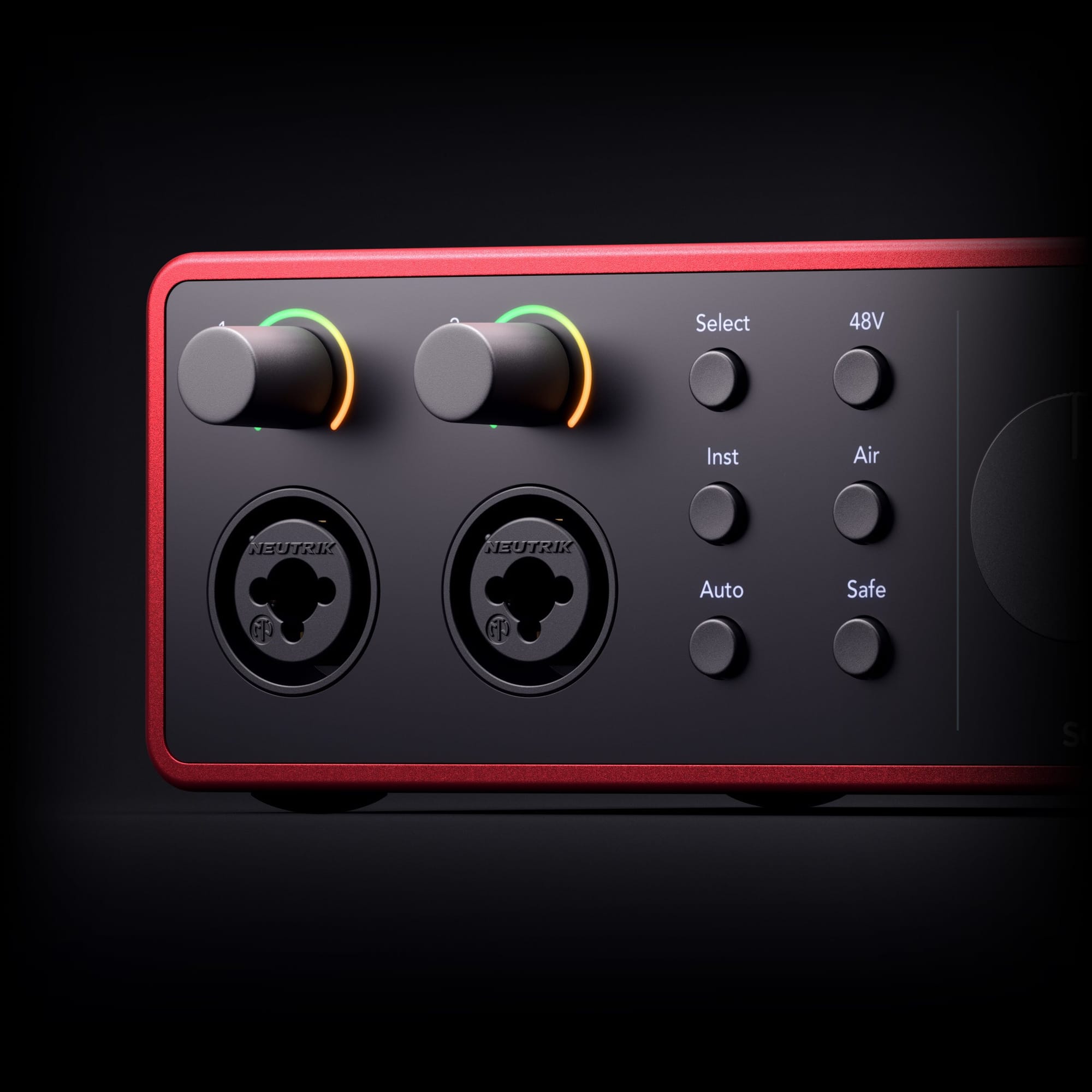
The 2i2 has two of Focusrite's lowest-noise preamps, each paired with a front-panel line and instrument input, so you can record any two sources at once, whether microphones, guitars or synths. The gain range jumps to 69 decibels, which is enough for hungry microphones like the classic broadcast dynamics.
The bigger upgrade is help with levels. Auto Gain listens to your voice or instrument and sets the input level for you. Clip Safe then watches the signal while you record and pulls the gain back automatically if you are about to distort. For anyone recording alone, that is the difference between a ruined take and a usable one. Focusrite also controls the preamps digitally, so the Focusrite Control 2 app on your desktop or phone can adjust them remotely.
Scarlett 4i4: for the gear collector
The 4i4 keeps the 2i2's two preamps and adds what a growing studio needs. Two extra line inputs on the back let a stereo synth or drum machine stay plugged in all the time. Four line outputs mean you can run two pairs of speakers, or send audio out to an effects pedal or outboard gear and back. Headphones, monitors and line outputs each get their own mix. And it has a MIDI (Musical Instrument Digital Interface) in and out, so an older synth or a drum machine can be sequenced from your computer without a separate MIDI box.

The trade-off is size and power. It is the heaviest of the three, and it needs 1.5 amps of USB power rather than 900 milliamps, so some older laptops and tablets may need a powered hub or the included power supply. If you are not going to use the extra inputs, outputs or MIDI, you are paying $100 for sockets you will never touch.
Which one for you
- Singer-songwriter or guitarist recording alone: 2i2. Auto Gain and Clip Safe alone justify the $70 jump over the Solo.
- Podcast or interview with two people: 2i2.
- Beatmaker with synths, a groovebox and a MIDI keyboard: 4i4.
- Tight budget and one microphone only: Solo, ideally paired with a condenser mic that does not need much gain.
Not sure which microphone to pair with it? Our guide to condenser vs dynamic microphones explains the difference, and our best microphones for home recording has picks at every price.
Our call
Our call: buy the Scarlett 2i2. It is the one interface in the lineup that nobody outgrows quickly. Two inputs cover almost every home recording situation, the 69 decibel preamps handle any microphone, and Auto Gain with Clip Safe will save more takes than any spec on paper. Spend less on the Solo only if you are sure you will never need a second input, and step up to the 4i4 when your desk fills up with synths and MIDI gear.
Focusrite Scarlett 2i2 4th Gen ($239.99 at Focusrite): our pick, two inputs with Auto Gain and Clip Safe. Check price
Focusrite Scarlett Solo 4th Gen ($169.99 at Focusrite): the simplest way in for one mic or one guitar. Check price
Focusrite Scarlett 4i4 4th Gen ($339.99 at Focusrite): extra line inputs, four outputs and MIDI for a growing studio. Check price
Every Scarlett at Focusrite: buy direct from the maker. Shop it at Focusrite
Want more options beyond Focusrite? See our best audio interfaces for home recording, and browse more studio gear in our Home Studio hub.
Prices are from Focusrite's US online store in November 2026 and change often, especially during holiday sales. Specifications and history are from Focusrite's official product pages and company story.
Unknowndivide may earn a commission from purchases made through links in this post. As an Amazon Associate we earn from qualifying purchases.