
Roland built the drum machines that most electronic music still runs on. The TR-808 and TR-909 (TR stands for Transistor Rhythm) gave hip hop its boom, house and techno their pulse, and industrial and EBM (electronic body music) their hammering kicks. Today Roland sells three modern TR machines that all promise those sounds, from a battery-powered box to a full analog flagship. They are very different instruments. Two of them recreate the classic circuits in software, and one puts real analog circuits back in the box for the first time in more than four decades. Here is how the TR-8S, TR-1000 and TR-6S compare, and which one to buy.
The quick answer
- Buy the TR-8S if you want the classic Roland drum machine experience with real hands-on control: 11 tracks, a fader for every sound, eight analog outputs and every TR model from the CR-78 to the TR-909.
- Buy the TR-6S if you want the same sound engine in a box that fits in a backpack and runs on four AA batteries. You give up tracks, faders and outputs, not sound quality.
- Buy the TR-1000 if you want the real thing: 16 analog voices rebuilt from the original TR-808 and TR-909 circuits, a stereo sampler with 46 GB of free space, ten individual outputs and the deepest sequencer Roland has made.
Analog circuits vs circuit models, in plain terms
This is the one difference that matters most, so it is worth getting straight. The TR-8S and TR-6S use Roland's ACB (Analog Circuit Behavior) technology, which models the original drum circuits part by part in software. Roland is clear that these are not sample packs: each model behaves like the original hardware when you turn the tune, decay and accent controls. Both machines carry models of the TR-808, TR-909, TR-606, TR-707 and TR-727, plus the CR-78 CompuRhythm, the late 1970s box that came before the TR-808.
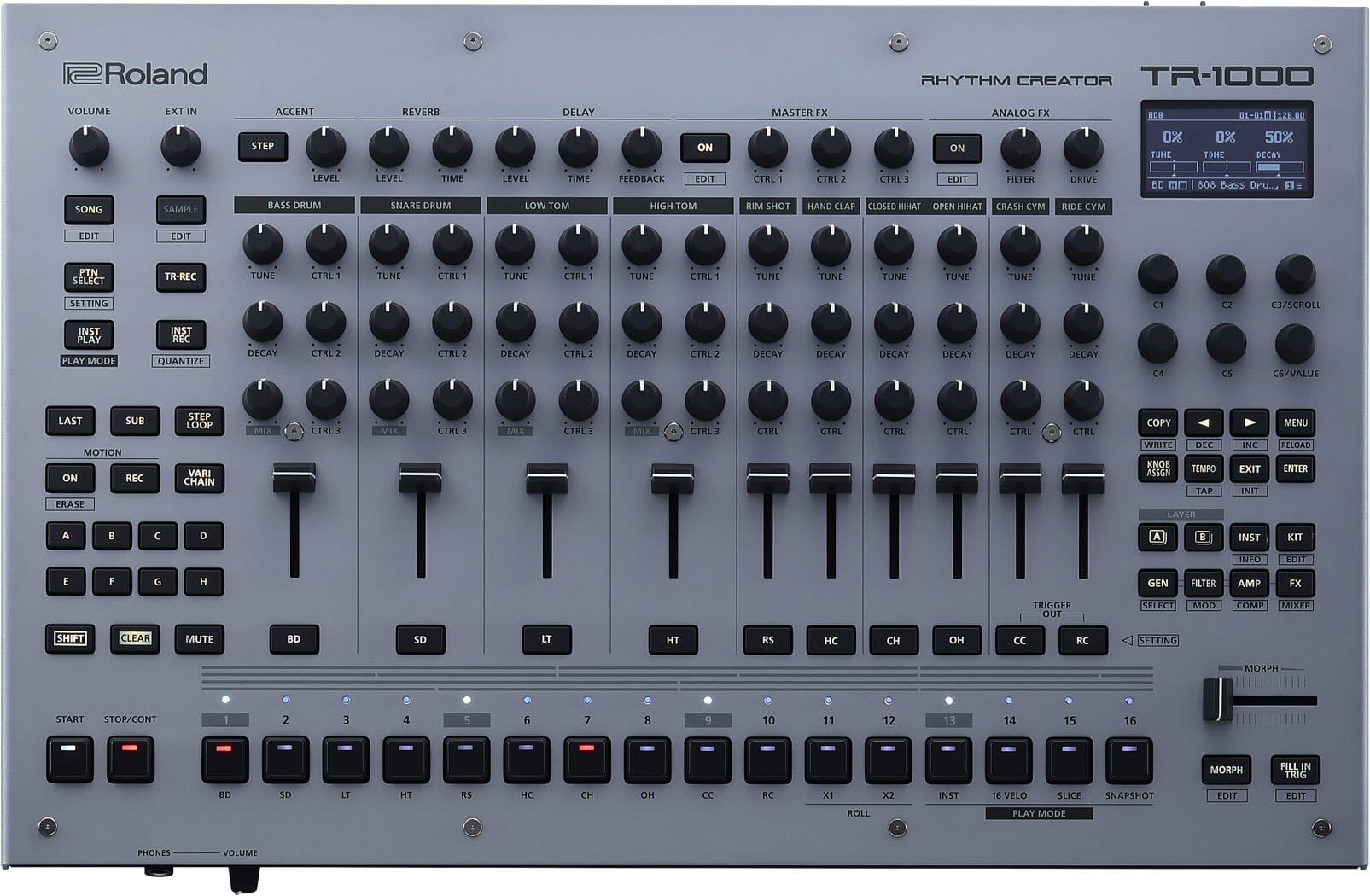
The TR-1000 has those models too, along with 21 circuit-bent versions of the 808 and 909 sounds. But its headline is a true analog engine, with 16 of the most sought-after TR-808 and TR-909 voices rebuilt from the original circuit designs with modern parts. Roland calls it the first Roland drum machine with a true analog engine in over 40 years. That is the "I didn't know that" fact behind the price: every Roland drum machine in between, including the TR-8S, has been digital at heart. On top of the analog voices, the TR-1000 adds 50 FM (frequency modulation) instruments, virtual analog synthesis, a library of PCM (pulse-code modulation) samples and a full stereo sampler, plus an analog filter and analog drive on the master bus.
TR-8S vs TR-1000 vs TR-6S, side by side
| TR-6S | TR-8S | TR-1000 | |
|---|---|---|---|
| Sound engines | ACB models, FM, samples | ACB models, FM, samples | True analog (16 voices), ACB models, FM, virtual analog, PCM, sampler |
| Instrument tracks | 6 | 11 | 10 (4 can stack two sounds each) |
| Sampling | Imports WAV and AIFF from SD card, about 600 seconds total | Imports WAV and AIFF from SD card, about 600 seconds total | Records in stereo, 46 GB of user space, up to 16 minutes per sample |
| Kits and patterns | 128 kits, 128 patterns | 128 kits, 128 patterns | 2,048 kits, 2,048 patterns |
| Audio outputs | Stereo mix out | Stereo mix plus 6 assignable outputs | Stereo mix, stereo analog effects out, 10 individual outputs |
| Inputs | None for audio | Stereo external input | Dual mono or stereo input for sampling and processing |
| Sync and control | MIDI in and out, USB audio and MIDI | MIDI, trigger out, USB audio and MIDI | MIDI, DIN sync, trigger in and out, filter CV (control voltage) in, clock out, multichannel USB-C audio |
| Display | Two-line LCD | Two-line LCD plus LED tempo readout | Graphic OLED screen |
| Power | 4 AA batteries or USB bus power | AC adapter | Built-in universal power supply |
| Size and weight | 224 x 132 x 60 mm, 705 g | 409 x 263 x 58 mm, 2.1 kg | 486 x 311 x 125 mm, 5.5 kg |
Specifications are from Roland's official product pages. Prices are typical US retail in November 2026 and move often.
TR-8S: the one most people should buy
The TR-8S came out in 2018, and it is still the drum machine you see on stage at techno, house and industrial shows for a simple reason: it was designed to be played live. Every one of its 11 tracks has its own fader and its own tune and decay knobs, and each track has a CTRL knob you can assign to whatever parameter matters for that sound, like the attack of a kick or the drive on a snare. Patterns hold eight variations and two fills each, steps can carry probability so a hi hat only plays some of the time, and motion recording captures your knob moves so a pattern keeps evolving on its own.
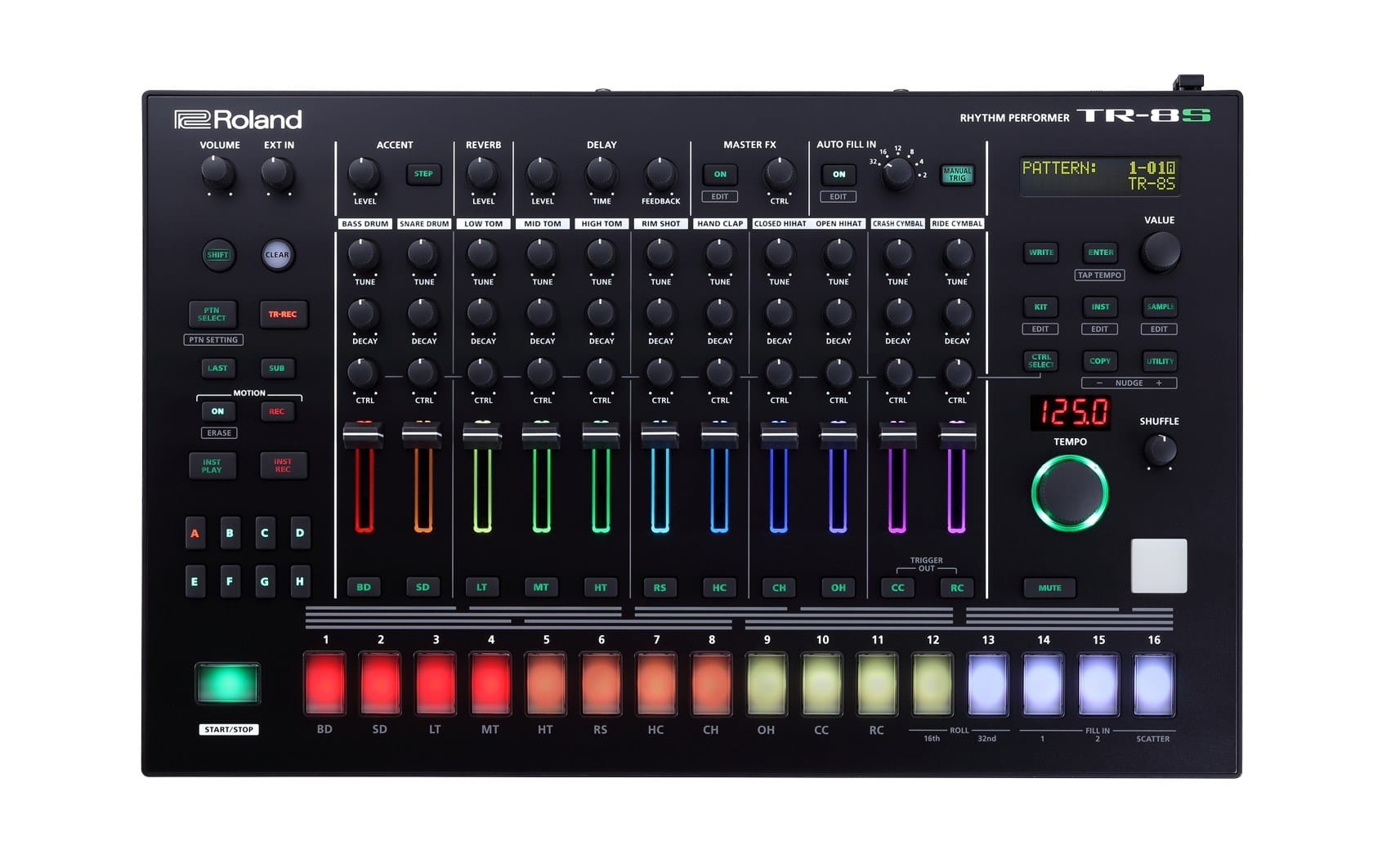
The detail that keeps it in studios is the eight analog outputs: a stereo mix plus six assignable outs, each of which can double as a trigger for external gear. That means you can send the kick to its own compressor, the snare to a spring reverb and the hats to a distortion pedal, which is how a lot of heavy, physical drum sound gets made. A later firmware update added six fully editable FM drum models with a Morph control that sweeps through metallic, glassy tones, and there is a stereo external input with sidechain, so you can duck a synth under the kick. Add your own samples from an SD (Secure Digital) card and the TR-8S covers almost any style.
TR-6S: the small box with the same sounds
The TR-6S, from 2020, is the TR-8S engine squeezed into a box about the size of a hardback book. It has the same ACB models, the same 72 FM tones, the same 300-plus preset samples and the same sample import, and it adds real-time recording, sub steps for rolls and ratchets, probability and motion recording. It also works as a USB audio and MIDI (Musical Instrument Digital Interface) interface, so one cable connects it to a laptop.
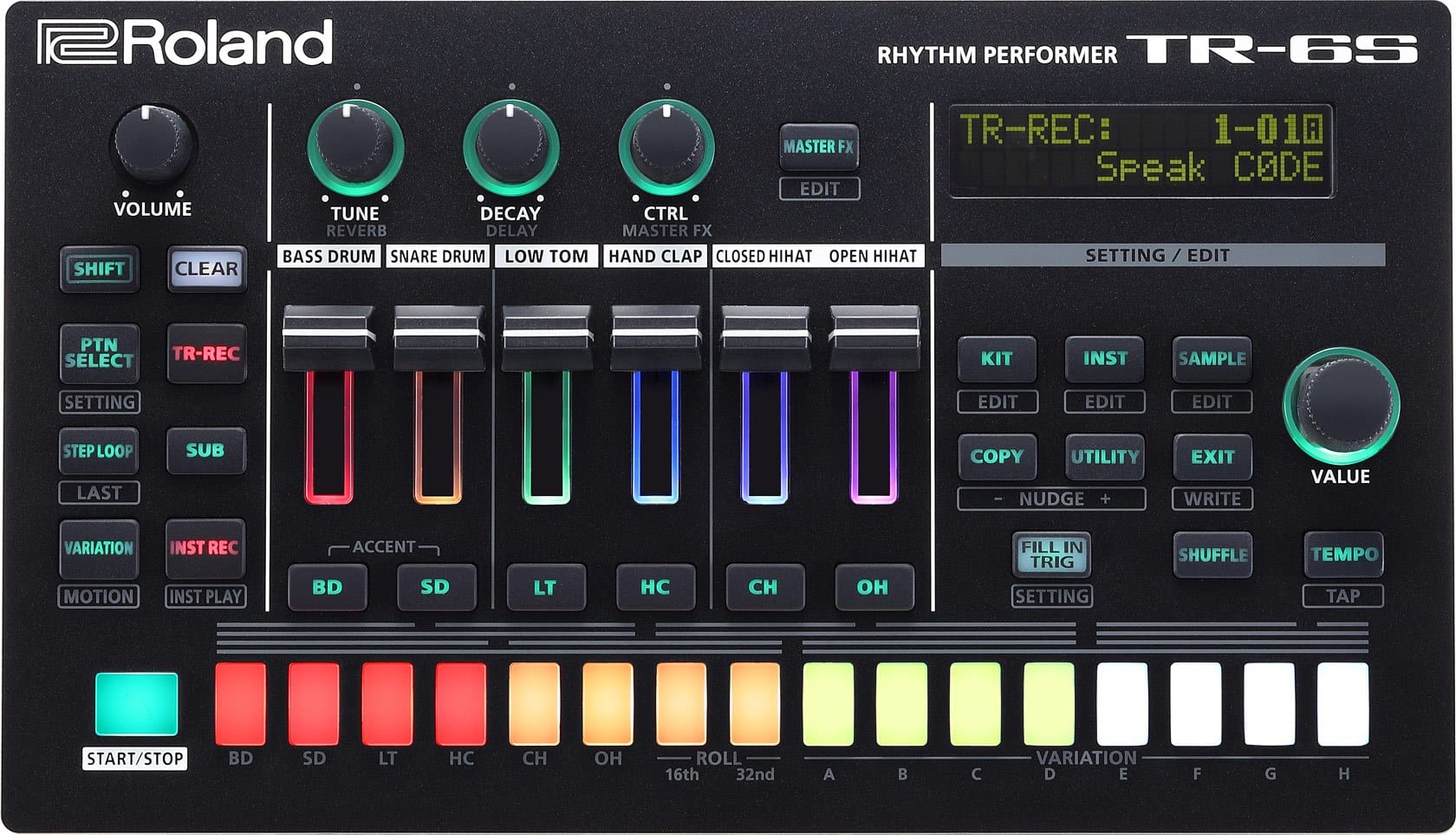
What you give up is room. There are six tracks instead of 11, so a full kit means juggling sounds, and there are no individual outputs or audio inputs, just a stereo mix out and a headphone jack. The upside is that it weighs 705 grams with batteries in and runs for about four and a half hours on alkaline AAs, according to Roland. For a couch, a train or a small desk next to a laptop, that matters more than extra faders.
TR-1000: the flagship with real analog
The TR-1000 is a different class of instrument, and its size says so: 486 mm wide, 5.5 kg, an aluminum panel on a steel chassis and a fan-free internal power supply. Roland says it built the machine with input from working artists, and it shows in the workflow. Four of its ten tracks are layer tracks that can stack two sound engines on one part, each track has its own compressor, filter or four-band EQ (equalizer) and effects, and the sequencer adds off-grid timing, per-track swing, step direction, cycle conditions, probability, a song mode and up to 16 snapshots per track that recall knob positions with one press.
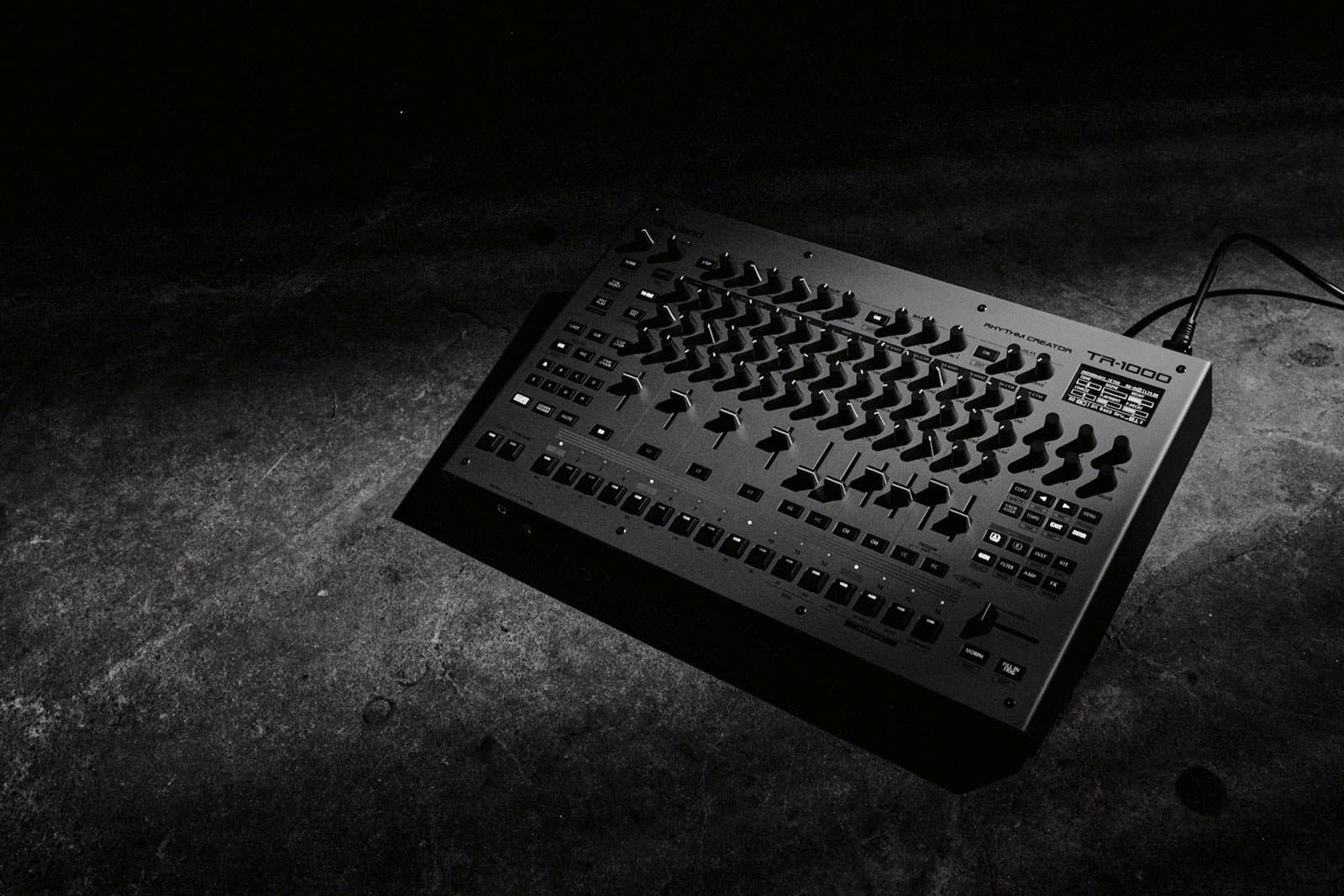
The sampler is the other big leap. The TR-8S and TR-6S can only play back files you load from a card. The TR-1000 records in stereo from its inputs, resamples its own output, time-stretches to tempo and slices loops without destroying the original, with 64 GB of storage, about 2,000 included samples and 46 GB left for your own sounds. There are ten individual outputs that also work as analog triggers, plus trigger, CV and DIN sync connections for driving modular systems and pre-MIDI vintage gear. If your rig includes a Eurorack case or an old TB-303, this is the TR that talks to all of it.
The catch is obvious: it costs about three and a half TR-8S machines, and it is a studio centerpiece, not a grab-and-go box. Buy it for the analog voices and the sampler, not for the 808 and 909 sounds alone, because the TR-8S already does those very well.
Which TR to buy, by buyer
- First real drum machine: the TR-8S. It is the most direct way to learn TR-style programming, with a control for everything.
- Laptop producer with a small desk: the TR-6S. Same sounds, a fraction of the space, and it doubles as an audio interface.
- Techno, industrial or EBM live sets: the TR-8S. Eleven faders, eight outputs and fills on demand are what a live set needs.
- Modular and vintage synth owners: the TR-1000. DIN sync, trigger and CV connections and ten outputs make it the hub of a hardware rig.
- Analog purist who wants the real 808 and 909 circuits: the TR-1000. Nothing else Roland makes has them.
- Want a sampler as well: the TR-1000, or pair a TR-8S with a dedicated sampler. Our Digitakt II vs Syntakt vs Digitone II guide covers a strong option.
Our call
Our call: buy the TR-8S. You get every classic Roland drum machine in one box, a fader and knobs for all 11 tracks, eight outputs and a sequencer that still feels like the originals. It does 90 percent of what most producers want from a TR. Buy the TR-6S if size and price matter more than hands-on control, and buy the TR-1000 only if real analog circuits, a serious sampler and modular connections are worth the big jump in price.
Roland TR-8S Rhythm Performer: our pick, with 11 tracks, a fader per sound and eight outputs. Check price
Roland TR-6S Rhythm Performer: the same sound engine in a battery-powered box. Check price
Roland TR-1000 Rhythm Creator: true analog 808 and 909 voices, a stereo sampler and ten outputs. Check price
Every TR at Roland: specs, manuals and dealers from the maker. See them at Roland
Want the backstory first? Read how the TR-808 and the TR-909 shaped dance and industrial music, see our best drum machines for beginners, and browse more records and gear in our Industrial hub.
Specifications are from Roland's official product pages. Prices are typical US retail in November 2026 and change often.
Unknowndivide may earn a commission from purchases made through links in this post. As an Amazon Associate we earn from qualifying purchases.