
Moog still builds three analog keyboards that answer the same question in different ways: how much instrument do you want under your hands, and how much of it should be a patchable workshop. Grandmother is the compact semi-modular with a spring reverb and a 32-key keyboard. Matriarch is the larger semi-modular with four oscillators, stereo ladder filters and a stereo analog delay. Subsequent 37 is the paraphonic panel synth with 256 presets and aftertouch. Here is how they compare, and which one to buy.
The quick answer
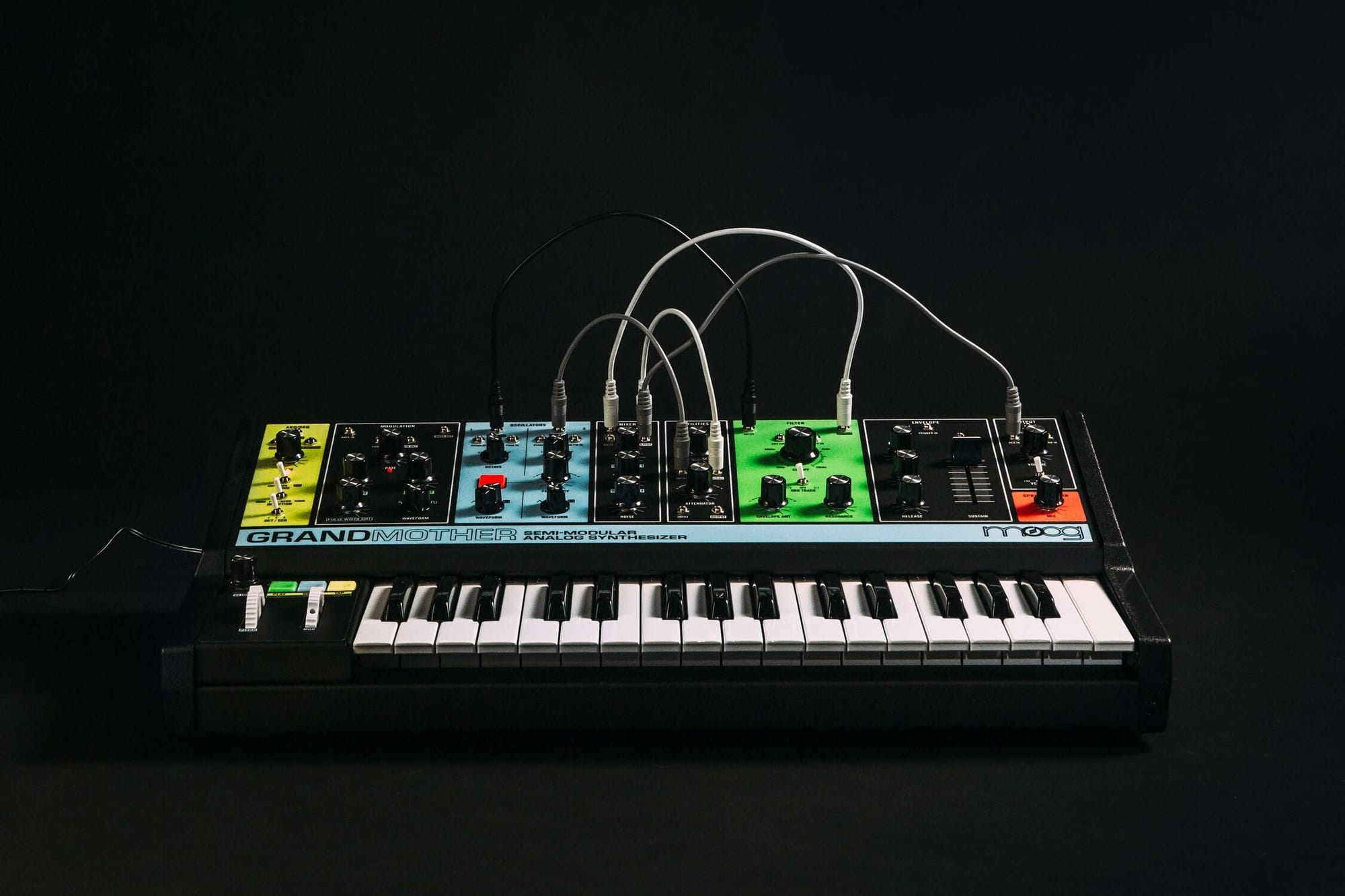
- Buy Grandmother if you want to start playing immediately with no patching required, then open the panel later. It is a monophonic semi-modular analog synth with 32 full-size keys, a built-in arpeggiator and sequencer, and a spring reverb tank inspired by classic Moog modular instruments.
- Buy Subsequent 37 if you want a conventional Moog keyboard you can save. It is a 2-note paraphonic analog synth with a 37-note semi-weighted keybed and aftertouch, a MultiDrive ladder filter and 256 presets (16 banks of 16).
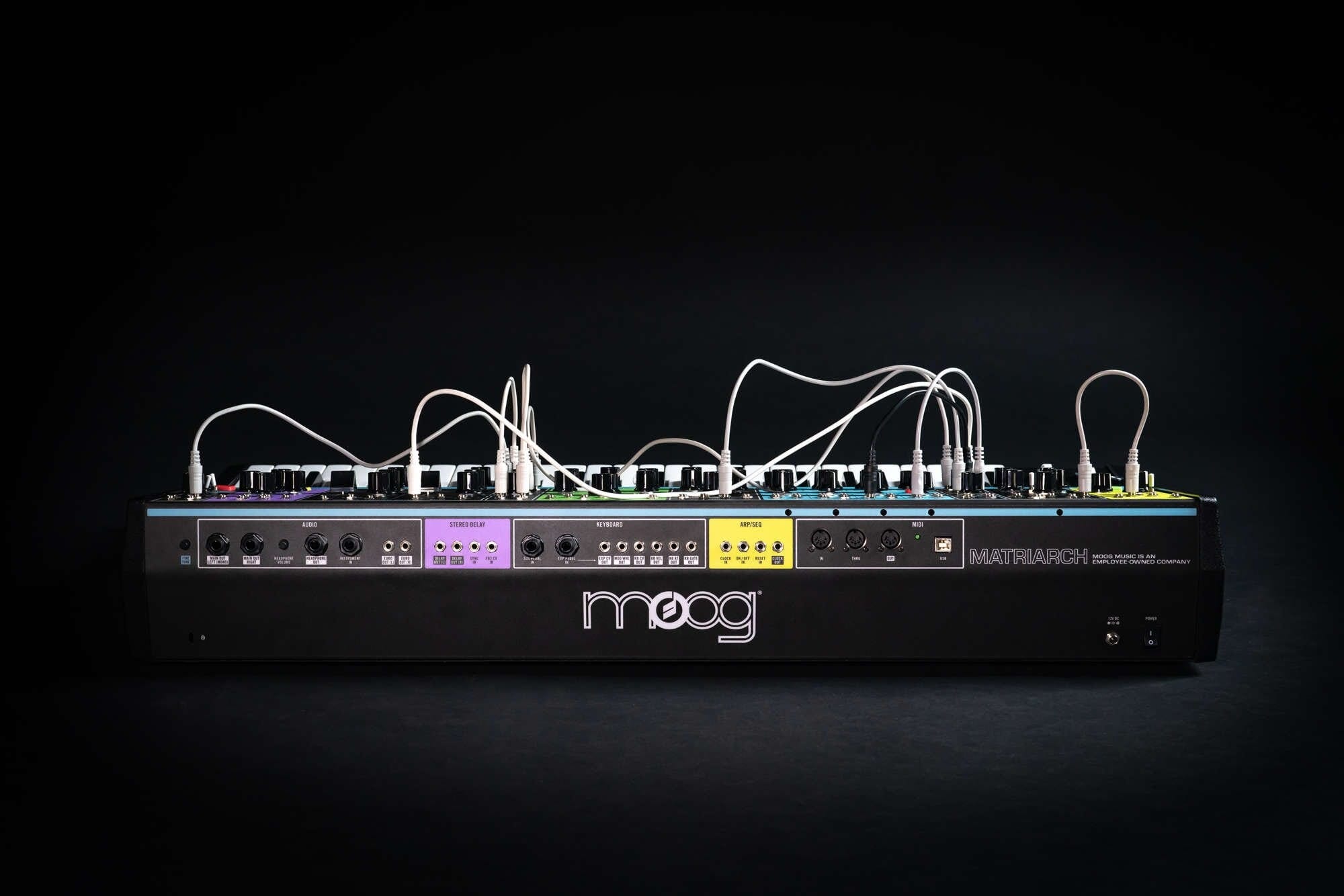
- Buy Matriarch if you want the largest of Moog's semi-modular family. It is a patchable 4-note paraphonic analog synth with 49 keys, 90 patch points, stereo ladder filters and a stereo analog delay, and it can run as a mono, duo or four-note instrument.
Three analog Moogs, two ideas
Grandmother and Matriarch belong together. Both are semi-modular analog synthesizers that, in Moog's words, need "no patching required" to start, then open into a reconfigurable front panel. Grandmother has 41 patch points (21 inputs, 16 outputs and 4 parallel-wired multiples). Matriarch has 90 (49 inputs, 33 outputs and two 4-way multiples). Both can store sequencer data: Grandmother holds three sequences of up to 256 steps each, Matriarch holds 12 patterns of up to 256 steps with up to four notes per step.
Subsequent 37 is a different instrument. It is not sold as a semi-modular playground. It is the later evolution of Moog's Sub 37, a 2-note paraphonic analog synthesizer with double the mixer headroom of that earlier model, a re-tuned MultiDrive circuit, and 256 recallable presets. If you think in saved sounds rather than cables, this is the one of the three that is built for that habit. For the history behind Moog's portable analog template, see our guide to the Minimoog Model D.
Grandmother vs Matriarch vs Subsequent 37, side by side
| Grandmother | Subsequent 37 | Matriarch | |
|---|---|---|---|
| Type | Semi-modular analog synthesizer | Paraphonic analog synthesizer | Semi-modular analog synthesizer |
| Sound engine | Analog | Analog | 100 percent analog |
| Keys | 32 full-size, velocity-sensing | 37 semi-weighted, with aftertouch | 49 full-size, velocity-sensing with aftertouch |
| Playability | Monophonic | Monophonic or 2-note paraphonic | Mono, 2-note or 4-note paraphonic |
| Oscillators | 2, plus white noise and an external input | 2 variable waveshape oscillators, a square-wave sub oscillator, analog noise and an external input | 4 analog oscillators, plus white noise and an external input |
| Filter | 24 dB/octave Moog ladder low-pass with resonance, plus a 6 dB/octave high-pass | 20 Hz to 20 kHz Moog ladder filter with 6, 12, 18 and 24 dB/octave slopes and MultiDrive | Dual 24 dB/octave analog filters, configurable in parallel, stereo or series |
| Effects | Onboard spring reverb tank | None listed as a built-in effect; MultiDrive is in the filter | Stereo analog delay, up to 700 ms, with ping-pong and MIDI or CV sync |
| Sequencer and arpeggiator | Yes; 256 steps, three sequence files | Yes; 64-note sequencer plus a multi-mode arpeggiator | Yes; 256 steps with up to 4 notes per step, 12 pattern locations |
| Presets | Not listed as a sound-preset instrument | 256 presets (16 banks of 16) | 12 stored sequencer patterns; not listed as a sound-preset instrument |
| Patch points | 41 | CV and gate inputs on the rear panel | 90 |
| Width and weight | 23 inches, 16 lb (7.25 kg) | 26.75 inches wide, 22 lb | 32 inches, 24 lb (10.89 kg) |
Specifications are from Moog Music's official Grandmother, Subsequent 37 and Matriarch product pages. Subsequent 37 also lists DAHDSR envelopes, MIDI over DIN and USB, and a universal IEC power supply. Grandmother and Matriarch ship with a 12 V DC adapter.
Grandmother: the compact semi-modular
Moog describes Grandmother as a semi-modular analog synthesizer with a built-in arpeggiator, sequencer and spring reverb tank, "inspired by the classic Moog Modular Synthesizers." The invitation is practical: start playing immediately, then "explore an infinite sonic playground with Grandmother's reconfigurable front panel." The sound engine, modulation engine and spring reverb are all analog.
It is monophonic, with two oscillators (oscillator 2 can sync to oscillator 1 and offers linear FM), a white noise generator and an external input. The main filter is a self-oscillating 24 dB/octave Moog ladder, with a separate 6 dB/octave high-pass. Velocity is available via MIDI and a keyboard-velocity output jack, rather than hard-wired to the voice. At 23 inches wide and 16 pounds, it is the smallest and lightest of the three, and it is the natural companion if you already have, or plan to add, a first synthesizer and want a patchable analog instrument rather than another preset keyboard.
Matriarch: the semi-modular flagship
Moog calls Matriarch "the pinnacle of Moog's semi-modular family of analog synthesizers." It is a patchable 4-note paraphonic analog instrument based on vintage Moog module circuits, with a 49-key velocity-and-aftertouch keyboard (velocity and aftertouch, like Grandmother's velocity, are available via MIDI and dedicated jacks rather than hard-wired). Officially you can "create rich evolving chord patterns immediately with no patching required," then use the 90 patch points to go further, including processing external sources and serving as a keyboard front end for a Grandmother, Mother-32, DFAM or Eurorack system.
The voice is larger in every direction: four analog oscillators, dual analog filters that can run in parallel (high-pass/low-pass), stereo (low-pass/low-pass) or series, dual ADSR envelopes, dual analog VCAs and a stereo analog delay with up to 700 ms of repeats, ping-pong and MIDI or CV clock sync. The sequencer can be decoupled to drive other gear. It is also the heaviest of the three, at 32 inches wide and 24 pounds.
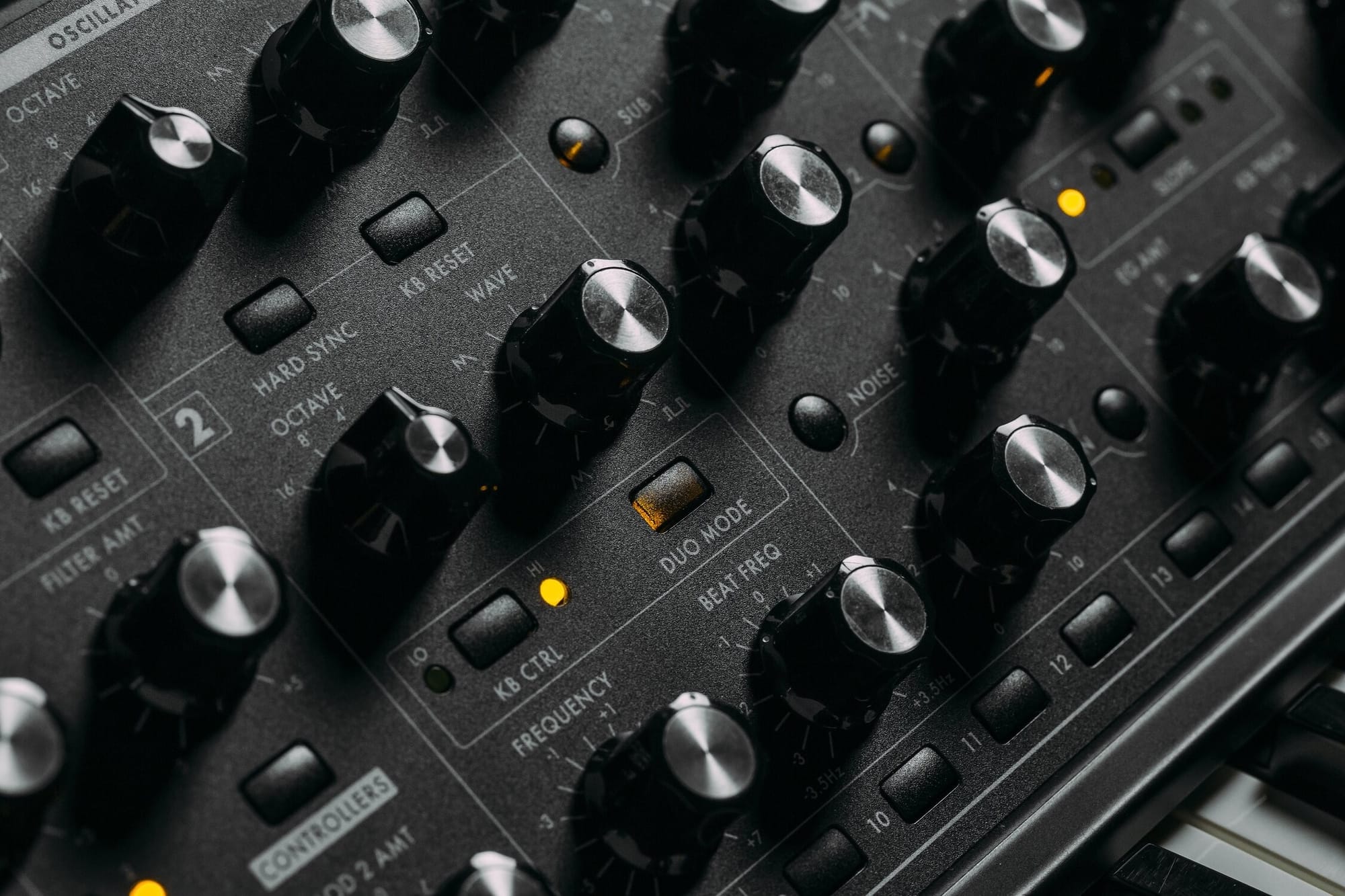
Subsequent 37: the preset paraphonic
Subsequent 37 is the one to buy if you want recall. Moog lists 256 presets in 16 banks of 16, a 37-note semi-weighted keybed with after pressure (aftertouch), and selectable monophonic or paraphonic play, with the option to poly-chain. Officially it has double the mixer headroom of the Sub 37, which Moog says opens "a new range of classic clean tones in both mono and duo performance modes," plus a reshaped ladder-filter gain stage and a re-tuned MultiDrive circuit.
The sound sources are two variable-waveshape oscillators, a square-wave sub oscillator, analog noise and an external input or filter-feedback path. The filter is a 20 Hz to 20 kHz Moog ladder with four slope choices and MultiDrive. Envelopes are DAHDSR, with looping, MIDI sync and latch among the options. There is no spring reverb or analog delay in the official specification; the character sits in the oscillators, the mixer headroom and MultiDrive. Rear-panel CV and gate inputs let it talk to modular gear without turning the whole instrument into a patchable panel like Grandmother or Matriarch.
Where to buy
- Grandmother at Moog Music: the 32-key semi-modular with spring reverb and 41 patch points.
- Subsequent 37 at Moog Music: the 37-key paraphonic analog with 256 presets and MultiDrive.
- Matriarch at Moog Music: the 49-key semi-modular with four oscillators, stereo filters and stereo analog delay.
Our call
Our call: buy Grandmother if you want the smallest semi-modular and a spring reverb already in the case, buy Subsequent 37 if you want presets, aftertouch and a two-note paraphonic voice you can recall, and buy Matriarch if you want the fullest patchable instrument of the three. If you are new to cables, Grandmother is the cleaner first step. If you already think like a performer who needs the same sound tomorrow, Subsequent 37 is the honest fit. Matriarch is for the person who knows they will use those 90 patch points and the stereo delay, not just admire them.