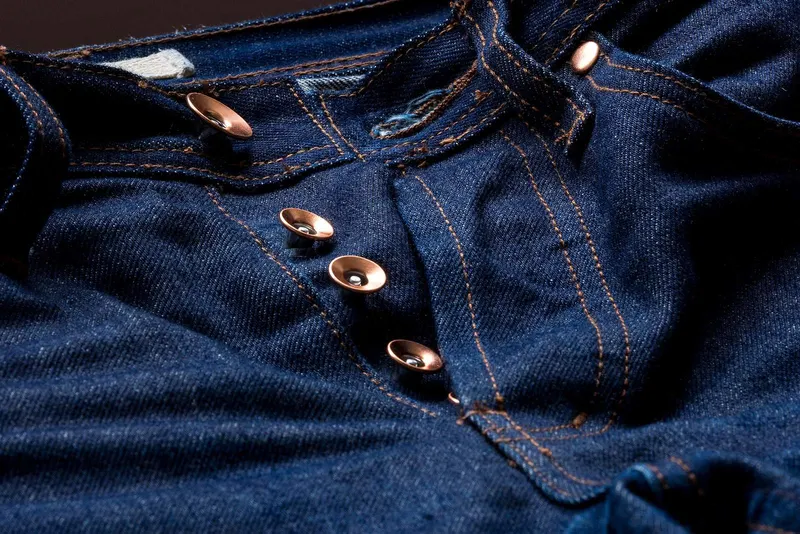
Most jeans are sold finished. They come pre-washed, pre-softened and often pre-ripped, with fake whiskers on the thighs and fades sanded in at a factory, so they look broken in on the first day and worn out a year later. Raw denim works the other way. It is sold exactly as it came off the loom and out of the indigo vat, stiff and dark and a little uncomfortable, and every crease and fade it develops comes from the person wearing it. That sounds like a niche obsession, and online it can look like one. In practice it is the oldest way to buy jeans, and it is cheaper to start than most people think.
A few terms first. Raw, or dry, denim has not been washed after dyeing. Sanforized raw denim has been pre-shrunk at the mill, so it will only shrink a little; unsanforized denim, like Levi's Shrink-to-Fit, can lose an inch or more on the first soak. Selvedge refers to the self-finished edge of fabric woven on older shuttle looms, visible as a clean line, often with colored thread, when you cuff the leg. Selvedge is a sign of how the cloth was made, not a guarantee of quality, and some of the best pairs here are not selvedge at all. Weight is measured in ounces per square yard: 12 to 13 ounces is light, 14 to 16 is the sweet spot for most people, and anything heavier is a commitment.
Unknowndivide may earn a commission from purchases made through links in this guide. As an Amazon Associate we earn from qualifying purchases.
Levi's 501 Shrink-to-Fit: the original
Every pair of jeans descends from the riveted work pants Levi Strauss and Jacob Davis patented in 1873, and the 501 name has been in use since 1890. The Shrink-to-Fit version is the closest thing to that original you can still buy at a mall. It is unsanforized, button fly and straight through the leg, and the classic ritual is to wear it into a bath and let it dry on your body. Levi's says to expect about an inch of shrinkage in the waist and two to three inches in length, and recommends buying two sizes up in the waist and two inches longer if you take the bathtub route. It is not selvedge, and it does not need to be. It is the cheapest honest way to find out whether raw denim is for you.
See the Levi's 501 Shrink-to-Fit on Amazon
Wrangler 13MWZ Rigid: the working cowboy's raw denim
In 1947 Blue Bell, the North Carolina workwear maker that created the Wrangler brand, hired the Philadelphia tailor Bernard "Rodeo Ben" Lichtenstein to design a jean for rodeo riders, with a longer rise, raised back pockets, a zip fly and smoothed rivets that would not scratch a saddle. That design became the Cowboy Cut, and the 13MWZ is still sold today. The rigid version uses 14.75-ounce broken twill woven from sanforized cotton, which means it barely shrinks and the leg seams stay straight instead of twisting. Wrangler lists it at $44.99 to $49.99, and it is still the official jean of ProRodeo competitors. It fades beautifully and costs less than a dinner out. Buy your true size.
See the Wrangler 13MWZ Rigid on Amazon
The Unbranded Brand UB201: Japanese selvedge for about $100
The Unbranded Brand was launched around 2010 by Brandon Svarc, the founder of Naked & Famous, with a simple pitch: strip out the branding, keep the fabric. The UB201 is a tapered fit in 14.5-ounce Japanese selvedge denim with a button fly, hidden rivets, a chain-stitched hem and a plain leather patch. It is stiff out of the box and takes a few weeks to break in, and some wearers find it tight through the thigh, so check the size chart before ordering. The official store lists it at $112. For most people this is the best first pair of selvedge jeans.
See the Unbranded UB201 on Amazon
Naked & Famous Weird Guy: the experimental one
Naked & Famous launched in Montreal in 2008, started by Svarc, a third-generation garment maker, to undercut a premium denim market built on celebrity endorsements and fake distressing. Every pair is cut and sewn in Canada from Japanese fabric, and the brand has become known for strange denims, including a 32-ounce jean in 2012 that it billed as the heaviest ever made. The Weird Guy is one of its signature tapered fits and comes in dozens of fabrics, from plain indigo to left-hand twill and stretch selvedge. On the brand's own site, prices run from about $150 to $260 depending on the cloth. This is the pair to buy once you know you like raw denim and want to try something odd.
See the Naked & Famous Weird Guy on Amazon
A.P.C. Petit New Standard: the cult fade
Jean Touitou founded A.P.C. in Paris in 1987, and its plain raw jeans became a quiet uniform for a generation of designers, musicians and art students. The Petit New Standard is slim and tapered, with the smallest leg opening in the A.P.C. line, a button fly, caramel topstitching and rigid Japanese denim. A.P.C. says it runs small, so size up. What makes it different is the Butler program, started in 2008: return a well-worn pair to an A.P.C. boutique and you get a new pair at half price, while your old jeans are washed, mended, marked with your initials and resold. A.P.C.'s US store lists the Petit New Standard at $340.
Momotaro Jeans: the Japanese deep end
Kojima, in Okayama Prefecture, is where Japan's jean industry grew up, and Momotaro is one of its best-known brands. Founded in 2006 out of a Kojima fabric wholesaler and now run by Japan Blue, it is named after the folk hero born from a peach, which explains the pink line in its selvedge. Its Standard series is woven at 67 threads per inch rather than the usual 64 and dyed by Kaihara in Hiroshima to an unusually deep shade the company calls Tokuno Blue. The two white "battle stripes" across the back pockets are its signature, and many models use Zimbabwean cotton prized for how it fades. On Momotaro's own store, jeans start at ¥33,000. This is not where you start. It is where you end up.
Whatever you buy, wear it a lot and wash it rarely, but do wash it: cold, inside out and hung to dry. If you are building a wardrobe around things that age well, our guides to heritage boots and everyday carry essentials follow the same idea, and the Viapiana Denim story shows how small makers are pushing it further. All four of the Amazon picks above are available at the links in each section.
More in our Sneakers & Style hub.



.jpg)
