Most headphone comparisons are settled by specs and frequency graphs, and most of them end with "it depends." This one does not need to. The Sony MDR-7506 and the Audio-Technica ATH-M50x are the two closed-back studio headphones recommended to nearly every person who has ever asked what to buy first, they are both priced for a first serious purchase, and they are both very good. They are also built around different ideas of what a studio headphone is for, and once that difference is clear the choice gets easy.
The short version: the Sony is a tool, and the Audio-Technica is an all-rounder. Here is how they compare, and which one most people should buy.
Unknowndivide may earn a commission from purchases made through links in this guide. As an Amazon Associate we earn from qualifying purchases.
The Sony MDR-7506: three decades of not changing
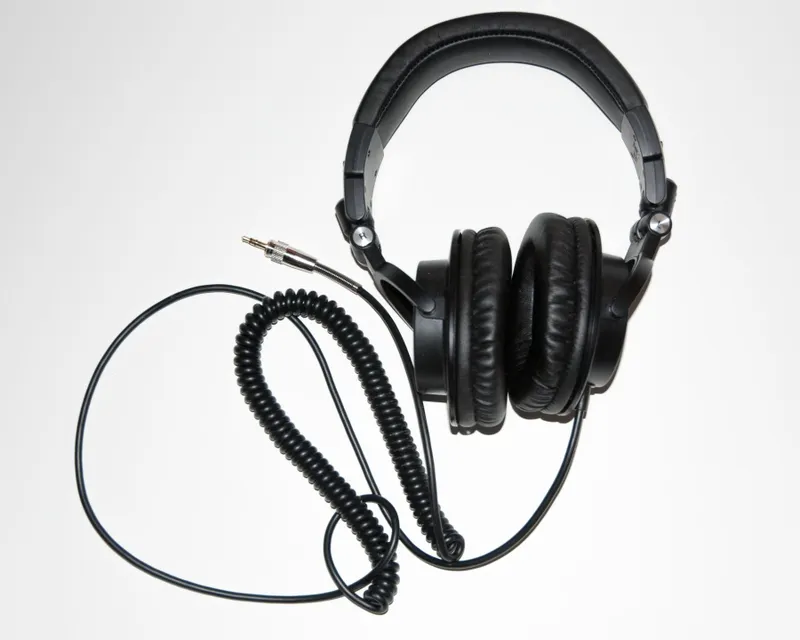
Sony introduced the MDR-7506 in 1991, and it has hung in broadcast booths, film sets and tracking rooms ever since. It uses 40mm drivers and a 63 ohm impedance that any laptop or phone can drive, folds into a soft pouch, and weighs about 230 grams. The cable is coiled, roughly three meters stretched, and permanently attached. The sound is the point: bright and forward in the upper mids and treble, which makes edits, clicks, breaths and sibilance jump out. That is exactly what a dialogue editor or a vocalist tracking a take needs to hear. It is less flattering for long listening sessions. Around $98 on Amazon.
See the Sony MDR-7506 on Amazon
The Audio-Technica ATH-M50x: the crowd favorite
Audio-Technica launched the original ATH-M50 in 2007, and the M50x followed in 2014 with the fix everyone wanted: detachable cables, three of them in the box, coiled and straight. Its 45mm drivers and 38 ohm impedance are just as easy to drive, the earcups swivel for one-ear monitoring, and the whole thing folds. It is heavier, at about 285 grams, and it clamps harder. The tuning is fuller and more exciting than the Sony's, with more weight in the low end and a slightly scooped middle, which is why producers and DJs like it for both work and pleasure. Around $159.
See the Audio-Technica ATH-M50x on Amazon
Sound: detail versus enjoyment
The Sony is the more revealing headphone for problems in a recording. Its treble lift exaggerates harshness, which sounds like a flaw until you realize it is the reason engineers trust it: if a vocal sounds fine on a 7506, it is fine. The M50x is easier to enjoy. Its bass is punchier, and electronic music, hip-hop and anything with a kick drum sounds bigger. The catch is that the same bass lift can fool you into mixing the low end too lean. Neither is a reference for final mixing decisions, and both work best checked against speakers. For tracking, editing and spotting noise, the Sony wins. For producing beats and listening for fun, the Audio-Technica does.
Build and repair: the cable question
This is where the M50x earns its higher price. A detachable cable is the single most common failure point on any studio headphone, and on the Sony it is soldered in. Replacing it is possible, and cheap if you can solder, but it is a project. On the Audio-Technica it is a twist-lock plug. Both have replaceable earpads, and you will need them: the Sony's pleather pads are notorious for flaking after a few years, and replacements cost little. Both frames are mostly plastic, and both routinely survive years of daily studio use.
Comfort and isolation
The Sony is lighter and clamps less, so it disappears on the head for long sessions, though its shallow pads can press on larger ears. The M50x isolates slightly better thanks to its firmer clamp, which helps when tracking vocals next to a loud room or wearing them on a train, but many people find it tiring after a couple of hours until it loosens up. If you wear glasses, the Sony is kinder.
The verdict
Buy the Sony MDR-7506. It costs less, it tells you more about what is actually on a recording, and its design has proven over more than thirty years that it does not need replacing. For anyone who records, edits, podcasts or wants one honest pair to check mixes on, it is the better tool and the better value. Buy the ATH-M50x instead if these will be your only headphones for everything, from studio work to the commute, or if you know you are hard on cables. It is more fun to listen to, and that detachable cable will save it more than once.
If neither is quite right, our guide to the best studio headphones covers the Beyerdynamic DT 770 Pro, AKG K371 and Sennheiser HD 600. All three are worth a listen before committing to either of these.
Full specifications are on the official pages for the Sony MDR-7506 and the Audio-Technica ATH-M50x. Both are available on Amazon at the links above.
More in our Home Studio hub.