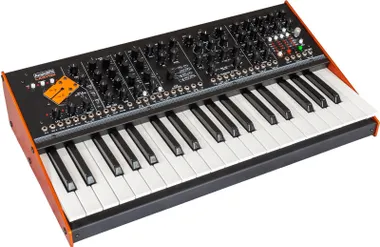

The DMNO was the synth that made people say "wait, it does what?" Two complete synthesizers in one keyboard, eight ways to make them fight, and a filter that could go from warm to unhinged in a quarter turn. Now UDO Audio has unveiled DMNO ON, a desktop version that keeps the whole engine and drops the keys. The twist is that you decide how many knobs you get.
The full engine, in a box
UDO is the British company behind the Super 6, and it is clear this is not a cut-down version. DMNO ON is the complete 8-voice, two-part multitimbral DMNO. Each of the two engines, DMNO 1 and DMNO 2, has its own FPGA-powered digital oscillators feeding an analog signal path, plus UDO's new Dynamic Multi-Core Stereo VCF (voltage-controlled filter), a per-voice analog filter that can run in series, parallel or stereo. FPGA stands for field-programmable gate array, a chip that lets the oscillators run at very high sample rates without the harsh aliasing cheap digital synths are known for.
Flip on Binaural mode and every voice gets a separate synth for each ear, with its own detune and phase, so you trade eight voices for four huge ones. It is the trick that made the original sound so wide.
Play Modes are the hook
The name is a domino joke for a reason. Eight Play Modes change how the two engines interact at the touch of one control. Single, Dual and Split are the classics. One-Two sends your first note to DMNO 1 and everything after to DMNO 2. Rotate alternates between them, Random flips a coin, Chaos adds curated note randomization, and Cascade routes DMNO 1's audio into DMNO 2 as a complex oscillator. That last one is where the happy accidents live.
The ON System
Here is the clever part. The base unit has one set of synth controls that you switch between the two engines. Want the keyboard's dual panel back? Bolt on an ONM-1 Synth Control, available at launch, and you get a second full set of hands-on controls. An ONM-2 FX Control, listed as coming soon, breaks out the effects and EQ that otherwise live in the display. The modules connect with a screw-locking D-Sub cable, need no extra power, and UDO says more ONM units are planned. Every unit has VESA mounting points, so the whole rig can sit on a monitor arm.
Key specs
- 8 voices, or 4 in Binaural mode, across two independent hybrid synths
- 2-in, 2-out 24-bit USB audio interface, plus DIN and USB MIDI
- Stereo external input with preamp, gate detector and envelope follower
- Two assignable CV and gate/clock outputs
- Delay, reverb, EQ, overdrive distortion and chorus, 64-step sequencer, arpeggiator
- 256 performance and 256 patch memories, shown on a vacuum fluorescent display
- Base unit: 487 x 220 x 107 mm, 4.5 kg
Price and availability
UDO has not posted a price or ship date on its own site yet. In the UK, retailer Elevator Sound is taking pre-orders at £2,095 for the base unit and £660 for the ONM-1, including VAT. US pricing should follow through UDO's stockists.
That is real money, but it is a smart way to buy a big synth. Start with the box, learn it, and add the second panel when you outgrow menu diving. If you are new to all this, our guide to the best synthesizers for beginners is a gentler on-ramp. For more hybrid oddballs, see the ASM Leviasynth Desktop and the AnalogFX LARYNX.
Two synths, eight ways to collide, and as many knobs as your desk can take. That is a very good pitch.