
Fender designed the Jazzmaster in 1958 for jazz guitarists, and jazz guitarists ignored it. Fender's own description of its American Vintage II reissue admits as much: the guitar was meant to lure players away from boxy archtops, failed with that crowd, and found its audience with surf bands in the 1960s and indie, alternative and even country players later. The Jaguar followed in 1962 as a flashier top-of-the-line model, and the Mustang arrived in 1964 as a short-scale student guitar. Decades later, punk, grunge and shoegaze turned all three offsets into cult objects.
They look like siblings, and they share the off-center waist that gives the family its name. But they feel, sound and behave very differently. Here is the short version, then the detail.
Jazzmaster vs Jaguar vs Mustang at a glance
| Jazzmaster | Jaguar | Mustang | |
|---|---|---|---|
| Introduced | 1958 | 1962 | 1964 |
| Scale length | 25.5 inches | 24 inches | 24 inches |
| Frets | 21 on vintage models, 22 on Player II | 22 | 22 |
| Pickups | Wide, flat single coils | Narrow single coils | Small single coils |
| Sound | Warm, round, jangly | Bright, thin, cutting | Punchy, nasal, raw |
| Vintage switching | Lead and rhythm circuits | Lead and rhythm circuits, pickup on/off switches | On/off and phase switch per pickup |
| Bridge | Floating tremolo | Floating tremolo with mute | Dynamic Vibrato, or a hardtail on Player II |
Jazzmaster: the long-scale one with the warm pickups
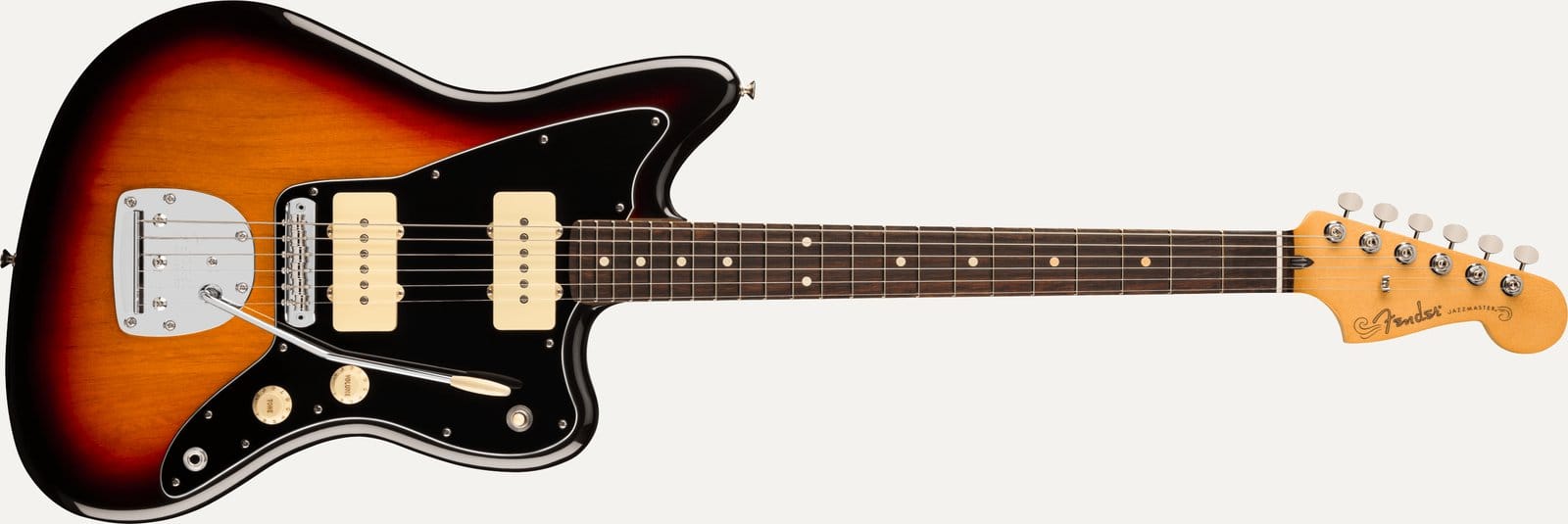
The Jazzmaster is the only one of the three on Fender's full 25.5-inch scale, the same as a Stratocaster. That gives it a firmer string feel and more snap than the others. Its pickups are the giveaway: wide, flat coils under big rectangular covers, which produce a fuller, rounder single-coil tone than a Strat. Clean, it chimes. Through a fuzz pedal, it turns into a wall.
The other signature is the floating tremolo, a long arm that bends the whole guitar's pitch smoothly in either direction. Kevin Shields of My Bloody Valentine built his warped, drifting sound on Jazzmaster and Jaguar arms, and the strings ringing behind the bridge add a shimmer that players either love or tame. Vintage-spec models add the rhythm circuit, a slide switch that drops to the neck pickup with its own preset volume and tone, so you can jump from a dark rhythm sound to a lead setting without touching a knob.
Buy it if you play clean and textured music, you want the most comfortable offset to sit with, and you already feel at home on a Strat-length neck. Sonic Youth and Dinosaur Jr. made it the alternative guitar: Fender lists a limited-edition Jazzmaster for Sonic Youth co-founder Kim Gordon, and Squier makes one for J Mascis, the Dinosaur Jr. leader.
- Best value: the Squier Classic Vibe '60s Jazzmaster keeps the rhythm circuit, the 21-fret neck and the floating tremolo, which makes it the most authentic offset at the Squier level.
- Best all-rounder: the Fender Player II Jazzmaster swaps in a modern 9.5-inch radius, 22 frets and Mustang-style saddles that keep strings seated, with a plain 3-way switch.
- Best vintage: the American Vintage II 1966 Jazzmaster, with its bound neck, pearl block inlays, 7.25-inch radius and period pickups. This is the one in the photo at the top.
Jaguar: the short, bright one with all the switches
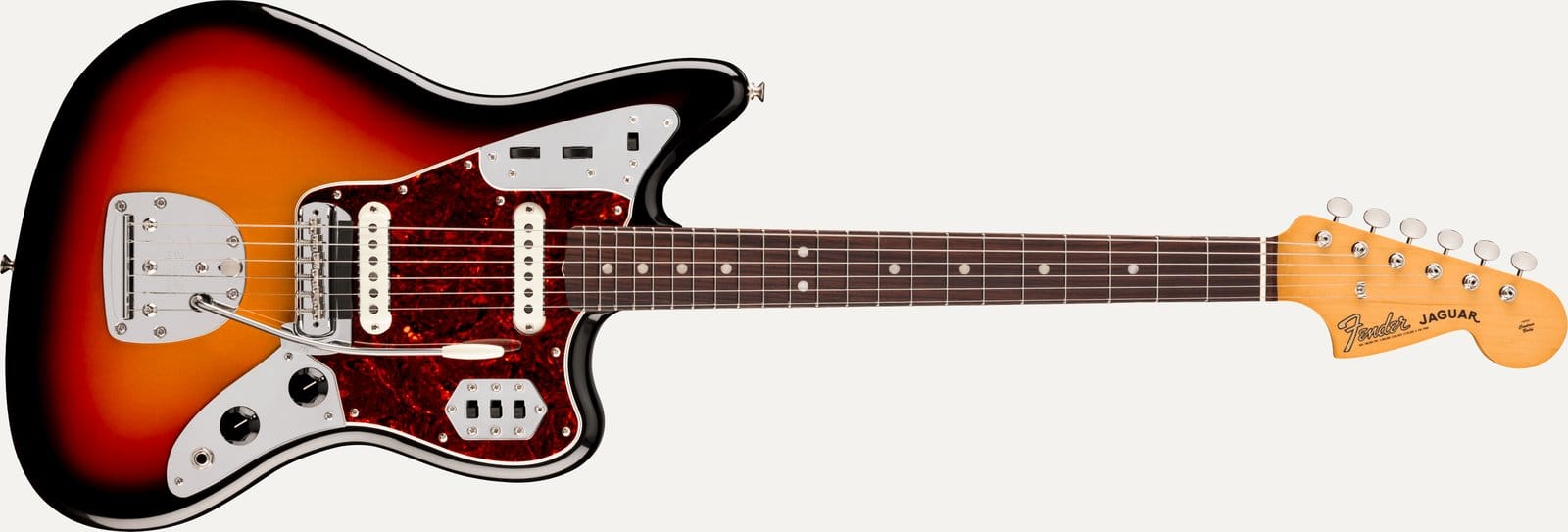
The Jaguar looks like a Jazzmaster with chrome control plates, and that is roughly what it is, on a shorter neck. At 24 inches, the scale makes bends easier and the strings feel looser, which is why so many players run heavier strings on one. Its pickups are narrower and brighter, with a thinner, more cutting tone that slices through a loud band. Vintage-spec Jaguars have the same lead and rhythm circuits as the Jazzmaster, plus on/off switches for each pickup, and a built-in string mute under the bridge cover.
Kurt Cobain played a secondhand left-handed 1965 Jaguar after Nirvana's Nevermind, fitted with humbuckers. Fender sells a reproduction of it, and Johnny Marr of The Smiths has his own signature Jaguar too.
Buy it if you play loud, you have smaller hands, or you want the most switching options. It is the punk and garage pick of the three.
- Best value: the Squier Classic Vibe '70s Jaguar has the full rhythm and lead circuits and pickup on/off switches, with block inlays.
- Best all-rounder: the Fender Player II Jaguar keeps the 24-inch scale and floating tremolo but uses a simple 3-way blade switch and master volume and tone.
- Best vintage: the Vintera III Mid '60s Jaguar, with the mute, tremolo lock and two on/off slide switches.
Mustang: the student guitar that punk adopted
The Mustang was built to be cheap and easy to play, and that is still its charm. It shares the Jaguar's 24-inch scale but has a smaller, lighter body and two small single coils with a raw, slightly nasal bark. The classic layout puts an on/off switch and a phase switch on each pickup, and running both pickups out of phase gives a hollow, honky tone no other Fender makes. Vintage-style models use Fender's Dynamic Vibrato, a different tremolo design from the one on the Jazzmaster and Jaguar.
One thing to check before you buy: the Player II Mustang drops the vibrato for a strings-through-body hardtail bridge. That makes it more stable for tuning, but it is not the classic Mustang setup.
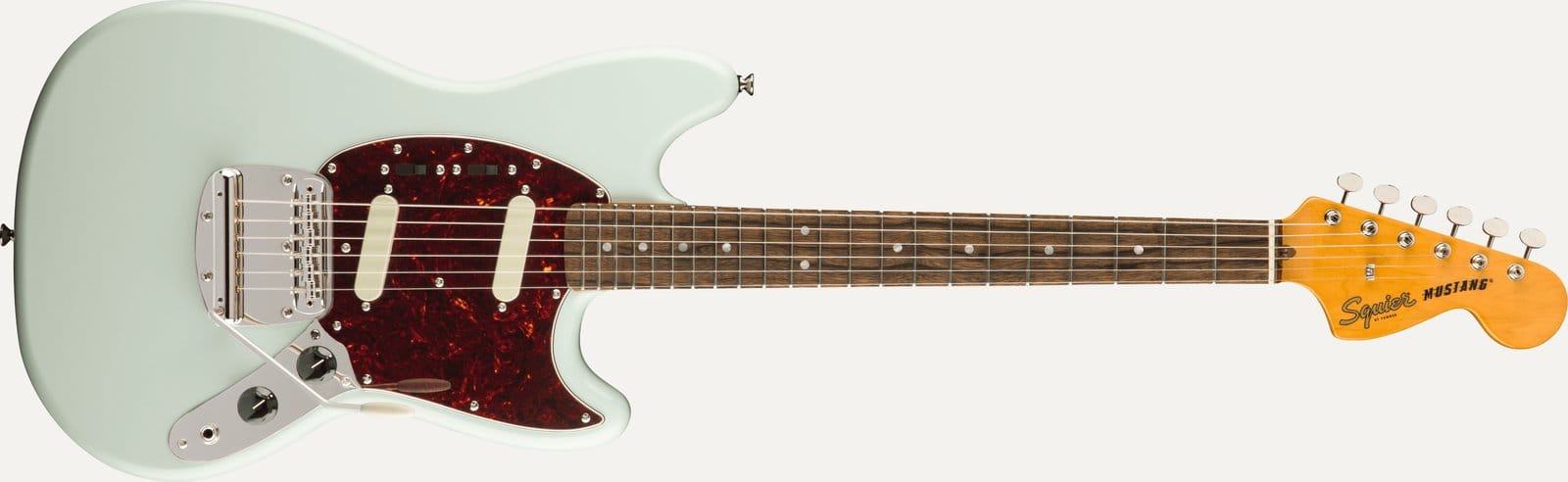
Buy it if you want a light, fast guitar for punk and lo-fi indie, or a first electric that does not feel like a toy.
- Best value: the Squier Classic Vibe '60s Mustang, which has the phase switches and the floating bridge with Dynamic Vibrato tailpiece.
- Best all-rounder: the Fender Player II Mustang, if you want the shape and short scale with a rock-solid hardtail.
- Best vintage: the Vintera III Mid '60s Mustang, with the Mustang floating tremolo and a 7.25-inch radius.
Which offset fits which music
Ambient, shoegaze and post-rock players usually land on the Jazzmaster, because those pickups and that tremolo feed reverb and delay so well. Pair one with something from our reverb pedals for ambient guide and you have the whole sound. Punk, garage and noise players lean Jaguar or Mustang for the shorter scale and brighter bite, and our overdrive vs distortion vs fuzz explainer covers what to put in front of them. For the records that made these guitars famous, start with our shoegaze starter guide.
Our call: buy the Jazzmaster if you are choosing one offset for life. Its longer scale and fuller pickups cover clean, textured and loud music best, and the Squier Classic Vibe '60s Jazzmaster keeps the vintage switching that makes it special. Pick the Jaguar if you play loud and want a shorter neck, and the Mustang if you want the lightest, rawest guitar of the three. Skip the Player II Mustang if the wobble is the reason you want one.